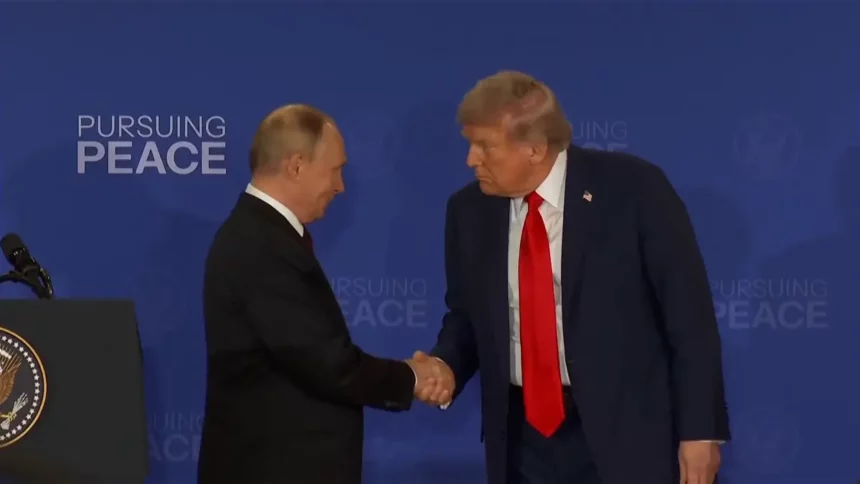
In a closely watched and historically symbolic meeting, United States President Donald Trump and Russian President Vladimir Putin met in Alaska to discuss one of the most pressing global conflicts — the war in Ukraine. The summit, which drew intense international attention, rekindled the personal rapport between the two leaders but ultimately failed to deliver a formal peace agreement. While both Donald Trump and Vladimir Putin spoke warmly about their discussions, they stopped short of announcing any concrete breakthrough, leaving the possibility of progress hanging on future talks. The event underscored both the potential and the challenges of navigating diplomatic channels between two of the world’s most powerful nations amid ongoing geopolitical tensions.
An Exchange Marked by Praise, But No Deal on Ukraine
The leaders convened in Alaska for a meeting that lasted approximately two and a half hours, a duration that hinted at serious and possibly delicate discussions. Emerging from their closed-door talks, Donald Trump and Vladimir Putin took the stage to brief the media, though neither took questions from journalists. The atmosphere was cordial, even deferential, with each leader publicly praising the other.
Donald Trump, while exuding optimism, remained clear about the outcome: no deal had been reached to end Russia’s war in Ukraine. This came despite Vladimir Putin’s assertion that the two had arrived at what he called “an understanding.” Donald Trump acknowledged that many points had been agreed upon during the session but emphasized that one particularly significant issue still stood in the way of a comprehensive agreement. “There’s no deal until there’s a deal,” Donald Trump stated plainly, underscoring the reality that optimism alone would not resolve the entrenched conflict.
The former US president stressed that he would be speaking with Ukrainian President Volodymyr Zelensky and European leaders soon, both to update them on the Alaska discussions and to seek ways forward. “We had an extremely productive meeting, and many points were agreed to,” Donald Trump explained. “And there are just a very few that are left. Some are not that significant. One is probably the most significant, but we have a very good chance of getting there. We didn’t get there.”
The statement suggested that, while progress had been made on certain fronts, the path to a full settlement remained fraught with complexity and possible stumbling blocks. Donald Trump’s choice to keep the details sparse only fueled speculation about the specific sticking points and the degree of compromise each side might be willing to entertain.
Vladimir Putin, on his part, described the meeting in positive terms, asserting that an “understanding” had been reached regarding Ukraine. However, he cautioned European nations against undermining the progress achieved thus far, urging them not to “torpedo the nascent progress.” His language suggested that he viewed the Alaska summit as a constructive step, even if the outcomes were not yet tangible.
Vladimir Putin’s Praise for Donald Trump and Hopes for Restored Relations
The Russian president took time to thank Donald Trump for what he described as the “friendly” tone of the conversation. He expressed the view that both nations should “turn the page and go back to cooperation,” signaling a desire to rebuild ties that have been strained for years by mutual distrust, sanctions, and conflicting strategic interests.
In his remarks, Vladimir Putin was unusually complimentary toward his American counterpart. He said Donald Trump “has a clear idea of what he wants to achieve and sincerely cares about the prosperity of his country.” At the same time, Vladimir Putin noted that Donald Trump “shows understanding that Russia has its own national interests,” a comment that could be read as an acknowledgment of the often delicate balance in international diplomacy, where mutual recognition of each nation’s priorities can be essential to productive negotiation.
“I expect that today’s agreements will become a reference point not only for solving the Ukrainian problem, but will also mark the beginning of the restoration of businesslike, pragmatic relations between Russia and the US,” Vladimir Putin remarked. This forward-looking statement suggested that the Russian leader viewed the Alaska meeting as part of a broader, long-term strategy to stabilize and possibly expand US-Russia cooperation in other spheres beyond the Ukraine conflict.
The press event closed on a lighter note, when Vladimir Putin, smiling, offered an invitation to Donald Trump: “Next time in Moscow.” Donald Trump, with a chuckle, replied, “That’s an interesting one,” acknowledging that such a visit would likely generate political criticism back home. Still, he did not dismiss the idea outright, adding, “I could see it possibly happening.”
The exchange captured the unique blend of formality, strategic calculation, and personal rapport that has marked the relationship between the two leaders over the years. While the Alaska summit may not have produced the headline-grabbing peace deal that some had hoped for, it reinforced the importance of ongoing dialogue and hinted at potential avenues for further engagement. In the absence of concrete resolutions, the mutual expressions of respect and the willingness to keep talking were, for now, the most tangible outcomes of this high-stakes diplomatic encounter.