The counting of votes in Kerala’s local body elections commenced on Saturday, December 13, at 8 am across 244 counting centers spread throughout the state’s 14 districts. The elections, conducted in two phases, were closely watched by political observers, given their potential to influence the political dynamics ahead of the Kerala assembly elections expected by April 2026. The stakes are high, as all three major political fronts—the ruling CPI(M)-led Left Democratic Front (LDF), the Congress-led United Democratic Front (UDF), and the BJP-led National Democratic Alliance (NDA)—have expressed confidence about securing strong results. The local body elections, which encompass a diverse set of urban and rural governance units, have witnessed intense competition across the state, with a triangular contest emerging in key regions, particularly in the capital city, Thiruvananthapuram. Analysts and voters alike see these elections as a litmus test of public sentiment on contemporary socio-political and governance issues.
Voting Patterns and High-Profile Contests Across Kerala
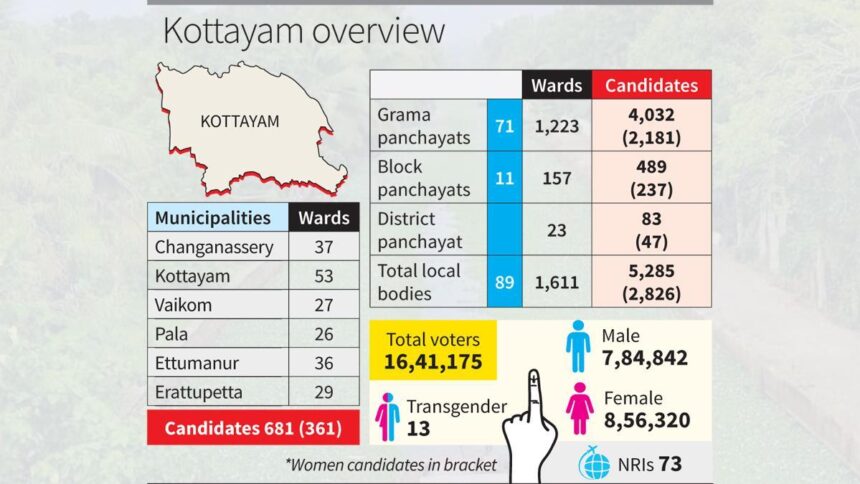
Kerala’s local body elections were held in two phases, reflecting the logistical complexity and demographic diversity of the state. The first phase on Tuesday, December 9, covered seven districts, including Thiruvananthapuram, Kollam, Pathanamthitta, Alappuzha, Idukki, Kottayam, and Ernakulam. The second phase took place on Thursday, December 11, in the remaining seven districts. These elections involved contests in a vast array of governance units, ranging from gram panchayats and block panchayats to district panchayats, municipalities, and municipal corporations. Specifically, 17,337 wards in 941 gram panchayats, 2,267 wards in 152 block panchayats, 346 wards in 14 district panchayats, 3,205 wards in 86 municipalities, and 421 wards in six corporations went to polls, excluding 14 wards where candidates from the ruling LDF won uncontested.
The electoral exercise highlighted the intricate political fabric of Kerala, where regional issues, caste dynamics, local development priorities, and party loyalty often converge to shape voter behavior. In several districts, voter turnout and engagement levels were remarkably high, reflecting the state’s long-standing culture of participatory democracy. The competitiveness of the polls, particularly in urban centers, illustrated how local governance issues are increasingly intertwined with state and national political narratives. For example, the Thiruvananthapuram corporation witnessed one of the most intense triangular contests, with the Congress fielding former MLA KS Sabarinathan and the BJP nominating former DGP R Sreelekha as potential mayoral candidates. The LDF, which currently governs the corporation, aimed to retain its stronghold amid stiff competition. Similar multi-front contests were observed in the Kollam and Kochi corporations, where political analysts noted heightened voter mobilization and party campaigning.
A significant aspect of the elections was the role of contemporary socio-political issues in shaping campaign narratives. The pilferage of gold at the Sabarimala temple, serious sexual assault allegations against expelled Congress MLA Rahul Mamkootathil, inflation and rising prices, and delays in National Highway expansion projects became recurring topics during public meetings and debates. Each front strategically emphasized these issues to appeal to specific voter segments, signaling how local body elections in Kerala are increasingly influenced by both local grievances and broader policy concerns. Analysts have pointed out that such issues often serve as indicators of public sentiment, providing insights into potential trends for the assembly elections.
Political Dynamics and Strategic Implications for the Assembly Elections
The local body elections in Kerala are more than just a contest over municipal and panchayat positions—they are an early barometer of political momentum for the upcoming assembly elections. The ruling LDF, which has historically relied on grassroots organization and cadre-based mobilization, aimed to consolidate its presence across both rural and urban governance units. Party leaders emphasized development initiatives, welfare schemes, and infrastructural projects completed during their tenure, attempting to highlight governance achievements as a rationale for voter support. Meanwhile, the UDF sought to capitalize on anti-incumbency sentiments in certain areas, highlighting issues of corruption, administrative delays, and perceived governance gaps. The BJP, which continues to expand its footprint in the state, focused on alternative leadership, law-and-order concerns, and development promises tailored to urban electorates, particularly in municipal corporations where its growth potential is increasingly evident.
In Thiruvananthapuram, the symbolic and political significance of the corporation election cannot be overstated. The city has historically been a bellwether for political trends in Kerala, and the intense triangular contest drew considerable attention from media, political analysts, and the public. The presence of high-profile candidates such as KS Sabarinathan and R Sreelekha reflected the strategic importance parties attach to winning the capital’s municipal leadership. In Kollam and Kochi, similar dynamics were observed, with political parties deploying extensive ground campaigns, door-to-door outreach, and targeted messaging to influence voter behavior. The competition extended beyond mere political rivalries, touching on identity, local governance efficacy, and promises of infrastructural and social development.
The timing of the elections also played a crucial role in shaping narratives and strategies. The electoral outcomes are expected to provide a preliminary reading of voter mood ahead of the 2026 assembly polls, enabling parties to calibrate campaign strategies, candidate selections, and alliance considerations. Analysts note that the results will influence policy emphasis, messaging, and resource allocation in the run-up to state elections, making the local body polls a critical testing ground for political positioning. The engagement of voters in both urban and rural areas underscores Kerala’s politically aware electorate, which often evaluates governance performance alongside party ideology and local candidate credibility.
Beyond the immediate electoral competition, the Kerala local body elections underscored broader trends in participatory democracy. Public discussions, media scrutiny, and political debates during the election period reflected a sophisticated and engaged citizenry, attuned to both local and state-level governance concerns. Contemporary issues, ranging from temple administration to infrastructure development, have increasingly become focal points for political mobilization, highlighting the evolving interplay between governance performance and electoral outcomes. As elected representatives prepare to take their oaths on December 21, the implications of these elections will continue to resonate across Kerala’s political landscape, shaping narratives, influencing policy priorities, and offering insights into the evolving dynamics of voter behavior.
The Kerala local body elections of 2025, with their extensive scale, multi-phase structure, and high-stakes triangular contests, represent a significant moment in the state’s political calendar. By combining grassroots engagement with broader policy debates, the elections have provided a nuanced view of political allegiances, governance expectations, and voter priorities. The outcomes, particularly in high-profile urban corporations and strategically significant districts, are likely to set the tone for party strategies and public discourse in the coming months. In essence, these local elections serve not only as instruments of democratic representation but also as crucial indicators of political momentum, public sentiment, and emerging leadership trends within Kerala’s complex and competitive political arena.