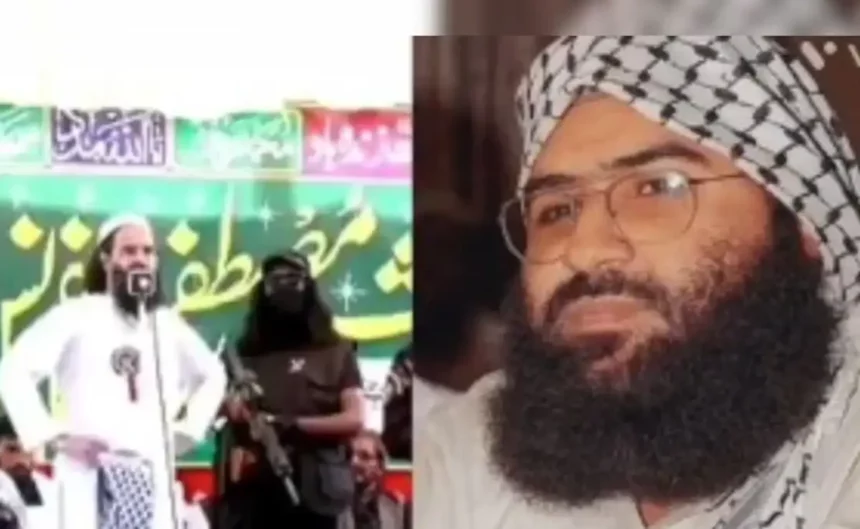
Fresh controversy has engulfed Pakistan’s military and terror nexus after a new set of videos featuring Jaish-e-Muhammed (JeM) commander Masood Ilyas Kashmiri surfaced online, revealing explosive claims that Pakistan Army Chief General Asim Munir had personally ordered top army officers to attend the funerals of terrorists killed during India’s Operation Sindoor. The commander also openly acknowledged the role of Jaish-e-Muhammed founder Masood Azhar in carrying out terror strikes on Indian soil, including attacks in Delhi and Mumbai, further exposing the deep collusion between Pakistan’s state machinery and internationally designated terror groups. While the authenticity of these videos has not yet been independently verified, the revelations, coming in the wake of India’s unprecedented coordinated strikes under Operation Sindoor, have sparked a new wave of scrutiny on Pakistan’s military establishment and its continued patronage of jihadist networks.
Pakistan Army’s Direct Role in Honouring Terrorists
In one of the widely circulated clips, Masood Ilyas Kashmiri can be heard disclosing that the Pakistan Army General Headquarters (GHQ) issued formal instructions to senior military commanders to honour slain terrorists killed in India’s Operation Sindoor with full military protocol. According to Kashmiri, General Asim Munir ordered corps commanders to personally attend the funerals of JeM cadres who were eliminated during Indian strikes in Bahawalpur, Kotli, and Muridke.
Kashmiri allegedly stated that GHQ mandated the martyrs be given the “last salute” and that senior officers should not only accompany the funeral processions in uniform but also stand guard to demonstrate institutional recognition of their so-called sacrifice. His exact words, translated from Urdu, highlight the disturbing reality of the state’s complicity: “GHQ directed that the martyrs be honoured with the last salute, and ordered corps commanders to accompany the janaza (funeral procession) in uniform and stand guard.”
These revelations reinforce long-standing allegations from New Delhi that Pakistan’s army and its intelligence wing, the Inter-Services Intelligence (ISI), not only shelter but also glorify and empower groups such as Jaish-e-Muhammed and Lashkar-e-Taiba. While Pakistan has repeatedly attempted to distance itself from these organizations in international forums, Kashmiri’s statements provide damning evidence of official patronage that blurs the line between the military and militant operations.
What makes the revelations particularly significant is their timing. Operation Sindoor, India’s large-scale retaliatory mission, was launched after the April 22 terror attack in Pahalgam, Jammu and Kashmir, which killed 26 civilians, mostly tourists. In response, India carried out a coordinated tri-service strike involving the Army, Navy, and Air Force, destroying nine terrorist hideouts across Pakistani territory, including Bahawalpur, which has long been a JeM stronghold. These strikes, described as precise and limited to terror hubs, avoided civilian casualties, according to Indian Army spokesperson Colonel Sofiya Qureshi. Yet, Pakistan counter-claimed that 26 people were killed and 46 injured, without acknowledging that the sites targeted were entrenched terrorist facilities.
Kashmiri’s admission that Pakistani commanders were ordered to honour terrorists killed during Operation Sindoor validates India’s narrative of targeting legitimate terror networks and exposes Pakistan’s duplicity in international diplomacy, where it routinely denies involvement with proscribed groups. It also demonstrates the extent of General Asim Munir’s involvement in actively supporting and legitimising extremist violence, despite Pakistan’s precarious economic situation and mounting global criticism.
Masood Azhar’s Confirmed Role in Attacks on Indian Soil
Another video, apparently recorded during the same gathering, contains Kashmiri’s direct acknowledgement of Jaish-e-Muhammed founder Masood Azhar’s involvement in orchestrating deadly terror attacks in Delhi and Mumbai. Speaking in Urdu, Kashmiri described Masood Azhar’s return to Pakistan after his release from India’s Tihar Jail in 1999, when he was freed as part of the Kandahar hijacking crisis. He went on to glorify Masood Azhar’s leadership, portraying him as a figure of inspiration for jihadists.
Kashmiri’s words shed light on how Pakistan continues to idolize Masood Azhar despite his global designation as a terrorist by the United Nations. He stated: “After breaking free from Delhi’s Tihar Jail and escaping the grip of the enemies, when Amir-ul-Mujahideen Maulana Masood Azhar came to Pakistan, it was the soil of Balakot that gave him strength to carry forward his mission and his cause in Delhi and Mumbai… This soil, every grain of it, remains indebted to him.”
This acknowledgment is particularly significant given the historical context. Masood Azhar’s Jaish-e-Muhammed was responsible for the 2001 Indian Parliament attack, the 2016 Pathankot airbase attack, and the 2019 Pulwama suicide bombing, among other atrocities. His direct involvement in terror operations within India has been widely reported, but Pakistan has consistently denied his presence in the country, claiming at various times that he was either missing or in poor health. Kashmiri’s statement not only contradicts these claims but also reinforces the argument that Masood Azhar remains actively celebrated and sheltered by elements within Pakistan.
The video also referenced the Indian strikes under Operation Sindoor, which Kashmiri admitted had devastated Masood Azhar’s own family in Bahawalpur. According to him, “Embracing terrorism, we fought Delhi, Kabul and Kandahar for protecting the borders of this country. After sacrificing everything, on May 7, Maulana Masood Azhar’s family was torn apart by Indian forces in Bahawalpur.” This admission underscores the precision and impact of India’s military operation, which directly hit the nerve centre of JeM’s leadership.
Operation Sindoor itself was a watershed moment in India’s counterterrorism strategy. Conducted as a swift and coordinated response to the Pahalgam massacre, the operation involved surgical precision and intelligence-driven targeting. Indian forces destroyed not just JeM hideouts but also key facilities of Lashkar-e-Taiba and Hizbul Mujahideen, significantly weakening the infrastructure of cross-border terrorism. By striking Bahawalpur, Kotli, and Muridke, India sent a clear signal that no location within Pakistan was beyond its reach if it continued to shelter terror organizations.
Pakistan, however, attempted to downplay the scale of the operation by citing civilian casualties, though no independent evidence corroborated its claims. Indian officials maintained that every effort had been made to avoid harm to civilians, and the absence of such casualties on the Indian side lent credibility to these assertions. Kashmiri’s open admission that Masood Azhar’s family was directly affected undermines Pakistan’s narrative further, as it inadvertently validates India’s claim of striking terrorist, not civilian, infrastructure.
The videos of Kashmiri also reignite debate within Pakistan itself, where sections of the population are increasingly questioning the state’s obsession with sponsoring proxy wars while the economy collapses and international isolation deepens. For years, Pakistani military leaders have projected jihadist groups as strategic assets against India and Afghanistan, but the costs of such policies are becoming unsustainable. The fallout from Operation Sindoor, combined with revelations like those from Kashmiri, are likely to intensify domestic and global pressure on the military establishment.
India, on its part, has consistently highlighted the collusion between the Pakistan Army and terrorist organizations at global forums such as the United Nations and the Financial Action Task Force (FATF). These revelations from within the ranks of Jaish-e-Muhammed itself provide further ammunition to New Delhi’s diplomatic campaigns, which emphasize that terrorism cannot be compartmentalized and that states which sponsor extremism must be held accountable.
As the authenticity of the videos circulates under scrutiny, what remains indisputable is the clarity of the message they deliver: Pakistan’s military under General Asim Munir continues to treat terrorists not as liabilities but as assets, honouring them with military ceremonies and embracing their cause. At the same time, leaders like Masood Azhar remain openly venerated despite being global pariahs. Operation Sindoor has thus exposed not only the physical vulnerabilities of terror sanctuaries but also the ideological bankruptcy of Pakistan’s strategy of denial.