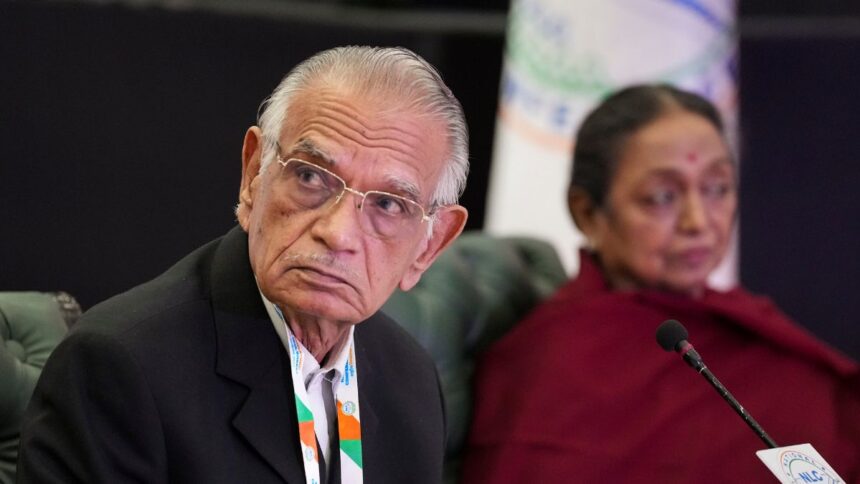
Shivraj Patil, the Congress stalwart and former Union Home Minister, passed away at the age of 91 on Friday at his residence in Latur, Maharashtra. Known for his long and eventful political journey, Patil’s life was defined by his dedication to parliamentary reforms, loyalty to the Congress leadership, and a series of controversies that marked his tenure in some of the highest offices of India. From his early days as the Speaker of the Maharashtra Vidhan Bhavan to his stint as the Lok Sabha Speaker, and later as India’s Home Minister, Patil’s career reflected a blend of administrative foresight, political allegiance, and occasional missteps that would leave a lasting imprint on the nation’s political landscape.
A Distinguished Parliamentary Career and Commitment to Reform
Shivraj Patil’s journey in public life began with a firm belief in parliamentary ethics and institutional processes. In March 1979, when rumours of Jayaprakash Narayan’s death spread across India, it created a wave of panic and mourning in many state assemblies. In a notable display of diligence and integrity, Patil, then Speaker of the Maharashtra Vidhan Bhavan, refused to act merely on unverified reports. Demonstrating his commitment to facts, he temporarily adjourned the House and personally called doctors at Jaslok Hospital, who were treating Narayan, to confirm the patient’s condition. This careful approach ensured that the assembly did not fall prey to misinformation, and under his guidance, Vidhan Bhavan became the only state assembly to issue a resolution wishing a long life for Narayan, who ultimately passed away in Patna seven months later.
Twelve years after his tenure in the Maharashtra Vidhan Bhavan, Patil ascended to the position of Speaker of the Lok Sabha, where his reformist approach further left a mark on parliamentary functioning. At the time, discussions in the House were often rushed due to time constraints, and several ministry budgets were approved without detailed deliberations. Recognizing the need for robust parliamentary scrutiny, Patil instituted a system where undiscussed ministry budgets were referred to standing committees for thorough examination. Political analyst Anant Bagaitkar later highlighted that Patil treated these committees as “mini-Parliaments” where leaders from various parties could debate, deliberate, and scrutinize budgets comprehensively. During his term, the iconic statue of Mahatma Gandhi in the Parliament complex was also inaugurated, symbolizing his efforts to intertwine history, symbolism, and parliamentary decorum.
Patil’s approach as Speaker reflected a balance between procedural discipline and democratic engagement. His tenure underscored the importance of committee-based governance, a model that continues to influence parliamentary functioning. Despite operating in an era marked by political volatility, Patil’s decisions reinforced the principle that parliamentary oversight should be inclusive, methodical, and non-partisan. His ability to navigate the complex dynamics of multi-party discussions and maintain the dignity of parliamentary institutions earned him respect across party lines, even as his later career would be marked by greater political turbulence.
Tenure as Home Minister: Challenges, Criticism, and Controversy
After years of distinguished parliamentary service, Patil’s loyalty to the Congress leadership paved the way for his elevation to India’s Union Home Minister, a role widely regarded as one of the highest in the government after the Prime Minister. Despite losing the 2004 Lok Sabha election from Latur, Patil’s past experience in Indira Gandhi and Rajiv Gandhi’s cabinets, coupled with Sonia Gandhi’s confidence in his capabilities, ensured his selection for this critical portfolio when the Congress returned to power. However, his four-year stint as Home Minister would be marked by unprecedented challenges, major terror attacks, and public scrutiny that ultimately overshadowed his administrative achievements.
The most defining moment of Patil’s tenure came on November 26, 2008, when ten Pakistani terrorists launched coordinated attacks across Mumbai, targeting iconic locations such as Chhatrapati Shivaji Terminus, Taj Mahal Hotel, Oberoi Trident, Leopold Café, and Nariman House. The attacks claimed 166 lives and left more than 300 injured, exposing vulnerabilities in India’s internal security framework. While one of the terrorists, Ajmal Kasab, was eventually captured and later executed, the attacks cast a long shadow over Patil’s leadership. In the aftermath, criticism mounted over the perceived inadequacies in preparation, coordination, and response. His colleagues in the Congress Working Committee reportedly expressed sharp disapproval, and three days after the attacks, Patil submitted his resignation to then-Prime Minister Manmohan Singh. Maharashtra Chief Minister Vilasrao Deshmukh was also relieved of his duties in the ensuing political fallout.
Internationally, Patil’s tenure attracted scrutiny as well. According to Wikileaks documents, David Mulford, the then U.S. ambassador to India, described him as “spectacularly inept” and suggested that his removal was inevitable, noting that he appeared “asleep on the watch” during critical security incidents. Domestically, Patil’s approach to counter-terrorism and law enforcement was widely debated. His emphasis on respecting human rights during investigations and his cautious operational style were often perceived as a soft approach to terrorism. Media narratives occasionally amplified these perceptions, focusing on personal quirks, such as his habit of changing clothes multiple times a day or ensuring polished footwear even in crisis zones, which added to the public discourse around his leadership.
Patil’s tenure as Home Minister was also punctuated by other terror incidents, such as the September 13, 2008, blasts in Delhi at Karol Bagh, Connaught Place, and Greater Kailash, which killed 25 people and injured over 150. His decision to maintain pre-scheduled engagements in Assam immediately after the blasts became a source of political contention and provided ammunition for opposition criticism. Yet, his commitment to procedural and predictable governance reflected a personality that prioritized structured leadership over reactive politics, even if public perception often skewed against him during crises.
After stepping down as Home Minister, Patil continued his public service as the Governor of Punjab in 2010, a position that marked the final chapter of his official political career. Unlike many of his contemporaries in the Congress party who remained engaged in Delhi’s corridors of power, Patil chose a quieter life, distancing himself from political machinations and focusing on personal pursuits, including his spiritual devotion as a follower of Sathya Sai Baba. His later years were characterized by reflection and commentary, including occasional statements that sparked debate, such as his remark in 2022 about the mention of jihad in the Gita, which he later clarified.
Throughout his life, Shivraj Patil remained a figure of complex contrasts. He was a reformist Speaker who strengthened parliamentary processes, a loyal Congress leader trusted with the country’s top internal security portfolio, and a public figure whose decisions often provoked intense scrutiny. His legacy is inseparable from the turbulent political and security challenges of contemporary India, reflecting both the potential and limitations of leadership in high-stakes governance. Patil’s passing at 91 closes the chapter on a career that spanned decades of public service, marked by institutional reforms, unwavering loyalty, and controversies that continue to resonate in the national political consciousness.