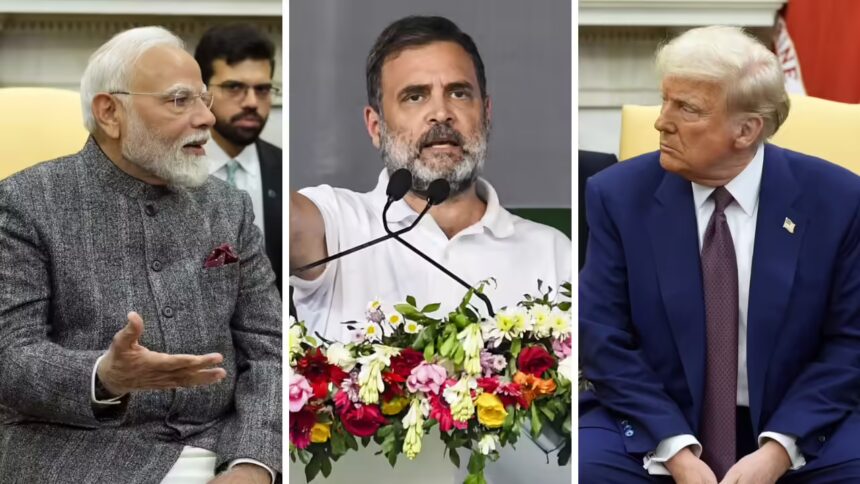
The political discourse in India escalated sharply following US President Donald Trump’s recent remarks that Prime Minister Narendra Modi assured him that India would halt its oil imports from Russia. The statements, made by Donald Trump at a White House briefing, quickly became a flashpoint for debate in New Delhi, with opposition leaders accusing the prime minister of compromising India’s strategic autonomy. Congress leader Rahul Gandhi, in particular, took to social media platform X to target PM Modi, alleging that the prime minister is “frightened of Donald Trump” and willing to let the US dictate India’s foreign and economic policy. Rahul Gandhi’s comments, and those of other senior Congress figures, have intensified the scrutiny on India’s foreign policy choices and the balance between diplomatic relations with major powers and the nation’s own strategic interests.
Rahul Gandhi’s Allegations and Political Repercussions
Rahul Gandhi’s response to Donald Trump’s assertions was swift and pointed. Taking to X on Thursday, the opposition leader directly accused PM Modi of surrendering India’s decision-making to the United States, emphasizing that the prime minister allowed the US president to publicly declare that India would no longer purchase Russian oil. Rahul Gandhi’s criticism was framed around the broader perception of PM Modi’s foreign policy, suggesting that India’s leadership is overly cautious or compliant in its dealings with powerful global actors like the US.
Rahul Gandhi highlighted that PM Modi’s alleged assurance to Donald Trump represents a troubling precedent for India’s sovereignty in critical international trade decisions. He underscored that the US president has consistently criticized India’s engagement with Russian energy markets, and Donald Trump’s statements following PM Modi’s supposed assurance have now become a point of contention in Indian political discourse. Rahul Gandhi argued that the prime minister’s actions indicate a level of subservience or undue influence, with the country’s strategic autonomy being compromised in favor of maintaining personal rapport with foreign leaders.
The Congress leader further criticized PM Modi for maintaining cordiality with the US despite repeated public snubs, describing this pattern as evidence of an unbalanced approach to international diplomacy. Rahul Gandhi’s remarks were not limited to the oil trade alone; they were framed within a broader critique of PM Modi’s tendency to prioritize personal diplomacy over India’s independent strategic interests. By raising these concerns, Rahul Gandhi sought to question the credibility of PM Modi’s leadership in balancing national priorities with international expectations.
Congress general secretary Jairam Ramesh also joined the chorus of criticism, elaborating on Rahul Gandhi’s observations. Ramesh contended that the prime minister’s famed “56-inch chest,” a metaphor popularized by Home Minister Amit Shah in 2019 to signify PM Modi’s decisive and strong leadership, has now metaphorically shrunk under the pressures of international diplomacy. Ramesh pointed out that the prime minister, according to Donald Trump, has effectively outsourced key decisions to the US, weakening the perception of India’s independent decision-making in crucial areas of foreign policy and defense operations. Ramesh cited Donald Trump’s repeated claims across multiple countries that his interventions influenced India’s strategic operations, framing this as evidence that India is yielding to external pressures rather than charting its own course.
The political ramifications of these statements are multifaceted. While Donald Trump’s comments are made from an American perspective and reflect his personal interpretation of diplomatic exchanges, their immediate reception in India has fueled debates over sovereignty, national interest, and the extent to which India can navigate its foreign policy independently in a world dominated by major powers. Opposition leaders argue that the public airing of such statements undermines India’s negotiating position and risks conveying a narrative that India’s leaders are reactive rather than proactive in strategic matters.
US Assertions and India’s Strategic Response
Donald Trump, in his statement at the White House, explicitly claimed that he had received an assurance from PM Modi that India would stop buying oil from Russia. Donald Trump described this as a “big step” in influencing the global energy market and reducing Russia’s revenue streams amid ongoing geopolitical tensions. He further suggested that after India, he would attempt to influence China to follow a similar path, framing India’s energy decisions as part of a larger US strategy to isolate Russia economically and politically.
The comments drew immediate attention in India due to the ongoing trade and energy negotiations between New Delhi and Washington. The US had previously imposed steep tariffs on Indian imports, citing India’s continued oil trade with Russia as a point of contention. By publicly asserting that PM Modi had assured him of a halt in Russian oil purchases, Donald Trump positioned India within the narrative of global energy realignment, signaling a desire for alignment with US foreign policy objectives.
Prime Minister Modi’s responses to US pressures and domestic scrutiny have centered on India’s strategic autonomy, economic self-reliance, and national interests. In previous addresses, including his Independence Day speech, PM Modi has emphasized the importance of self-reliance and maintaining the country’s sovereign decision-making in matters of energy, trade, and foreign policy. He has highlighted initiatives such as “Make in India” and reiterated commitments to protecting the livelihood of Indian citizens, particularly farmers, even when faced with international pressures or punitive trade measures.
PM Modi has consistently argued that India’s energy decisions are guided by pragmatic considerations, including cost-effectiveness, energy security, and long-term sustainability, rather than the preferences of any single global power. The purchase of Russian oil, often at discounted rates, has been defended as a strategic move to secure reliable energy sources while managing global price volatility. These considerations form the core of India’s argument for maintaining autonomy in energy procurement decisions, even as it balances relations with major powers like the US and China.
The dynamic between Donald Trump’s public assertions and PM Modi’s policy approach has generated a unique political environment. On one hand, Donald Trump’s statements appear to cast India as compliant with US expectations, which opposition leaders like Rahul Gandhi and Ramesh argue undermines India’s strategic credibility. On the other hand, PM Modi’s narrative emphasizes sovereignty, pragmatic economic decision-making, and a balanced approach to international relations. This tension between perception and policy illustrates the complexities of modern diplomacy, where public statements, media coverage, and international messaging can significantly influence domestic political discourse.
The controversy also raises questions about the role of social media in shaping public perception of foreign policy. Rahul Gandhi’s and Ramesh’s use of X to voice their criticisms highlights how digital platforms are increasingly central to political debate in India. Statements made by international leaders are rapidly amplified, interpreted, and critiqued in real-time, creating a feedback loop where domestic political narratives are shaped not only by government actions but also by global communications and media coverage.
The strategic implications extend beyond India-US relations. Energy trade, particularly involving Russian oil, has broader geopolitical significance, affecting global markets, bilateral relations, and strategic alignments. India’s position as a major importer of Russian energy, second only to China, positions it as a key player in global energy security. Any perceived alignment or compliance with US preferences can influence regional power dynamics, impacting India’s relationships with Russia, China, and other countries with vested interests in energy and trade.
Experts note that the unfolding discourse demonstrates the delicate balance India must maintain. Aligning too closely with one global power risks alienating others and can be interpreted as compromising strategic autonomy. Conversely, ignoring major powers’ concerns could result in trade penalties, diplomatic friction, or limitations on cooperation in other sectors. Leaders in Delhi must therefore navigate this complex landscape with both caution and foresight, ensuring that India’s core interests remain protected while managing global expectations.
From a domestic political perspective, the opposition’s framing of Donald Trump’s statements serves to question PM Modi’s leadership style and decision-making process. Rahul Gandhi’s accusation that PM Modi is “frightened of Donald Trump” aims to portray the prime minister as reactive and deferential to foreign influence, challenging the image of a strong, decisive leader. By highlighting the contrast between public perception and policy realities, opposition parties seek to influence public opinion, particularly in the context of upcoming elections and ongoing debates over India’s international positioning.
The discourse surrounding India-Russia oil trade and Donald Trump’s remarks also underscores the broader challenges of contemporary diplomacy. Leaders must negotiate complex international relationships, economic dependencies, and domestic political pressures simultaneously. Decisions regarding energy imports, trade agreements, and strategic partnerships involve multifaceted considerations, including price, reliability, geopolitical alignment, and long-term national interests. Public statements and political reactions, such as those from Rahul Gandhi and Ramesh, reflect the intersection of these factors, highlighting the scrutiny under which national leaders operate.
Additionally, the episode illustrates the evolving nature of India’s foreign policy communication. While the government maintains a formal narrative emphasizing autonomy and strategic pragmatism, opposition parties exploit moments of international commentary to challenge credibility and leadership effectiveness. The interplay between these narratives affects public perception and shapes debates around India’s role on the global stage.
The controversy triggered by Donald Trump’s statements about India’s Russian oil imports has catalyzed a multifaceted political and diplomatic debate. Rahul Gandhi’s criticism, highlighting fears of US influence and the alleged outsourcing of key decisions, has intensified scrutiny on PM Modi’s foreign policy approach. Concurrently, the government’s defense of energy strategy, national autonomy, and pragmatic decision-making underscores the complexity of balancing domestic and international interests in an era of globalized media and diplomacy. The unfolding situation continues to illustrate how public perception, political discourse, and international commentary intersect in shaping contemporary governance, policy-making, and strategic choices.