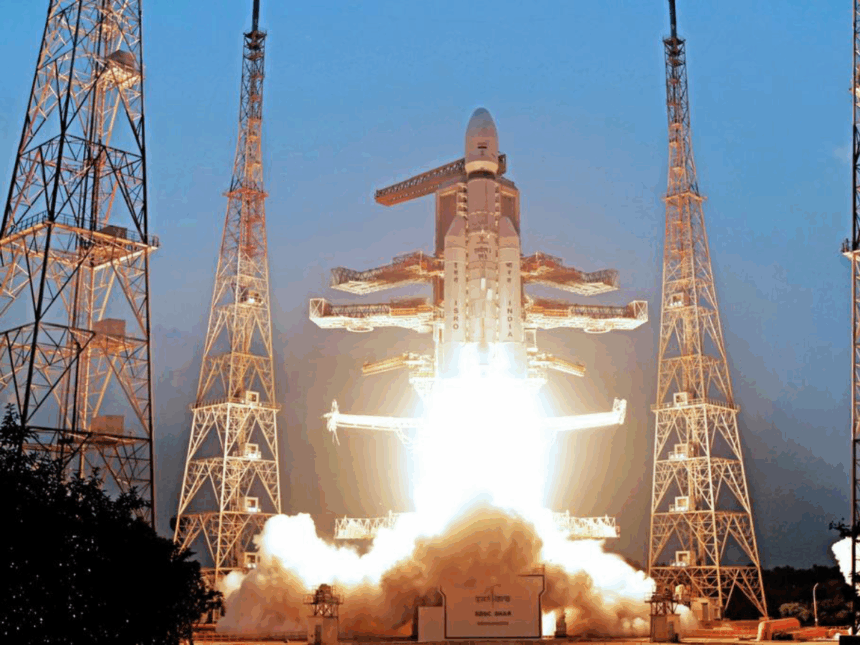
In a major milestone for India’s space program, the Indian Space Research Organisation (ISRO) successfully launched its heaviest-ever communication satellite, CMS-03, aboard the powerful LVM3-M5 rocket—fondly called the “Bahubali” of Indian rockets. The mission, executed from the Satish Dhawan Space Centre in Sriharikota on Sunday evening, underscored India’s growing prowess in developing indigenous heavy-lift space technology. The satellite, weighing around 4,400 kilograms, is not just ISRO’s most massive communication payload to date but also a technological demonstration of India’s expanding self-reliance in advanced satellite and rocket systems.
The launch took place at 5:26 pm from the second launch pad, and within minutes, the rocket flawlessly injected CMS-03 into its intended orbit. The success of this mission strengthens India’s position in the global space community as a country capable of designing, manufacturing, and deploying heavy satellites using its own launch vehicles. The achievement is another proud moment in ISRO’s legacy, coming at a time when India continues to expand its strategic and communication capabilities through space technology.
A Leap Forward in India’s Communication and Defense Capabilities
The CMS-03 satellite represents a new chapter in India’s communication and defense infrastructure. As ISRO confirmed, CMS-03 is a next-generation, multi-band communication satellite designed to deliver robust and high-capacity communication services over a wide geographical region, including the entire Indian landmass and the vast expanse of the Indian Ocean. Built to operate for at least fifteen years, the satellite promises to enhance India’s telecommunication and data relay systems, serving both civilian and strategic applications.
According to ISRO Chairman Dr. V. Narayanan, the mission exemplifies India’s Atmanirbhar Bharat initiative in the field of space technology. He highlighted that CMS-03 incorporates several new technologies, including advanced encryption, multi-frequency capabilities, and high-powered transponders designed for secure and uninterrupted communication. “This satellite is not only a major step in communication advancement but also a shining example of self-reliant India,” Narayanan said after the successful launch.
Officials from the Indian Navy also emphasized the satellite’s strategic importance, pointing out that it would enhance the Navy’s space-based communication and maritime domain awareness in the Indian Ocean Region. With CMS-03 operational, the Navy will have access to more secure and reliable telecommunication channels, essential for coordination of network-centric operations and improved situational awareness across naval fleets.
Lt Gen (Retd) Anil K. Bhatt, Director General of the Indian Space Association (ISpA), described CMS-03 as a “game changer” for India’s maritime and national security ecosystem. In a statement following the launch, he said, “The CMS-03 satellite will significantly boost India’s communication coverage over the Indian Ocean and strengthen our defense network through advanced and secure communication systems.” The satellite’s high-capacity transponders and wide frequency coverage are expected to provide India’s defense forces with reliable real-time data and connectivity during operations across land and sea.
Beyond its strategic applications, the satellite is also geared to enhance civilian communication infrastructure. It will support services such as internet connectivity in remote areas, digital television broadcasting, and secure communication links for government and emergency networks. CMS-03 thus represents an integrated step toward improving India’s digital and strategic independence through space-based solutions.
LVM3: The ‘Bahubali’ Powering India’s Heavy-Lift Ambitions
At the heart of this successful mission lies ISRO’s trusted heavy-lift launch vehicle, LVM3—known as “Bahubali” for its massive strength and reliability. The rocket, which has previously powered significant missions like Chandrayaan-3 and the Gaganyaan test flights, once again demonstrated its versatility and robustness. The LVM3-M5 variant used for the CMS-03 mission is a three-stage vehicle equipped with two massive solid strap-on boosters, a liquid core stage, and a fully indigenous cryogenic upper stage called C25.
The LVM3 series has evolved into the backbone of India’s heavy satellite launch program. It was first flight-tested in December 2014 under the Crew Module Atmospheric Re-entry Experiment (CARE), marking the beginning of ISRO’s journey toward mastering high-payload orbital delivery. Since then, the vehicle has completed multiple successful missions, including the Chandrayaan-2 lunar mission, the Gaganyaan test flight for human spaceflight capability, and commercial satellite launches through ISRO’s commercial arm, NSIL.
ISRO scientists have often referred to LVM3 as the country’s gateway to advanced space missions and deep-space exploration. The rocket can carry payloads weighing up to 8,000 kilograms to low Earth orbit and about 4,000 kilograms to geostationary transfer orbit—making it India’s most powerful rocket yet.
For the CMS-03 mission, the LVM3’s cryogenic engine played a crucial role in achieving precise orbital insertion. The engine’s C25 stage, powered by liquid hydrogen and liquid oxygen, was entirely designed and developed in India, underscoring ISRO’s expertise in cryogenic propulsion technology. This indigenous development is a remarkable engineering feat, considering the complexity of cryogenic systems and the technological barriers India once faced due to international restrictions on their transfer.
The launch was closely watched not only by scientists but also by defense and communication experts who recognized its implications for national capability enhancement. The successful deployment of such a heavy satellite aboard an Indian-made rocket sends a strong signal of India’s technological maturity and readiness to compete in the global space market.
ISRO’s journey toward heavy-lift capability has been one of gradual and consistent progress. The LVM3 rocket, developed after decades of research and experimentation, is now paving the way for India’s upcoming missions, including interplanetary explorations and human spaceflight programs. Its reliability and performance make it a preferred vehicle for both national and international payloads.
The CMS-03 mission, in particular, demonstrates how far India has come in integrating its space program with broader strategic and developmental goals. By leveraging indigenous innovation, ISRO continues to make strides in advancing national security, boosting communication infrastructure, and fostering technological self-reliance. The combination of LVM3’s power and CMS-03’s advanced capabilities positions India as a formidable player in the rapidly evolving space communication domain.
With this mission, ISRO once again reaffirms that the country’s space ambitions are not just about exploring the cosmos but also about strengthening the nation’s terrestrial systems through the power of space-based technology.