Hamas launched three rockets toward Tel Aviv, marking the first such attack since Israel resumed its military offensive in Gaza. The Israel Defense Forces (IDF) reported intercepting one rocket, while the remaining two landed in uninhabited areas. This escalation follows a brief pause in large-scale military action that began in January under a ceasefire agreement, which has since collapsed.
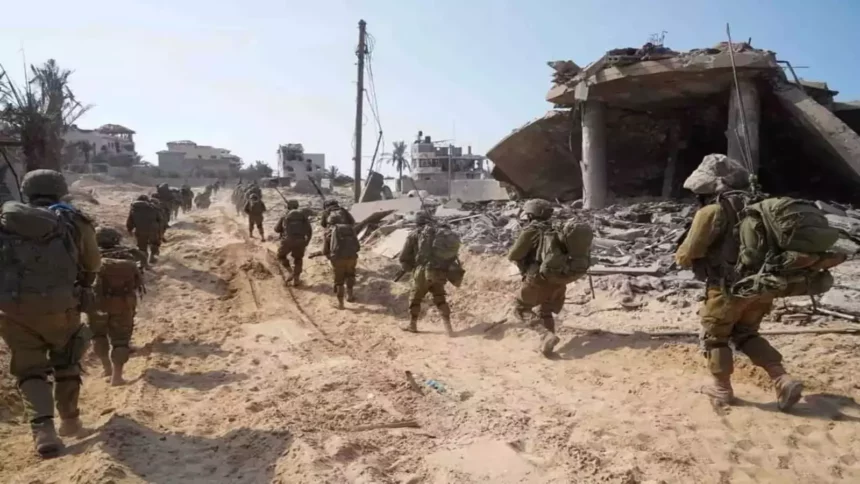
According to the Hamas-run Gaza health ministry, at least 591 people, including over 200 children, have been killed since Israel resumed its offensive on Tuesday. The IDF confirmed it has expanded its ground operations, particularly targeting areas in Rafah, near the Egyptian border, as well as regions in northern and central Gaza. Israel claims its forces have dismantled terrorist infrastructure and created a “partial buffer” between the northern and southern parts of Gaza.
Israeli government spokesperson David Mencer attributed the renewed conflict to Hamas, alleging that the group rejected all hostage deal offers mediated by the U.S. and other international parties. The Israeli military resumed attacks after ceasefire negotiations stalled, stating that its operations would continue until all remaining hostages were released. Israel asserts that Hamas still holds 59 hostages, 24 of whom are believed to be alive.
The humanitarian toll of the conflict continues to mount. The United Nations Relief and Works Agency (UNRWA) reported that five of its staff members, including teachers, doctors, and nurses, were killed in recent days. UN officials have warned that the situation could worsen amid the ongoing military campaign. On Wednesday, a UN compound in Deir al-Balah, central Gaza, was damaged, resulting in the death of a UN worker and injuries to five others. The UN blamed an Israeli strike, though Israel denies targeting the facility and has launched an investigation.
International responses to the escalation remain mixed. The U.S., a major arms supplier to Israel, reaffirmed its commitment to ensuring compliance with international law. White House Press Secretary Karoline Leavitt stated that President Donald Trump fully supports Israel’s recent actions. Meanwhile, UK Foreign Secretary David Lammy confirmed that a British national was wounded in an attack on a humanitarian compound, with efforts underway to assist the individual and their family.
In southern Gaza, civilian casualties continue to rise. At Nasser Hospital in Khan Younis, a father mourned the loss of his two-year-old son, who was killed when a tent nearby was bombed. A doctor at the hospital described the scene as “a level of horror and evil that is really hard to articulate.”
The conflict has also sparked domestic unrest in Israel, with thousands protesting in Jerusalem and Tel Aviv, demanding the return of the hostages. Security forces arrested several demonstrators, deploying water cannons to disperse crowds.
Beyond Gaza, regional tensions are intensifying. Yemen’s Houthi rebels claimed responsibility for a ballistic missile attack targeting Ben Gurion Airport near Tel Aviv, though Israeli forces intercepted the missile before it could reach its target.
Israeli Prime Minister Benjamin Netanyahu has declared that combat operations will continue with full force, insisting that ceasefire negotiations must take place “under fire.” A group representing the families of hostages accused the government of prioritizing military action over the safe return of captives.
The latest hostilities stem from the October 7, 2023, Hamas attack on Israel, which killed approximately 1,200 people and led to the taking of 251 hostages. In response, Israel launched a large-scale military campaign, resulting in over 48,500 Palestinian deaths and widespread destruction, as reported by the Hamas-run health ministry. As the conflict persists, both sides remain entrenched in their positions, leaving little hope for an imminent resolution.