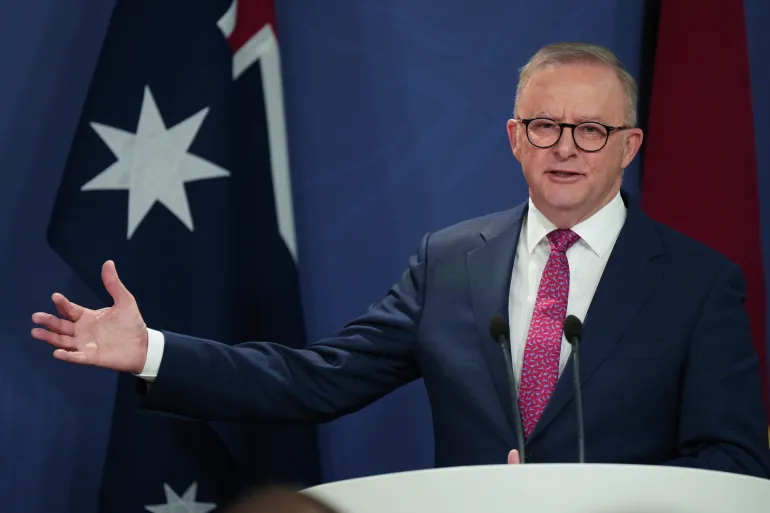
In light of U.S. President Donald Trump’s recent announcement regarding the Gaza Strip, Australia’s Prime Minister Anthony Albanese reiterated his government’s stance on the ongoing Middle East conflict, affirming that Australia continues to support a two-state solution for Israel and Palestine. The Prime Minister’s statement came during a news conference on Wednesday, where he underscored that Australia’s position on the matter has not changed and remains consistent with past policies.
Donald Trump’s controversial declaration was made in the presence of Israeli Prime Minister Benjamin Netanyahu during a joint press conference, where he revealed plans to take over the Gaza Strip. The U.S. President stated that his administration intended to take control of the region and resettle Palestinians in neighboring countries as part of an attempt to resolve the longstanding territorial dispute. The announcement, which has sparked widespread concern and criticism, outlined a vision of reshaping the region’s political landscape by addressing the contentious issue of Palestinian statehood through displacement rather than negotiation.
Albanese, however, made it clear that Australia remains steadfast in its advocacy for a two-state solution, emphasizing the need for a peaceful resolution based on the recognition of both Israel and Palestine as independent, sovereign states. His remarks came in response to Donald Trump’s sudden proposal, which is seen by many as undermining efforts for a negotiated settlement in the Middle East.
The Australian government has consistently advocated for dialogue between Israel and Palestine, supporting efforts to establish a lasting peace agreement. Prime Minister Albanese’s comments reaffirmed Australia’s long-standing position that a two-state solution, where both Israel and Palestine coexist peacefully within secure and recognized borders, remains the most viable approach for achieving stability in the region.
The announcement by Donald Trump, which has drawn criticism from various international bodies and governments, is seen as an extension of his controversial foreign policy approach in the Middle East. The U.S. President’s remarks regarding Gaza have been met with both regional and international concern, with fears growing over the potential humanitarian crisis and further destabilization in the region.
Albanese’s reaffirmation of Australia’s support for a two-state solution highlights the country’s commitment to global diplomatic efforts aimed at resolving the Israeli-Palestinian conflict. The Australian government has repeatedly called for peace talks to resume, with the goal of reaching a fair and equitable resolution that respects the rights of both Israelis and Palestinians.
As the situation continues to evolve, the world is watching closely to see how global powers, including Australia, the United States, and Israel, will navigate the complexities of the Middle East conflict and work towards a solution that can bring lasting peace to the region. Australia’s continued support for a two-state solution reflects its ongoing commitment to promoting stability, peace, and justice in one of the most volatile regions of the world.