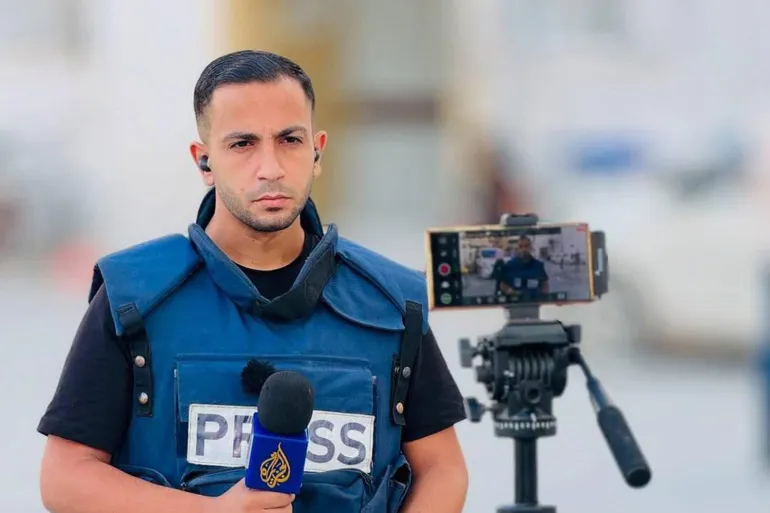
In a tragic and alarming development, Israeli forces killed two of Gaza’s leading journalists from the Al Jazeera network, along with several of their colleagues, during a strike on a journalists’ tent near al-Shifa hospital in Gaza City. The attack occurred late on Sunday, just hours after Israeli Prime Minister Benjamin Netanyahu rejected international criticism over his plans to “take over” Gaza City amid escalating conflict.
Among the victims were Anas al-Sharif and Mohammed Qreiqea, two of Al Jazeera’s most recognizable correspondents reporting from Gaza. The network issued a statement condemning the attack, saying the journalists were deliberately targeted when Israeli forces struck their tent. Alongside Anas al-Sharif and Qreiqea, three other media workers lost their lives, with two additional unnamed Palestinians also killed in the strike.
Anas al-Sharif, a 28-year-old father of two, had been stationed outside the main gate of al-Shifa hospital along with cameramen and photojournalists Ibrahim Zaher, Mohammed Noufal, and Mosaab Al Sharif. Just moments before the strike, Anas al-Sharif posted a video on the social media platform X (formerly Twitter), documenting intense Israeli missile strikes on eastern and southern parts of Gaza City. The final video captured the deafening sound of explosions close to where he was located.
In the aftermath, the Israeli military claimed—without presenting any evidence—that Anas al-Sharif was killed because he “served as the head of a terrorist cell in the Hamas terrorist organization.” This allegation is part of a broader pattern since Israel launched its war on Gaza in October 2023, where Palestinian journalists are frequently accused of being Hamas members. Human rights groups argue these claims are an attempt to discredit journalists reporting on Israeli military actions and abuses.
Al Jazeera called Anas al-Sharif “one of Gaza’s bravest journalists” and denounced the attack as “a desperate attempt to silence voices in anticipation of the occupation of Gaza.” The network emphasized that Anas al-Sharif and his colleagues were among the last remaining media personnel within the besieged Gaza Strip, providing unfiltered, on-the-ground coverage of the suffering endured by Palestinians.
Despite international media being barred from Gaza, Al Jazeera’s journalists remained inside the enclave, documenting the destruction, hunger, and human suffering over nearly two years of relentless bombing and conflict. Their courageous live coverage has provided critical eyewitness accounts of the devastation caused by the ongoing hostilities.
Hani Mahmoud, another Al Jazeera journalist based in Gaza, described the assassination as “perhaps the hardest thing I’m reporting about the past 22 months.” Speaking shortly after the attack, Mahmoud said he was just one block from al-Shifa hospital and witnessed the massive explosion light up the sky. News soon circulated that the journalists’ camp near the hospital’s main gate had been struck.
The killing follows a disturbing pattern of threats and intimidation directed at Al Jazeera journalists. In July, Israeli army spokesperson Avichai Adraee shared a video on X openly threatening Anas al-Sharif, a message widely condemned as targeting a journalist. Anas al-Sharif himself had previously told the Committee to Protect Journalists (CPJ) that he lived with the constant fear of being bombed and killed at any moment.
Jodie Ginsberg, chief executive of the CPJ, told Al Jazeera that Anas al-Sharif’s killing “fits a longstanding Israeli pattern of targeting journalists.” She highlighted that this was not an isolated incident but part of decades of such actions by Israeli forces.
Anas al-Sharif’s final message, reportedly written on April 6 and posted to his social media after his death, reflected his commitment to truthful reporting despite the immense personal risks. He wrote, “I have lived through pain in all its details, tasted suffering and loss many times, yet I never once hesitated to convey the truth as it is, without distortion or falsification.” He went on to lament the silence of the international community and those who accept the killing of journalists and civilians without taking action.
The strike killing the five media workers came days after Israel’s security cabinet approved a plan to occupy the Gaza Strip. The operation aims to seize control of Gaza City and forcibly displace nearly one million Palestinian residents. While Israel officially described this as a “takeover,” Israeli media reported that the term “occupy” was deliberately avoided to sidestep legal responsibilities under international law.
Anas al-Sharif’s assassination is especially poignant given his personal losses in the conflict. More than a year ago, Israel bombed his family home in a refugee camp, killing his 65-year-old father.
This deliberate targeting of journalists raises grave concerns about freedom of the press and the safety of media workers reporting from conflict zones. It highlights the perilous conditions under which Palestinian journalists operate and the concerted efforts by Israeli forces to control the narrative by silencing critical voices.
As the conflict intensifies and the international community grapples with the humanitarian crisis unfolding in Gaza, the killing of Anas al-Sharif and his colleagues stands as a stark reminder of the human cost of war and the urgent need to protect journalists who risk their lives to tell the truth.