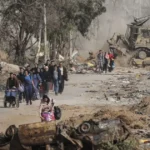
In a strong response to US President Donald Trump’s recent comments about the forced displacement of Palestinians from Gaza, Palestinian leaders, including President Mahmoud Abbas and Hamas, have firmly rejected any such proposals. The remarks, made by Donald Trump during a conversation with the press, suggested that Gaza, after months of conflict, had become a “demolition site” and needed to be “cleaned out.” The US president’s statement included an idea to move Palestinians out of Gaza, potentially to neighboring Egypt or Jordan, a suggestion that has deeply angered Palestinians and many in the Arab world.
In a dinner gathering hosted by Indian President Droupadi Murmu on Sunday, Mahmoud Abbas, the President of the Palestinian Authority, strongly condemned Donald Trump’s remarks, expressing rejection for any plan aimed at displacing the Palestinian people. Abbas’s office issued a statement reaffirming that Palestinians would not abandon their land or their holy sites, regardless of the suggestions made by international leaders. “The Palestinian people will not abandon their land and holy sites,” the statement emphasized. Abbas’s sentiments were echoed by members of Hamas, including Bassem Naim, a prominent member of its political bureau, who stated that Palestinians would continue to resist displacement, just as they have rejected similar proposals over the decades.
The proposed “cleaning out” of Gaza by Donald Trump, which he suggested could involve moving approximately 2.4 million Gazans temporarily or permanently, has sparked outrage among Palestinians. For them, any such move would bring painful memories of the 1948 Nakba, when hundreds of thousands of Palestinians were displaced during the establishment of Israel. In response to Donald Trump’s remarks, Rashad al-Naji, a displaced Gaza resident, voiced a sentiment shared by many, declaring, “We say to Donald Trump and the whole world: we will not leave Palestine or Gaza, no matter what happens.”
Donald Trump’s suggestion was also met with strong disapproval from the Arab League, which condemned any attempt to displace Palestinians, labeling it as “ethnic cleansing.” The League warned against efforts to uproot Palestinians from their land and made it clear that they would not support such moves. Similarly, both Jordan and Egypt, two of the neighboring countries to Gaza, rejected the idea. Jordanian Foreign Minister Ayman Safadi reiterated the country’s firm stance on rejecting the displacement of Palestinians, declaring, “Jordan is for Jordanians, and Palestine is for Palestinians.”
The tension over the issue of forced displacement comes amid ongoing developments related to a truce between Israel and Hamas. Under this fragile ceasefire, a hostage exchange took place on Saturday, with four Israeli hostages and 200 Palestinian prisoners being released. However, disputes over the details of the deal and the movement of Palestinians between different parts of Gaza have continued to cause friction. Reports indicated that many Palestinians, who had been displaced by the war, were attempting to return to northern Gaza, where Israel had blocked their passage. The situation was further complicated by the detention of an Israeli woman hostage, with the two sides accusing each other of violating the terms of the truce.
Humanitarian concerns continue to loom large in Gaza, where the war, which began after Hamas’s attack on southern Israel on October 7, 2023, has caused widespread devastation. Despite the recent truce and the influx of humanitarian aid into the region, the situation remains dire. The UN has reported that the humanitarian crisis in Gaza continues to worsen, with thousands of lives lost on both sides of the conflict. According to the health ministry in Gaza, more than 47,000 people, mostly civilians, have been killed as a result of the Israeli offensive. Meanwhile, in Israel, the initial Hamas attack led to the deaths of over 1,200 people, the majority of whom were civilians.
The exchange of hostages is one of the few positive developments in the ongoing conflict, but the situation remains tense. The complex political and humanitarian issues surrounding Gaza, Israel, and Palestine continue to dominate the global stage, as world leaders and organizations search for ways to bring lasting peace to the region. Despite the pressure from international leaders, Palestinians have made it clear that they will not be displaced and that their right to live on their ancestral land remains non-negotiable.