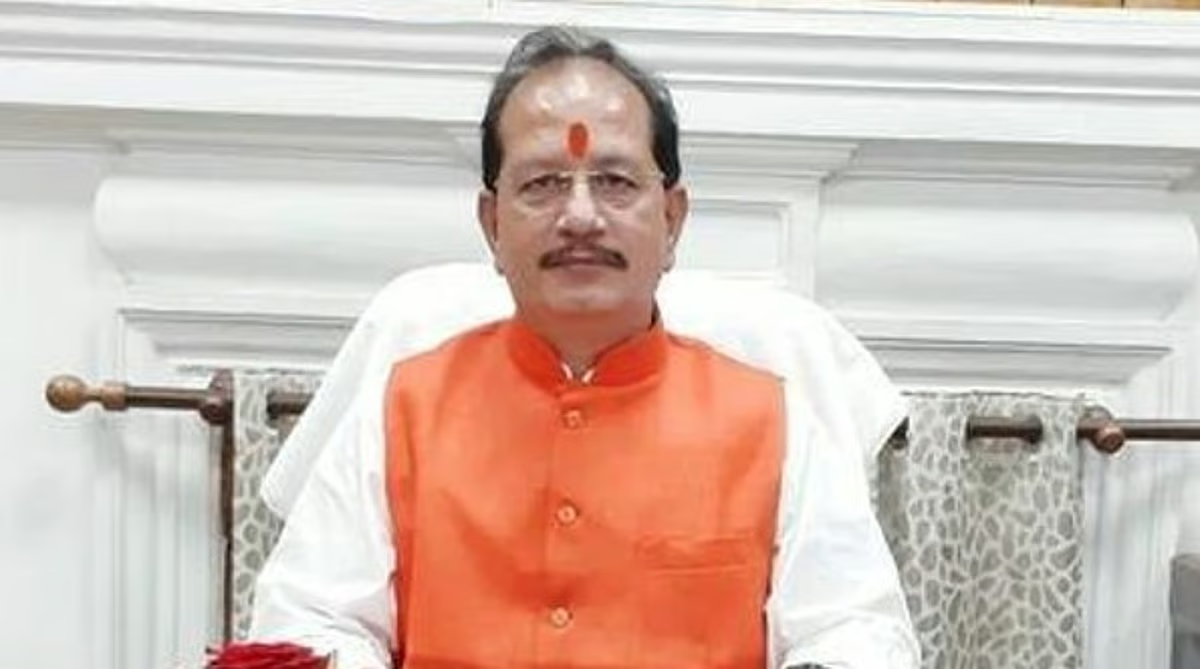
Bihar’s Deputy Chief Minister and senior BJP leader Vijay Kumar Sinha has been served a notice by the Election Commission over allegations of possessing two voter ID cards and being registered as a voter in two separate locations. This development comes amid a highly charged political controversy over alleged fake voters, a debate prominently driven by Congress leader Rahul Gandhi.
The notice was issued following a complaint highlighting discrepancies in the draft electoral rolls where Vijay Kumar Sinha’s name appeared in two different constituencies. Bihar Congress chief Rajesh Kumar shared screenshots on the social media platform X, showing Sinha listed as a voter both in Lakhisarai—his home assembly seat—and Bankipur in Patna. These revelations have intensified the ongoing dispute over voter registration integrity in Bihar, especially ahead of crucial elections.
The Electoral Registration Officer of Bankipur Assembly constituency has formally sent the notice to Sinha, demanding an explanation for his dual inclusion in the voter lists. The Deputy Chief Minister has been asked to respond by 5 pm on August 14. This marks an official probe into the matter as the Election Commission seeks clarity on the issue, which has become a politically sensitive topic.
Sinha, however, has categorically denied any wrongdoing. In a statement, he insisted that he votes from only one place and accused the Rashtriya Janata Dal (RJD) leader Tejashwi Yadav of spreading misinformation. “I vote from only one place. Last time, too, I voted from only one place. The prince of jungle-raj (Tejashwi Yadav) is simply trying to mislead people by giving wrong facts,” Sinha said. He demanded a public apology from Tejashwi for what he described as baseless allegations.
Earlier on Sunday, Tejashwi Yadav had accused Sinha of holding two voter ID cards and questioned what action was being taken against him. According to Yadav, “His name is there in the Lakhisarai assembly constituency in Lakhisarai and also in the Bankipur assembly seat in Patna district.” Yadav pointed out the timing of this anomaly, noting that it came to light after the Election Commission conducted a Special Intensive Revision (SIR) of the electoral rolls in Bihar. “Who should be held responsible—Sinha himself or the Election Commission? What action is being taken against Sinha?” he demanded, calling for the Deputy Chief Minister’s resignation.
Responding to these claims, Sinha explained the situation from his side. “Earlier, names of mine and my family members were listed in the Bankipur assembly seat. In April 2024, I applied to add my name from Lakhisarai. I also filled a form to remove my and my family members’ names from Bankipur. For some reason, my name was not removed from Bankipur,” he clarified, addressing the opposition’s allegations directly.
This tit-for-tat exchange has further polarized political narratives in Bihar, with each side accusing the other of malpractices related to electoral rolls. BJP’s Jagadambika Pal responded sharply to Tejashwi’s accusations, claiming that the RJD leader himself was registered as a voter in two places. “He had two voter IDs, which is illegal. It is a crime. So it means that on a large scale, people of Tejashwi’s party are registered as voters at many places,” Pal alleged, turning the spotlight on the opposition.
Adding to the complexity, Tejashwi Yadav had previously claimed that his name was missing from the draft electoral rolls. However, Election Commission officials countered this claim after an investigation revealed that his name was indeed present but registered under a different EPIC (Elector Photo Identity Card) number. The officials asked Yadav to provide an explanation regarding this discrepancy.
This episode of mutual accusations over voter ID cards and electoral roll discrepancies underscores the highly charged political atmosphere in Bihar, where election integrity remains a hot-button issue. The controversy also reflects wider concerns about the accuracy of electoral data and the processes governing voter registration.
The Election Commission’s notice to Vijay Kumar Sinha signals its intent to investigate these allegations seriously, especially given the high-profile nature of the individuals involved and the potential implications for electoral fairness. The Commission’s call for an explanation by August 14 will be closely watched by political parties, media, and the public alike.
The political tussle also highlights the challenges the Election Commission faces in maintaining transparent and credible electoral rolls, particularly in states with intense political competition. With the elections approaching, all parties are under scrutiny for how they manage voter registrations and whether any attempt is made to manipulate the system.
In summary, the Bihar Deputy Chief Minister’s dual voter ID controversy has ignited a fierce political debate, with both the BJP and RJD leaders exchanging allegations of wrongdoing. While Sinha denies any fault and blames opposition leaders for spreading misinformation, the Election Commission’s involvement points to a formal inquiry that could have significant political repercussions.
As the deadline for Sinha’s response nears, all eyes will remain on how the Election Commission handles this sensitive issue and what steps will be taken to address any irregularities found. Ensuring voter list integrity is crucial not only for the upcoming elections but also for strengthening democratic processes and public confidence in the electoral system.
The case also sends a broader message about the importance of accountability and transparency among elected representatives, reinforcing that no individual is above the law, especially in matters affecting the democratic mandate.