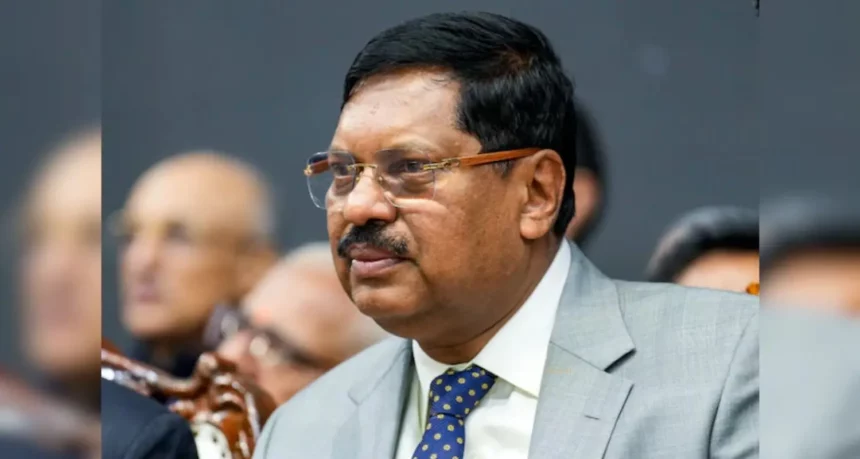
Chief Justice of India (CJI) Bhushan R. Gavai, delivering the Justice Sunanda Bhandare Memorial Lecture in New Delhi, called upon society to embrace collaboration over confrontation in the pursuit of gender equality. He stressed that the road to a gender-equal India cannot be paved by women alone but must be a joint effort where men—especially those in positions of power—actively participate in dismantling social, cultural, and institutional barriers that restrict women’s freedom and opportunities. Gavai emphasized that true equality lies not in symbolic gestures or tokenism but in ensuring women’s meaningful participation in every sphere of life, from governance and law to education and industry.
Collaboration, Not Confrontation: Reimagining Power for Equality
Speaking at the 30th Justice Sunanda Bhandare Memorial Lecture, themed “Justice for All: Building a Gender Equal and Inclusive India,” CJI Gavai highlighted that sharing power should not be perceived as a loss for men but as a liberation for society as a whole. He urged men in leadership roles to reimagine the concept of authority by recognizing that true progress comes when power and opportunity are equitably distributed across genders. “Achieving gender justice is not the responsibility of women alone. It requires an active reimagining of power by men, especially those who occupy positions of authority in our institutions, workplaces, and political systems,” he said.
Gavai paid tribute to Justice Sunanda Bhandare, a pioneering figure in Indian jurisprudence known for her commitment to gender justice and social equality. He said her vision continues to inspire the legal fraternity and civil society to uphold the constitutional promise of equality. “The path to a gender-equal India lies not in confrontation but in collaboration, where men and women together rebuild the moral and institutional architecture of equality envisioned by our Constitution,” Gavai remarked.
Reflecting on India’s 75-year journey since the adoption of the Constitution, CJI Gavai acknowledged that while progress has been substantial, the task is far from complete. He noted that the true measure of gender equality lies not in statistical representation but in the substantive empowerment of women across social and economic strata. “Gender equality is not to celebrate symbolic achievements or token representations but to ensure women have a real and equal share in spaces of power, decision-making, and opportunity,” he added.
Gavai pointed out that despite constitutional guarantees and legislative efforts, the benefits of equality have not reached many women in rural and marginalized communities. He called for a renewed commitment to ensuring that the rights guaranteed by the Constitution extend beyond urban centers and privileged contexts. “The rights guaranteed by our Constitution must reach every woman, not just those in metropolitan cities or privileged contexts, but also those in small towns, villages, and marginalized communities who continue to live at the edges of justice,” he emphasized.
He also drew attention to the deep-rooted cultural and structural impediments that perpetuate inequality. According to him, dismantling these “invisible barriers” requires continuous societal introspection and the willingness of those in authority to share power meaningfully. Gavai underscored that laws alone cannot change realities unless supported by collective will, awareness, and sensitivity.
Lessons from Judicial History: The Role of Courts and Citizens
In his address, CJI Gavai cited landmark judgments that have shaped India’s journey toward gender justice. He credited the judiciary for advancing women’s rights through progressive interpretations of constitutional principles but also acknowledged the limitations of the legal system when divorced from public consciousness. “Progress in gender justice has never been the achievement of courts alone,” he said, noting that real transformation has always depended on public engagement and the moral force of collective voices.
He referred to the infamous 1979 Mathura rape case, where two policemen accused of raping a minor tribal girl inside a police station were acquitted by the Supreme Court. The verdict, which sparked nationwide outrage, became a turning point in India’s feminist movement, leading to major legal reforms in rape laws. Gavai described it as a “moment of institutional embarrassment” but one that demonstrated the power of civil society in shaping judicial accountability. “The dialogue between the courts and the people thus remains one of the most vital sources of India’s democratic strength, reminding us that the march toward gender equality is not a destination reached, but a commitment constantly renewed,” he observed.
The Chief Justice emphasized that judicial interventions must be complemented by grassroots movements, policy reform, and public participation to bring about sustained change. He argued that while courts can lay down progressive principles, it is the responsibility of institutions, governments, and citizens to translate those ideals into lived realities.
In his address, Gavai also touched upon several key judgments by the Supreme Court that have contributed to women’s empowerment—ranging from the recognition of women’s equal property rights and workplace safety to their participation in armed forces and religious institutions. These decisions, he said, reflect an evolving jurisprudence that seeks to make equality a tangible reality rather than a constitutional aspiration.
CJI Gavai observed that the advancement of gender justice has been most successful when driven by collaboration between the judiciary, legislature, and civil society. He reaffirmed that the judiciary’s role is to interpret the Constitution in a manner that upholds the dignity and autonomy of every woman, while ensuring that the principles of equality and inclusion remain at the heart of governance.
The event was attended by several sitting and retired judges of the Supreme Court and high courts, senior lawyers, and academicians. Among the speakers were Delhi High Court Chief Justice D.K. Upadhyay and former Supreme Court judge Justice Madan Lokur, who echoed similar sentiments on the need for institutional reforms to make gender equality a lived experience.
Justice Sunanda Bhandare, in whose memory the lecture series was instituted, served as an eminent judge of the Delhi High Court until her untimely demise in 1994. Remembered as a fierce advocate of women’s rights and social justice, her legacy continues through the annual memorial lecture, which brings together leading voices from the judiciary, academia, and public life to deliberate on the state of justice and equality in India.
CJI Gavai concluded his address by reiterating that equality cannot thrive in isolation or confrontation. It demands mutual respect, cooperation, and the dismantling of rigid hierarchies that have historically excluded women from spaces of influence. His message underlined a simple but profound truth: gender equality is not merely a women’s issue—it is a collective moral, constitutional, and societal obligation that requires continuous participation from all genders and all sections of society.