In a new flashpoint between Dhaka and New Delhi, Bangladesh’s foreign ministry has officially summoned India’s deputy high commissioner to lodge a strong protest against former Prime Minister Sheikh Hasina’s recent interactions with the Indian media. The move underscores growing diplomatic friction between the two neighbours, with Dhaka demanding that India immediately curtail Hasina’s access to journalists.
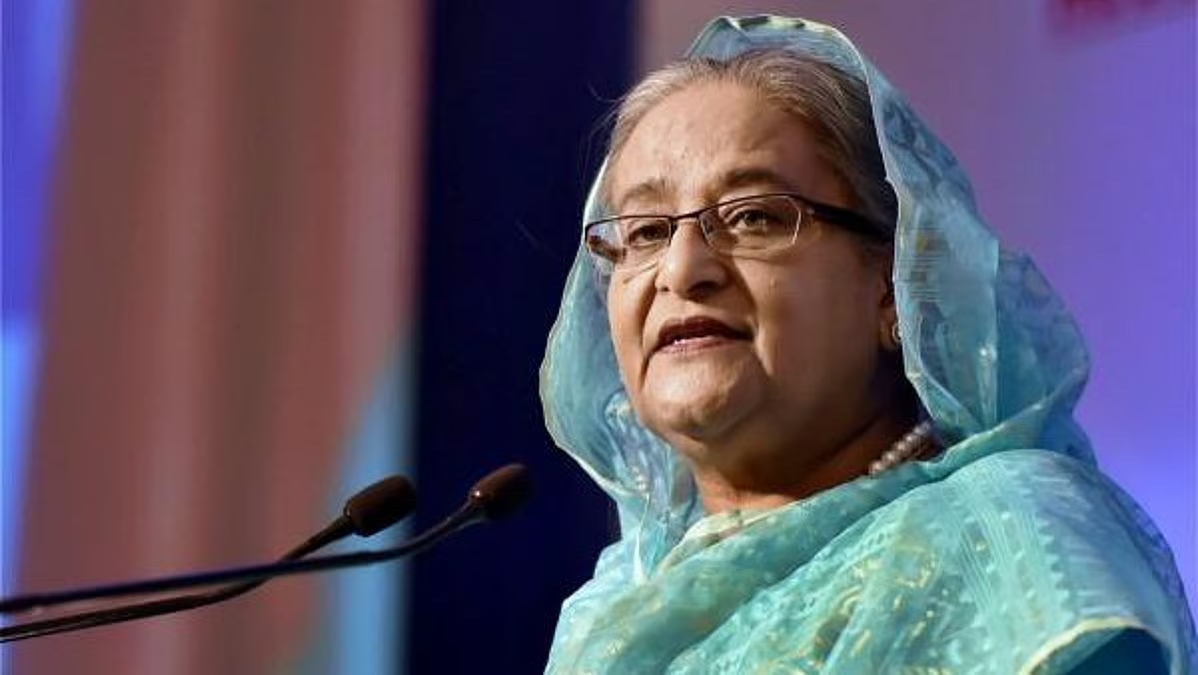
According to officials, the diplomatic protest was conveyed to India’s Deputy High Commissioner Pawan Badhe on Wednesday, following Hasina’s series of interviews with prominent Indian media houses, including Hindustan Times. The 76-year-old former leader, who has been living in self-exile in India since her government’s ouster in August 2024, spoke to the press for the first time since fleeing Bangladesh after massive student-led demonstrations toppled her administration.
Dhaka expressed deep displeasure over what it termed India’s “support” for Hasina’s continued public appearances and alleged that allowing her a media platform to express her views amounted to interference in Bangladesh’s internal affairs. India, however, maintained that its media functions independently and that the government does not influence or regulate who journalists may interview.
Bangladesh’s Diplomatic Protest and Allegations Against India
The Ministry of Foreign Affairs in Dhaka issued a formal statement expressing “serious concern” about India’s stance, stating that the government was providing space for a “notorious fugitive currently under trial for crimes against humanity.” The ministry accused New Delhi of harbouring a person who has been charged with severe human rights violations and claimed that such actions were “detrimental to the spirit of bilateral cooperation.”
The report, first published by Bangladesh’s state-run news agency BSS, detailed that the Bangladeshi side handed over a written note of protest to the Indian diplomat, urging India to “immediately discontinue” Hasina’s interaction with the press. The statement went further, accusing Hasina of using the Indian media to spread misinformation and hatred against the current caretaker government, led by Nobel laureate Muhammad Yunus.
According to sources quoted by BSS, the Bangladeshi government views Hasina’s recent remarks as an attempt to destabilize the ongoing political transition in Dhaka. Officials in the interim administration allege that Hasina’s interviews were orchestrated to gain international sympathy and discredit the caretaker government. “Such media engagements serve only to inflame tensions and mislead the international community,” said one official.
This latest diplomatic action reflects the sharp downturn in India-Bangladesh relations since August 2024. Following Hasina’s ouster amid widespread protests over corruption and authoritarian rule, India’s public statements expressing concern over attacks on minorities in Bangladesh were perceived in Dhaka as interference. The diplomatic tone between the two countries has grown increasingly tense ever since.
Indian officials, while refraining from an official statement on the recent summons, privately expressed surprise at the move, noting that Hasina has also spoken to major international media outlets, including those in the United Kingdom and France, without provoking similar reactions from Bangladesh’s foreign ministry. New Delhi’s diplomatic circles reportedly viewed the summoning of its envoy as “unwarranted and disproportionate.”
Political Backdrop and Reactions from Media Bodies
Sheikh Hasina, who served as Bangladesh’s prime minister for over 15 years, fled the country following her government’s collapse after weeks of violent protests spearheaded by students. The demonstrations, initially triggered by economic discontent and rising unemployment, rapidly escalated into a nationwide movement demanding her resignation. Since then, she has been living in India, largely away from the public eye.
Her recent interactions with Indian media outlets marked her first detailed public comments since her self-exile. During the interviews, Hasina reportedly discussed her version of the events leading to her government’s fall, describing it as a “foreign-backed conspiracy” and accusing the caretaker regime of political vendetta. These statements have angered the current authorities in Dhaka, who accuse her of attempting to undermine Bangladesh’s sovereignty.
Adding to the controversy, Shafiqul Alam, spokesperson for interim government head Muhammad Yunus and a former journalist himself, publicly criticized the Indian journalists who interviewed Hasina, calling them “Indian bootlicking reporters.” His remarks triggered outrage among Indian media professionals and drew condemnation from journalistic bodies.
The Press Club of India (PCI) issued a strong statement on Tuesday condemning Alam’s comments as “deeply reprehensible” and demanded an apology. “To describe professionals from responsible media outlets pursuing a legitimate news story as ‘bootlicking journalists’ is an unacceptable slur,” the PCI said. The organization further emphasized that the media’s role is to report objectively and independently, regardless of political sensitivities between nations.
This episode has also reignited debate about freedom of the press and government control over journalism in South Asia. Many commentators noted the irony that while Dhaka accused India of “allowing” Hasina to speak to the media, India’s own position highlighted precisely the independence of its media institutions—a contrast to the current restrictions on journalists in Bangladesh.
Political analysts in New Delhi believe Dhaka’s decision to summon an Indian diplomat reflects the insecurity of the interim administration led by Muhammad Yunus, which has been facing mounting criticism at home and abroad for its heavy-handed approach toward dissent and its treatment of minority communities.
The diplomatic tensions come at a time when bilateral relations, once considered among the warmest in South Asia, have soured dramatically. The Hasina government had maintained close ties with New Delhi for over a decade, strengthening cooperation in trade, connectivity, and regional security. However, since the caretaker government took office, there has been a noticeable erosion of trust, with each side accusing the other of overstepping boundaries.
Observers also point out that Dhaka’s sharp tone towards New Delhi contrasts with its muted response to Hasina’s appearances on Western platforms such as the BBC and Le Monde. “If Dhaka truly believed in the principle it is invoking, it would have issued similar protests to the British or French embassies,” a senior Indian analyst remarked. “This selective outrage appears politically motivated.”
Meanwhile, the interim administration continues to pressure New Delhi for Hasina’s extradition, a demand India has so far ignored. Sources suggest that New Delhi is unlikely to act on the request anytime soon, given concerns over political persecution and the lack of due process in Bangladesh’s current judicial environment.
Within Bangladesh, public opinion remains divided. Supporters of the interim regime argue that Hasina should face justice for alleged human rights violations and corruption during her tenure, while her loyalists believe she is being targeted as part of a political vendetta. The exiled leader continues to command considerable support among sections of the Bangladeshi diaspora, especially in India and the UK.
As the diplomatic friction intensifies, both nations find themselves navigating a complex and increasingly fragile relationship. India remains a critical partner for Bangladesh in terms of trade, energy cooperation, and regional security. However, the current atmosphere of mistrust threatens to undo years of strategic partnership painstakingly built during Hasina’s tenure.
The situation also poses challenges for India’s foreign policy establishment, which has traditionally balanced democratic values with pragmatic regional engagement. For New Delhi, continuing to provide refuge to Hasina while maintaining diplomatic decorum with Dhaka requires a delicate equilibrium—one that may grow more difficult as the Yunus administration hardens its position.
For now, both sides have avoided direct public confrontation, but the underlying tension is unmistakable. While India insists its media cannot be censored or controlled by the government, Bangladesh’s insistence on restricting Hasina’s voice has added a new dimension to the already strained ties. Whether this dispute escalates further or gives way to quiet backchannel diplomacy remains to be seen, but what is clear is that the shadow of Sheikh Hasina continues to loom large over India-Bangladesh relations.