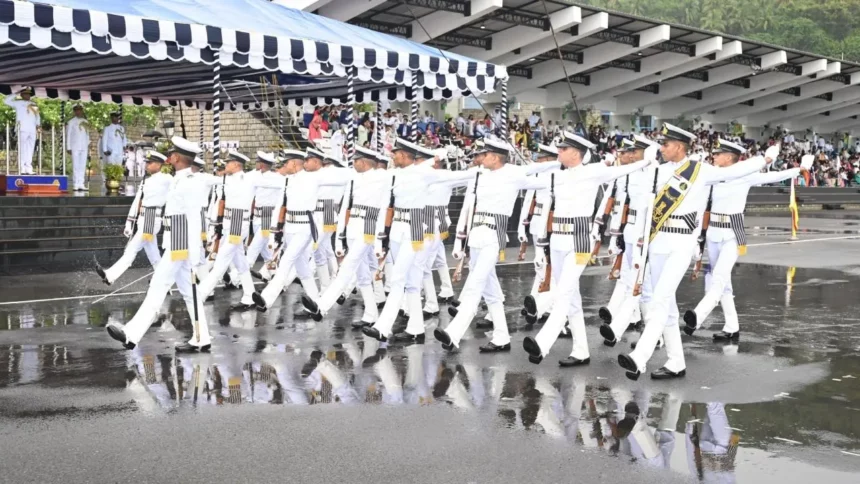
The Indian Naval Academy (INA), Ezhimala, Kerala, is set to host the Passing Out Parade (POP) for the Autumn Term 2025 on 29 November, marking the successful completion of rigorous military and professional training by its graduating cadets. General Anil Chauhan, Chief of Defence Staff (CDS), will preside over the parade as the Reviewing Officer, a role that underscores the event’s national importance and the academy’s contribution to India’s maritime security apparatus. The ceremony will see a new cohort of officers inducted into the Indian Navy, Indian Coast Guard, and several friendly foreign navies, continuing a legacy of excellence in military training and defence diplomacy.
Held at Asia’s premier naval officer training institution, the parade formally celebrates cadets who have undergone months of structured training in seamanship, navigation, military tactics, leadership development, ethics, and physical conditioning. These young officers, honed through one of the most demanding defence training pipelines in the country, will soon take on operational responsibilities, strengthening India’s maritime readiness amid evolving regional and global security challenges. The ceremony also reflects India’s growing emphasis on human resource transformation in the defence sector and the increasing role of advanced technologies such as artificial intelligence (AI), cyber systems, and digital analytics in future-ready policing and naval operations.
A legacy of discipline, excellence, and maritime cooperation
The Passing Out Parade is one of the Indian Navy’s most prestigious ceremonial traditions, symbolising the values of discipline, duty, honour, and operational precision. This year’s parade will feature midshipmen and cadets of the Indian Navy and Indian Coast Guard, including international trainees from partner nations—Bangladesh, Maldives, Mozambique, Myanmar, Seychelles, Sri Lanka, and Vietnam—highlighting India’s expanding maritime training footprint and long-standing defence partnerships. According to officials, the participation of foreign cadets reinforces India’s strategic role in strengthening collective maritime capability in the Indian Ocean Region and beyond.
The ceremony will be attended by distinguished dignitaries, senior naval officers, academy trainers, proud parents, mentors, and instructors who have played a key role in shaping the cadets’ journey. The parade will showcase immaculate drill, ceremonial precision, and exceptional military bearing, reflecting the academy’s high training standards. The POP will also include the award of medals and trophies to the cadets who have demonstrated exemplary academic, operational, and overall training performance. A significant highlight of the ceremony is the formal ‘Shipping of Stripes’, a symbolic and ceremonial moment marking the commissioning of cadets as officers. The event also recognises outstanding dedication through awards that honour exceptional commitment, resilience, and performance across diverse training areas.
Beyond ceremonial significance, the parade also reflects India’s evolving maritime and defence outlook and the key role played by INA, Ezhimala, in developing officers for integrated maritime strategy. Over decades of existence, the INA has become a core pillar in sustaining India’s maritime defence talent pipeline. The academy combines modern classroom learning, real-world operational exposure, aggressive physical endurance training, and moral leadership mentoring, moulding officers who are ready to command in dynamic and high-pressure maritime environments. Officials emphasised that the training regimen is not only physically and mentally transformative but also professionally exacting, enabling seamless integration of cadets from both Indian and international defence setups.
Advanced training conclave signals future-focused internal security approach
In addition to inducting Indian officers, the presence of international cadets from seven partner nations reflects India’s expanding defence training diplomacy, which has become one of the country’s strategic instruments in building multilateral maritime trust and interoperability. India has trained thousands of foreign defence officers over the years, promoting shared tactical doctrines, cultural understanding, and collaborative frameworks for maritime crisis management.
The POP also heralds discussions on modern security dimensions under the broader defence shipping and security vision, with recent defence conclaves placing AI-enabled disaster management, forensic science, geospatial intelligence and counter-extremism at the centre of national and global maritime partnership dialogues. The parade therefore stands not only as a ceremonial graduation but also as a strategic signal that India is working to build a maritime officer class equipped with both traditional naval skills and technological fluency: from data-guided surveillance to AI-powered emergency response and forensic-enabled maritime investigations.
The Indian Navy has confirmed that for national and global audiences, the parade will be livestreamed on official Facebook and YouTube platforms, enabling citizens and international observers to witness this historic moment of defence tradition and cooperation. The livestream initiative, according to defence officials, is aimed at celebrating officer induction beyond institutional perimeters, encouraging national pride and inspiring future generations to contribute to India’s maritime security mission.
What the parade will feature
Review of the parade by CDS General Anil Chauhan
Awarding of medals and trophies to top-performing cadets
Civilian and military dignitaries, including senior naval leadership
Ceremonial Shipping of Stripes for officer commissioning
Participation of cadets from India, Coast Guard, and friendly foreign navies
Livestreaming for audiences in India and abroad
Strategic significance of INA, Ezhimala
The INA has become a fulcrum of India’s military training for the Indian Ocean region, supporting:
Maritime leadership training for partner countries
Coast Guard training interoperability
Counter-extremism preparedness
AI-enabled disaster and cyber response training
Forensic and digital investigations exposure
Geospatial maritime intelligence learning
International maritime cooperation expansion
Public and defence community response
Parents and instructors said that the ceremony is not merely a graduation but a testimony to years of personal sacrifice, training excellence, and institutional rigour. Naval officials said that the parade will solidify India’s role as a maritime training hub that emphasises both security preparedness and diplomacy.
Defence and maritime analysts note that India’s global image as a collaborative regional power has increasingly been shaped through such officer training partnerships.
Path ahead
The graduating batch will assume duties across naval command, coastal security grids, disaster response units, maritime partnership cells, and AI-enabled internal security systems. Officers from partner nations will return home as force multipliers, carrying forward shared military doctrines and India-trained leadership ideals.
This edition of the parade is expected to be politically and diplomatically consequential, signaling a unified maritime security roadmap founded on cooperation, trust, discipline, and technological modernisation.