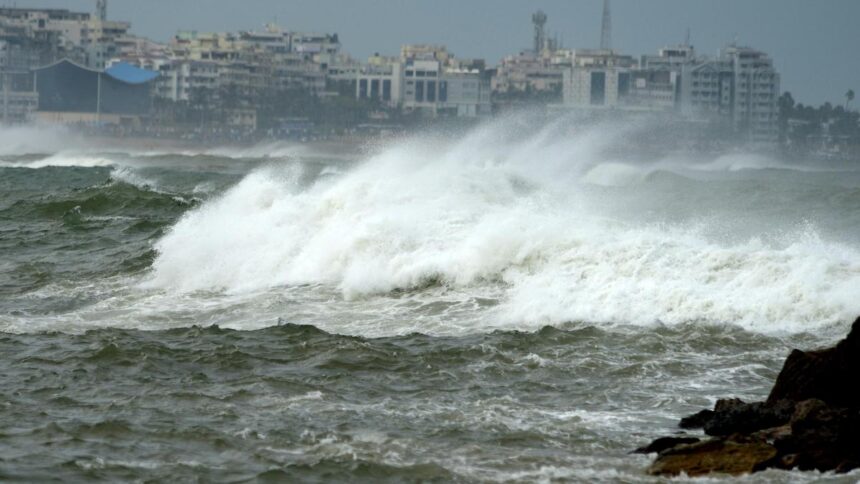
Cyclone Ditwah, currently positioned over coastal Sri Lanka and the adjoining southwest Bay of Bengal, has unleashed intense rainfall, flooding, and heavy winds across the region, prompting large-scale preparedness measures in Tamil Nadu and neighboring coastal territories. As the system advances toward north Tamil Nadu and gathers strength, officials across multiple states have accelerated emergency protocols, reviewed response mechanisms, and issued warnings to residents in vulnerable zones. Meanwhile, Sri Lanka has already suffered severe devastation, with nearly one hundred deaths reported amid relentless downpours and widespread structural damage, underscoring the cyclone’s escalating impact across South Asia.
Tamil Nadu strengthens emergency response as cyclone approaches and districts declare closures
Cyclone Ditwah’s journey across coastal Sri Lanka and the southwest Bay of Bengal has raised significant concern in Tamil Nadu, where early rainfall on Friday signaled the beginning of a period of potentially extreme weather. The India Meteorological Department has forecast very heavy to extremely heavy rainfall across Rayalaseema and south coastal Andhra Pradesh between November 29 and December 1 as the cyclone progresses north-northwestward, preparing to move closer to the Tamil Nadu coastline by early November 30. This projected trajectory has triggered a series of emergency measures across the state, including closures, high-alert declarations, and strategic deployments of relief forces.
Tamil Nadu Chief Minister M. K. Stalin issued updated instructions to party office bearers and ground-level members, urging them to remain active and ready to extend support to the public as the cyclone approaches. In a public statement, he clarified that the state government has held multiple review meetings over the past two days with senior officials, assessing the infrastructure readiness, emergency supplies, and coordination among various departments responsible for managing weather-related crises. These discussions primarily focused on ensuring that low-lying areas, flood-prone towns, and coastal settlements are monitored continuously and that relief agencies are prepared to respond swiftly to any sudden escalation.
Several districts in Tamil Nadu responded to the warnings by announcing a holiday for schools and colleges on November 29 to ensure student safety and reduce mobility during potentially hazardous weather. This includes coastal districts where early rainfall had already caused waterlogging, hampering transportation and raising concerns about the risk of uprooted trees, localized flooding, and infrastructure strain. The decision was taken as a precautionary measure to minimize exposure to extreme conditions, particularly since the cyclone’s intensity may increase as it nears the coastline.
Photographs and eyewitness accounts from various parts of Thoothukudi captured streets submerged in rainwater and winds pushing through tree lines and electrical poles. Residents in the delta and adjoining districts experienced heavy showers throughout the morning, hinting at the intensifying moisture and atmospheric instability associated with the cyclone’s proximity. Disruption to daily life was evident as roads became slippery, drainage systems struggled to accommodate the sudden inflow, and public transportation was forced to adjust schedules.
Emergency teams, including police units, fire and rescue personnel, and health officials, have been placed on high alert. Coastal villages were issued advisories urging fishermen not to venture into the sea, while harbors secured boats and set up shelters for marine workers. Power utilities have begun load management exercises to prevent outages, while water supply departments have activated backup systems. Temporary relief shelters have been equipped with basic resources for residents who may need to be relocated. Government hospitals, too, have strengthened emergency wards and ensured the availability of ambulances.
The IMD has predicted wind speeds ranging from 70 to 90 kmph by Saturday morning, which could lead to falling trees, damaged rooftops, and disruptions in electricity. Given the multi-day rainfall forecast, officials are particularly worried about cumulative flooding in low-lying locations. Disaster management authorities are maintaining continuous communication with district collectors, verifying stockpiles of food, drinking water, medicines, fuel, and emergency tools necessary for rescue work.
In agricultural regions, farmers have voiced concerns about the potential damage to standing crops, especially paddy, banana, and sugarcane. The agriculture department has advised securing saplings, clearing irrigation channels, and monitoring water levels in ponds and reservoirs to prevent overflow. Veterinary teams have been alerted to support livestock safety, especially in remote villages where animal shelters may be at risk from strong winds.
Public advisories have also emphasized caution in urban areas, asking residents to stay indoors during peak rainfall hours, avoid unnecessary travel, and charge essential devices beforehand. Communication networks are being monitored to ensure minimal disruptions, and telecommunication teams have been instructed to prepare mobile towers for adverse wind conditions.
Amid the growing apprehension, civic bodies across the state have deployed teams to clear stormwater drains, remove loose hoardings, and trim overgrown branches that could fall during the storm. Chennai, although not in the immediate impact zone, has undertaken precautionary checks around key water bodies, pumping stations, and subways that often flood during heavy rains. The Greater Chennai Corporation has readied motor pumps, power generators, and rapid response teams to handle emergency complaints.
The cyclone’s approach has also prompted coordination with neighboring states. Andhra Pradesh, which faces the likelihood of heavy rainfall through the weekend, has issued similar advisories and placed its coastal districts on alert. Rayalaseema, historically vulnerable to heavy rains associated with cyclones moving through Sri Lanka and the Bay of Bengal, has prepared for possible road blockages, isolated flooding, and communication disruptions.
Transportation authorities in Tamil Nadu are monitoring roadways, highways, and railway lines to ensure rapid clearing of debris if required. State-run bus services have been instructed to avoid routes at risk of waterlogging or landslides, while railway officials have increased track inspections in sensitive sections. Airports across the state are coordinating with meteorological units to anticipate possible delays or cancellations should wind speeds intensify.
In the midst of these preparations, the state government has urged citizens not to panic but to remain attentive to official weather updates and follow advisories closely. The scale of coordination among departments highlights the government’s attempt to minimize damage and ensure all resources are accessible as the cyclone draws closer.
Sri Lanka suffers devastating impact as heavy rains trigger widespread destruction and rising fatalities
While Tamil Nadu and Puducherry brace for the cyclone’s arrival, Sri Lanka has already endured the full force of relentless rains and fierce winds associated with Cyclone Ditwah. As of Friday evening, nearly one hundred deaths had been reported across the island, and dozens were still missing amid expanding flood zones, collapsed homes, and landslides triggered by continuous downpours. Several districts recorded rainfall levels far exceeding typical seasonal averages, plunging communities into chaos and overwhelming rescue systems.
Sri Lanka’s central, southern, and western regions experienced some of the heaviest rainfalls, causing rivers to swell, inundating villages, and destroying critical infrastructure. Roads were washed away, bridges collapsed, and power lines snapped under the weight of stormy conditions. Entire neighborhoods found themselves submerged, with residents forced to evacuate homes at short notice as floodwaters rose quickly, particularly in low-lying and riverbank settlements.
Emergency response teams have been working continuously, but access challenges persist. Landslides in hilly areas have blocked major routes, delaying the arrival of medical teams, rescue equipment, and relief supplies. Evacuations have been carried out in multiple districts, with thousands of people being moved to temporary shelters set up in schools, community halls, and religious buildings.
The human toll continues to rise as reports of bodies being recovered from rivers, collapsed residences, and landslide-affected zones emerge. Authorities have acknowledged the difficulty of establishing communication with certain remote regions where phone networks have failed due to infrastructure damage. Many families remain untraceable, contributing to the fear that the actual number of casualties may be significantly higher than current estimates.
Hospitals in several districts are functioning under challenging circumstances. Power outages, limited supplies, and staff shortages have complicated treatment efforts for the injured. Medical teams have appealed for additional resources, particularly in districts hit hardest by landslides, as they expect the number of casualties to grow once access improves.
Sri Lanka’s meteorological department has warned that rainfall may continue intermittently as the cyclone system slowly shifts northward. With many districts already saturated, even moderate rainfall poses a risk of further landslides. The government has urged residents living near slopes, riverbanks, and flood-prone zones to relocate to safer areas immediately, emphasizing that the soil remains unstable.
In response to the escalating crisis, India has extended support to Sri Lanka under a relief initiative to assist in rescue and rehabilitation. Supplies and technical teams are being mobilized to support local authorities in handling the widespread devastation. The operation aims to provide essential aid, from food packets and medical kits to temporary shelters.
Economic activities across Sri Lanka have also been severely disrupted. Many markets, schools, and offices remain closed, transportation is limited, and several regions are facing shortages of drinking water and essential commodities. The impact on agriculture, particularly paddy fields and plantation crops, is expected to be significant, potentially affecting livelihoods in the coming months.
As the cyclone moves away from Sri Lanka, it leaves behind a landscape marked by destruction—entire communities uprooted, families displaced, and local economies strained. Yet recovery efforts are already underway, even as the threat of further rain lingers. The devastation in Sri Lanka stands as a stark reminder of the cyclone’s severity and the importance of robust early-warning systems and coordinated response mechanisms in mitigating disaster impacts.