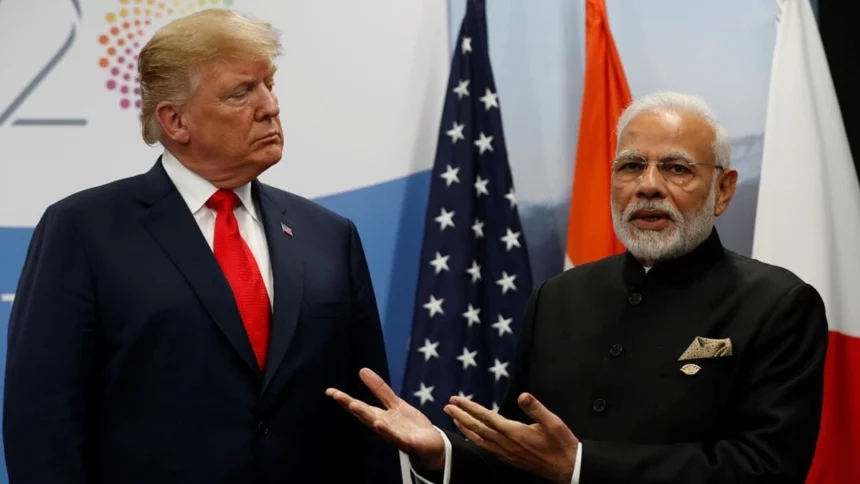
In recent weeks, US President Donald Trump has reignited controversy over America’s trade relationship with India, claiming that it represents a “totally one-sided disaster.” Through a post on Truth Social, Donald Trump argued that India exports massive amounts of goods to the United States while purchasing very little in return, using this assertion to justify his push for higher tariffs on Indian products. However, a closer examination of trade data and broader economic realities reveals that Donald Trump’s characterization is highly misleading. The US trade deficit with India, though real, is modest compared to the enormous deficits the United States maintains with other major trading partners such as China, Mexico, and the European Union. The narrative of India being the principal culprit in America’s trade imbalance oversimplifies complex global trade dynamics and appears to be more politically motivated than economically grounded. In fact, US-India trade flows are increasingly balanced, with American exports to India rising significantly in key sectors such as energy, defense, aerospace, and technology. Experts, including strategic affairs analysts and former US officials, have highlighted that Trump’s claims about India distort the truth and risk undermining both bilateral relations and broader economic cooperation between the two democracies.
US-India Trade Deficit and the Broader Context
Donald Trump’s assertion that India is a major source of US trade imbalance does not align with the actual data. In 2024, the United States recorded a record $1.2 trillion trade deficit in goods, reflecting structural imbalances in global trade that extend far beyond India. Breaking down this figure by country, the US deficit with China reached approximately $270 billion, with the European Union around $236 billion, Mexico $157 billion, Vietnam $113 billion, Canada $55 billion, and India only $41.5 billion. India’s trade deficit represents one of the smallest among America’s significant trading partners, yet Donald Trump continues to single out India in his statements. This selective focus raises questions about the motivations behind his tariff rhetoric, as China, Mexico, and the EU account for far larger portions of the overall US trade deficit.
Historical context further complicates Donald Trump’s claims. While it is true that India has maintained higher tariffs in sectors such as automobiles, agriculture, and electronics, it is not unique in this regard. Many global economies, including China, Brazil, and the EU, impose similar tariffs and non-tariff barriers to protect domestic industries. Moreover, India has gradually reduced tariffs in strategic areas such as energy imports, information and communication technology products, and defense procurement, where US companies increasingly seek business opportunities. The progressive opening of India’s market has facilitated growth in bilateral trade, allowing US exports to expand in sectors where Indian demand is surging.
US exports to India demonstrate a clear pattern of growth and diversification, contradicting the narrative of a “one-sided” trade relationship. American shipments of liquefied natural gas (LNG), crude oil, aircraft, machinery, and defense equipment have increased steadily, reflecting India’s rising demand for critical infrastructure and technology products. India has become one of the fastest-growing markets for US exports, providing American businesses with unprecedented opportunities. In addition to tangible goods, the demand for advanced technology, digital solutions, and energy supplies underscores India’s role as a key strategic and commercial partner for the United States. This growing interdependence demonstrates that the bilateral trade relationship is mutually beneficial and cannot be reduced to the oversimplified claim of India as the “biggest beneficiary.”
Critics and analysts have pointed out that Donald Trump’s focus on India is disproportionate and politically driven. If the administration’s concern were truly to address America’s largest trade imbalances, the primary attention would logically be on countries like China, Mexico, or Vietnam, which account for far larger deficits. Instead, singling out India appears to serve a domestic narrative aimed at appealing to certain voter bases while presenting an exaggerated view of bilateral trade concerns. As strategic affairs expert Dr. Brahma Chellaney has noted, Donald Trump’s public statements about India contain “falsehoods and distortions,” and former Foreign Secretary Kanwal Sibal has similarly highlighted that Donald Trump has been “economical with truth and trading in falsities.” Both experts stress that India’s trade policies are nuanced, with ongoing negotiations reflecting efforts to gradually reduce barriers and enhance cooperation across multiple sectors.
Impact of Tariffs and Self-Inflicted Challenges for the US
The implementation of higher tariffs on Indian products, as proposed by Donald Trump, carries significant implications for American businesses, consumers, and institutions. Analysts have highlighted that a 50 percent duty on Indian exports could result in immediate price increases across a wide spectrum of everyday goods. Key exports from India to the United States—including auto parts, information technology hardware, textiles, industrial chemicals, pharmaceuticals, and specialized software services—are widely used in American manufacturing and retail sectors. Any increase in tariffs would directly impact production costs, supply chain efficiency, and consumer prices, potentially undermining the very constituencies that the administration claims to protect.
India’s role in supplying both finished products and intermediate goods is particularly critical. Active pharmaceutical ingredients (APIs), specialty chemicals, and IT services from Indian partners form an essential part of the US supply chain. Tariffs and related trade barriers introduce uncertainty into these established systems, increasing operational risks for American companies that rely on Indian suppliers for components and services. The resulting disruptions could lead to higher costs, slower production cycles, and diminished competitiveness for US manufacturers, highlighting the self-inflicted nature of the economic damage that could result from unilateral tariff measures.
Beyond the immediate economic impacts, higher tariffs risk creating broader geopolitical and commercial consequences. US-India trade relations are not solely about numbers on a balance sheet; they form part of a larger strategic partnership encompassing regional security, technology collaboration, and multilateral engagement. By framing India as the primary trade problem, the narrative undermines this broader relationship and distracts from cooperative efforts to enhance mutual prosperity. The growing economic interdependence between the two countries, including energy security, digital innovation, and aerospace collaboration, is increasingly crucial to achieving strategic objectives in Asia and beyond. Any disruption caused by punitive tariffs could have lasting consequences for bilateral cooperation in these key domains.
Experts also caution that the political narrative around India-focused tariffs obscures broader trends in US trade policy. While Donald Trump emphasizes India as a problematic partner, data clearly show that trade deficits with China, Mexico, and the EU are far larger. The selective targeting of India therefore appears designed more to advance political messaging than to address structural economic imbalances. Former officials and analysts stress that constructive engagement, rather than unilateral tariffs, is essential to maintaining a healthy and balanced trade relationship that benefits both countries. Efforts to reduce barriers through negotiation and collaboration are more likely to support American economic interests in the long term than punitive measures based on misleading claims.
US exports to India continue to rise in strategic sectors, reflecting both demand-side growth and evolving bilateral agreements. Sectors such as LNG, defense equipment, aerospace, and high-technology machinery have shown significant upward trends, and Indian demand for these goods is expected to grow further. Similarly, India’s initiatives to expand its renewable energy, digital infrastructure, and advanced manufacturing sectors create new avenues for American companies. The trade relationship is therefore dynamic, multidimensional, and mutually reinforcing, far removed from the one-sided disaster narrative promoted in social media posts.
In addition to economic considerations, experts emphasize that rhetoric portraying India as a trade problem has broader implications for international perceptions of US policy. Reliability, credibility, and consistency are key factors in global diplomacy and trade relations. Misrepresenting India’s role in bilateral trade could undermine confidence among allies and partners, signaling unpredictability in American trade policy. This has potential knock-on effects for broader strategic partnerships and multilateral cooperation, including in areas such as technology transfer, supply chain integration, and regional security initiatives.
Furthermore, unilateral tariffs on India would contradict ongoing efforts to strengthen regional stability in Asia. US-India economic collaboration is closely linked to broader strategic objectives, including counterbalancing regional tensions, enhancing maritime security, and promoting sustainable development. Economic coercion that mischaracterizes India’s trade behavior could therefore disrupt both commercial and strategic cooperation, weakening the partnership that has been steadily building over the past decade.
The debate over tariffs also underscores the importance of accurate data analysis in trade policymaking. While Donald Trump’s statements focus on perceived imbalances, a factual review of trade flows demonstrates that the United States is benefiting from India’s growing market and increasing import of US goods. Advanced technology, energy resources, aerospace equipment, and IT services represent significant contributions to bilateral trade. By promoting a narrative disconnected from these realities, policymakers risk pursuing measures that could harm US economic interests while providing limited leverage over India.
Experts including Dr. Brahma Chellaney and Kanwal Sibal have highlighted the factual misrepresentations in Donald Trump’s claims. Dr. Brahma Chellaney observed that Donald Trump’s attacks on India were based on “falsehoods and distortions,” while Kanwal Sibal emphasized that India has engaged in measured tariff reductions in certain sectors while maintaining firm redlines where necessary. Both analysts suggest that the narrative of India as the largest beneficiary of US trade is misleading, and that ongoing collaboration presents far greater opportunities than risks.
The impact of potential tariffs is also likely to affect American universities, research institutions, and technology firms that rely on Indian exports and services. Key sectors such as pharmaceuticals, IT hardware, and industrial components are integrated into the operations of academic and research institutions, as well as manufacturing enterprises. Any disruption could slow research, development, and production, highlighting the unintended consequences of a politically motivated trade stance.
Ultimately, the narrative of a one-sided trade relationship with India fails to account for the complexities of modern global commerce. Trade deficits are influenced by structural factors, consumption patterns, and bilateral agreements, and cannot be accurately reduced to simplistic claims about India’s exports and imports. The evidence demonstrates that trade between the US and India is becoming increasingly reciprocal, with growing opportunities for both nations. Mischaracterizing this relationship not only risks harming economic interests but also undermines the strategic partnership that has emerged over decades of diplomatic, commercial, and technological collaboration.