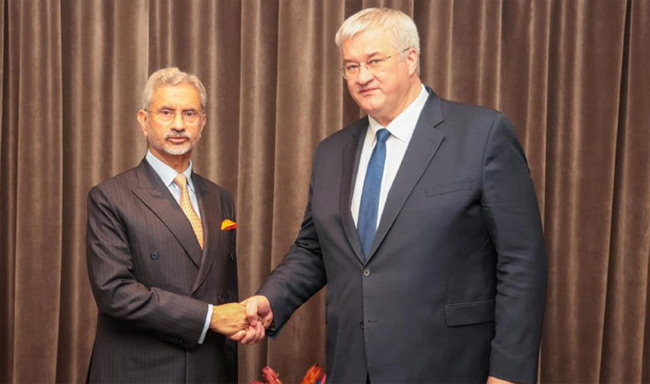
In a significant diplomatic exchange, India’s External Affairs Minister Dr. S. Jaishankar held a telephonic conversation with Ukrainian Deputy Chief of Staff Andrii Sybiha, underscoring India’s consistent stand for a peaceful and early resolution to the ongoing Russia-Ukraine conflict. The discussion highlighted the importance of dialogue, bilateral cooperation, and regional stability, reflecting India’s proactive role in global diplomacy. This conversation comes against the backdrop of ongoing military hostilities between Russia and Ukraine, which have drawn international attention and prompted numerous diplomatic interventions. Dr. Jaishankar emphasized that India continues to advocate for the earliest possible cessation of hostilities, a lasting peace framework, and efforts to restore normalcy in affected regions, signaling India’s commitment to constructive engagement in global conflicts.
Strengthening Bilateral Relations and Coordinated Positions
During the call, Dr. Jaishankar and Andrii Sybiha discussed the broader framework of bilateral cooperation between India and Ukraine, highlighting ongoing partnerships in trade, technology, and humanitarian support. The discussion also focused on the importance of maintaining open lines of communication between New Delhi and Kyiv to ensure coordinated responses to evolving geopolitical developments. India’s approach, as articulated by Dr. Jaishankar, reflects a balanced stance that seeks to support peaceful resolution without taking sides in the conflict, emphasizing dialogue, negotiation, and adherence to international norms.
This conversation closely followed recent interactions between Ukrainian President Volodymyr Zelenskyy and Prime Minister Narendra Modi, which took place ahead of Modi’s bilateral meetings with Russian President Vladimir Putin and Chinese President Xi Jinping during the Shanghai Cooperation Organisation (SCO) summit. Zelenskyy had informed PM Modi about productive discussions with former U.S. President Donald Trump and European leaders, reiterating Ukraine’s readiness to engage in peace talks with Russia. In response, PM Modi reaffirmed India’s steadfast position for a peaceful settlement, emphasizing the need for immediate measures to reduce hostilities and restore stability.
Dr. Jaishankar’s dialogue with Sybiha further reinforced India’s emphasis on multilateral coordination and proactive engagement. Both leaders agreed that the end of the conflict must begin with an immediate ceasefire, accompanied by structured diplomatic negotiations aimed at ensuring lasting peace. By maintaining these consistent and coordinated positions, India signals its commitment to balancing humanitarian considerations with strategic diplomacy, while supporting efforts for an early resolution that benefits both the region and the broader international community.
India’s Consistent Stance on Peaceful Resolution
India has maintained a neutral yet proactive position throughout the Russia-Ukraine conflict, advocating for dialogue and negotiation rather than escalation. Through multiple interactions with both Ukrainian and Russian leadership, India has repeatedly stressed the importance of immediate cessation of hostilities, humanitarian support for civilians, and adherence to international law. PM Modi’s previous conversations with Zelenskyy and Putin underscored India’s unwavering commitment to diplomacy as a means to restore peace, while also ensuring that India’s engagements remain constructive and impartial.
The recent telephonic conversation between Dr. Jaishankar and Andrii Sybiha reiterated that India supports early conflict resolution, humanitarian assistance, and diplomatic channels that enable long-term stability in Eastern Europe. India’s approach also reflects the broader strategic goal of positioning itself as a reliable partner in global peace efforts, capable of mediating or facilitating dialogue where possible. By emphasizing dialogue and the immediate implementation of a ceasefire, India aims to reduce civilian suffering and prevent further escalation of the conflict, while maintaining strong bilateral relations with both Ukraine and Russia.
India’s diplomatic efforts have been complemented by continuous communication between Prime Minister Modi and President Zelenskyy. In a recent interaction on August 11, PM Modi reaffirmed India’s consistent support for a peaceful resolution of the conflict and urged both sides to explore dialogue-based solutions. These discussions underscore India’s long-standing emphasis on constructive diplomacy, where engagement with multiple stakeholders is prioritized over partisan alignment. By upholding principles of neutrality, India continues to navigate the delicate balance of supporting humanitarian imperatives while maintaining strategic relationships across conflicting parties.
The engagement between Dr. Jaishankar and Andrii Sybiha also emphasizes India’s commitment to international law, multilateral cooperation, and the protection of civilian populations affected by the conflict. The talks highlighted the importance of early peace initiatives and reinforced India’s position as a country advocating for the immediate cessation of military operations, continued negotiation, and the establishment of a stable and lasting peace framework. Through these consistent diplomatic efforts, India demonstrates both responsibility and leadership in supporting global stability, reinforcing its image as a principled actor in international affairs.
By maintaining a proactive dialogue with Ukraine and other key stakeholders, India seeks to ensure that its diplomatic influence contributes meaningfully to conflict resolution. The telephonic conversation with Andrii Sybiha also reflects India’s ongoing efforts to strengthen bilateral relations, coordinate on humanitarian measures, and underscore the importance of timely diplomatic interventions. Both leaders agreed on the necessity of working towards common objectives that mitigate the impact of conflict, promote trust, and create avenues for sustained cooperation.
India’s approach is further shaped by its commitment to multilateral frameworks, including the SCO and other regional groupings, which provide platforms for strategic engagement and coordinated responses to global crises. By engaging with Ukrainian leadership while maintaining communication with Russia and other international actors, India continues to project a balanced, pragmatic, and forward-looking foreign policy. Dr. Jaishankar’s discussions underline India’s insistence on early conflict resolution, the establishment of enduring peace, and support for humanitarian priorities, signaling a comprehensive and multidimensional diplomatic approach.
Through this dialogue, India emphasizes the importance of continuity in diplomatic engagement, ensuring that peace efforts are not derailed by temporary escalations or unilateral actions. By reiterating its commitment to an early ceasefire and structured negotiations, India positions itself as a credible mediator capable of facilitating dialogue while maintaining impartiality. The conversation also serves as a reaffirmation of India’s consistent foreign policy principles, where neutrality, diplomacy, and humanitarian considerations guide interactions with conflicting parties.