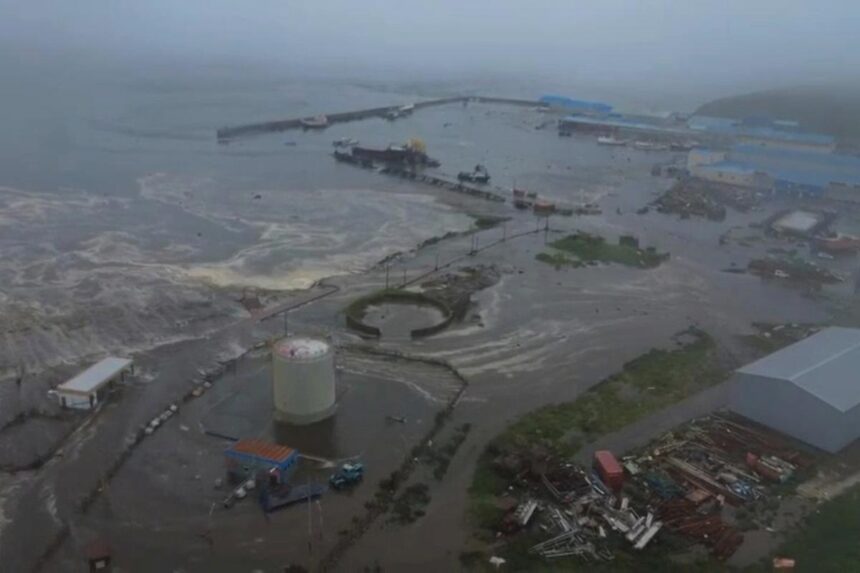
In a major relief for Indian citizens both within the country and abroad, authorities have confirmed that the powerful 8.7-magnitude earthquake that struck Russia’s Far East on Wednesday morning poses no tsunami threat to India or the Indian Ocean region. Despite tsunami warnings being issued across several Pacific nations including the US, Japan, and New Zealand, Indian coastal areas remain safe, according to India’s Tsunami Warning Centre. Meanwhile, Indian diplomatic missions in affected regions have advised Indian nationals to remain cautious and follow safety protocols as a precaution.
The earthquake, which hit near Russia’s Kamchatka Peninsula, caused widespread concern across the northern Pacific. With tremors strong enough to activate emergency alert systems in multiple countries, residents in affected coastal regions responded with swift evacuation efforts. Sirens blared across cities like Honolulu, and authorities in countries such as Japan and the United States began closely monitoring wave patterns for signs of a potential tsunami impact.
No Tsunami Threat to India Despite Powerful Seismic Activity
Following the seismic event, the Indian National Centre for Ocean Information Services (INCOIS) moved swiftly to assess the situation. Operating the country’s Tsunami Early Warning Centre, INCOIS analyzed seismic data from the Kamchatka quake and confirmed that there was no risk of tsunami waves reaching Indian shores. A formal statement from the agency reiterated, “There is no tsunami threat to India or the Indian Ocean region in connection with this earthquake.”
The statement came as a crucial clarification, especially in the wake of tsunami alerts sounding across the Pacific. The initial magnitude was reported as 8.7, but the United States Geological Survey (USGS) later revised the earthquake’s magnitude to 8.8. Although this escalation in magnitude raised further global concerns, INCOIS stood by its findings that the impact would not extend to South Asian waters.
Indian authorities also emphasized that Indian coastlines, including major port cities like Chennai, Visakhapatnam, Kochi, and Mumbai, are not under threat. Oceanic modeling systems tracked the wave propagation in real time and found no indication that tsunami waves would travel towards the Indian subcontinent. This proactive monitoring has significantly helped to prevent panic among the population and ensured that local disaster response agencies remained informed.
Advisory for Indian Nationals Abroad in Pacific Zones
While India itself remains unaffected, the Ministry of External Affairs has extended support to Indians living in tsunami-affected regions overseas. The Consulate General of India in San Francisco released an urgent advisory directed at Indian nationals residing in high-risk zones such as California, Hawaii, and other US West Coast states.
The advisory outlined precautionary steps that Indian nationals should take in the event of a tsunami warning. These include monitoring official alerts from local US authorities, moving immediately to higher ground if an alert is issued, avoiding coastal areas, and preparing for emergencies by keeping mobile devices fully charged. The consulate also issued a dedicated emergency helpline number (+1-415-483-6629) for those requiring assistance.
In Hawaii, where the threat was considered more imminent, sirens were activated across Honolulu, triggering emergency evacuations. People were advised to leave low-lying areas and head toward elevated zones. Local emergency response teams coordinated with federal agencies to facilitate smooth and swift evacuation processes.
The event led to heightened security measures in other Pacific nations as well. Japan and New Zealand increased their monitoring of coastal regions and advised residents to stay away from beaches and harbors. So far, no significant damage or casualties have been reported, but tsunami alerts continue to remain in effect until further assessment by geological experts.
India’s timely response and the clear communication from INCOIS were widely appreciated. The reassurance provided by the country’s Tsunami Warning Centre helped quell rumors and misinformation, particularly on social media, where unverified alerts often gain traction. Authorities advised the public to rely only on official channels for updates and urged against spreading unconfirmed reports.
Across the northern Pacific, emergency teams remained on high alert, with live updates being issued by the US National Tsunami Warning Center and other local agencies. Although the primary energy of the quake was directed eastward into the Pacific, experts continued to evaluate potential aftershocks and secondary effects. Indian oceanographers confirmed that due to the direction and depth of the quake, energy waves would dissipate long before reaching Indian waters.
As the situation developed, coordination between international seismic agencies ensured real-time data exchange and helped governments issue timely public safety messages. India’s inclusion in this network has proven instrumental in enhancing its disaster readiness capabilities in recent years.
This incident underscores the importance of early warning systems, international coordination, and public awareness. While India is geographically distant from the quake’s epicenter, events of such magnitude are a reminder of the interconnected nature of oceanic disasters. For now, Indian citizens, both at home and abroad, can remain assured of their safety—thanks to swift scientific analysis and effective diplomatic outreach.