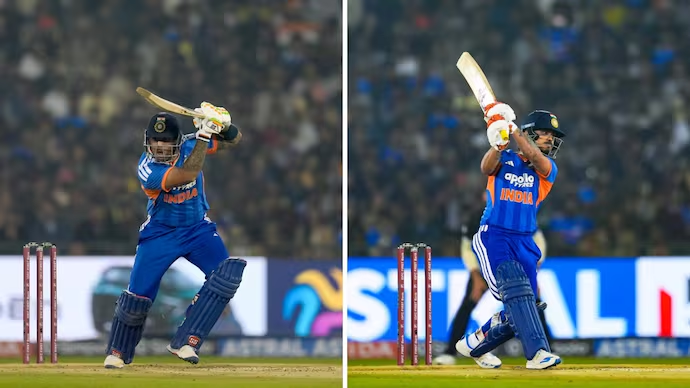
In a thrilling second Twenty20 international match played at the Shaheed Veer Narayan Singh International Stadium in Raipur, India delivered a masterful performance against New Zealand to secure a resounding seven-wicket victory and take a 2–0 lead in the five-match series, showcasing explosive batting, resilient strategy and team confidence that resonated throughout a high-scoring contest where key players delivered standout performances to turn the game decidedly in India’s favour.
New Zealand post competitive total but India’s chase overshadows opposition effort
The second game in the India-New Zealand T20I series began with New Zealand winning the toss and electing to bat first at Raipur, seeking to build on their formidable batting strength and set a challenging target for the Indian side. From the outset, the New Zealand batters displayed intent to score heavily, crafting a substantial total through disciplined hitting and calculated aggression. Early contributions were mixed but steadily built momentum as the innings progressed, with several batsmen making valuable scores that kept the scoreboard ticking at a brisk pace.
As the New Zealand innings matured, middle-order resilience emerged as a defining theme. Rachin Ravindra played a measured and effective innings, anchoring key phases and ensuring that momentum was maintained through purposeful stroke play. Mitchell Santner, known for his clever batting and tactical acumen, provided a late surge with an unbeaten cameo that accelerated the run rate and bolstered the total beyond the 200-run mark. Together, the partnership between Ravindra and Santner helped New Zealand achieve a competitive ending total of 208 for six in their allotted 20 overs, a score that demanded a high-quality response from the Indians.
The Indian bowling attack, led by a mix of seasoned campaigners and emerging talents, operated with focus and aggression. Bowlers varied their lines and lengths, seeking to disrupt the rhythm of New Zealand’s batters and create opportunities for breakthroughs. Although New Zealand reached a formidable score, the disciplined execution by Indian bowlers at crucial intervals prevented any single dominant partnership from inflicting the greatest damage, keeping the total within reach.
As New Zealand completed their innings, the target of 209 runs set a benchmark that reflected both the batting depth of the visitors and the escalating scoring rates that have defined modern T20 cricket. The Indian dressing room entered the interval with a clear challenge ahead: to chase down a demanding total against a New Zealand side that had shown both batting strength and tactical awareness.
India’s response began in an atmosphere filled with intensity and anticipation. From the first delivery of the chase, it was clear that the Indian batters were not merely chasing a target but asserting their intent to dominate the contest. Early setbacks came in rapid succession, however, as India lost two quick wickets in the opening overs, itself a testament to New Zealand’s bowling discipline under pressure. Sanju Samson, the wicketkeeper, fell cheaply in the early exchanges, followed by opener Abhishek Sharma departing without troubling the scoreboard, moments that could have altered the complexion of the chase.
The pressure of early dismissals, however, triggered the entrance of Ishan Kishan, whose approach combined fearless stroke play with astute timing. Kishan’s response was electric, and from his very first deliveries he sought to counterattack New Zealand’s bowlers. His innings was defined by power, precision and timing that drove the momentum squarely back toward India. With each boundary and maximum, Kishan infused the innings with renewed vigour, turning what could have become a nervous pursuit into a growing sense of control.
Parallel to Kishan’s ascendancy was the calm and calculated aggression of India’s captain, Suryakumar Yadav, who arrived at the crease determined to seize the initiative and guide the chase with authority. Suryakumar, known for his innovative shot selection and ability to capitalise on loose deliveries, began to build an innings that gradually eroded the required run rate while maintaining a healthy strike rate that kept pressure on the opposition.
The partnership between Kishan and Suryakumar became the defining phase of India’s chase. Their combined efforts took India from the brink of early instability to a commanding position where the target began to look surmountable well before the job was complete. While Kishan’s aggression set the tone, Suryakumar’s composed stroke play and strategic placement of shots ensured the partnership remained balanced and progressive. As they rotated the strike effectively and punished errors from the New Zealand bowlers, the required runs began to melt away with astonishing speed.
Shivam Dube provided crucial support toward the end of the chase, contributing with powerful hitting that added the finishing touches to India’s pursuit. With each partnership and calculated onslaught, India maintained the upper hand, eventually reaching the target of 209 runs in just 15.2 overs with seven wickets in hand. The match concluded as a statement of batting depth and execution precision, underscored by the ability to absorb early setbacks and respond with tactical brilliance.
Individual brilliance, team strategy and series implications
The standout aspect of the Indian innings was the remarkable performance by Ishan Kishan and Suryakumar Yadav, both of whom delivered innings of explosive quality and tactical clarity that elevated India’s chase from competitive to emphatic. Kishan’s innings was marked by an aggressive and fearless approach, showcasing his ability to dominate bowlers by finding boundaries with ease and sustaining momentum throughout his stay at the crease. His 76 runs off just 32 deliveries provided the foundation upon which the chase was built, and his performance resonated as one of precision and power born out of confidence and timing.
Suryakumar’s contribution was equally significant in anchoring the innings and steering India toward victory. His unbeaten 82 off 37 deliveries marked a triumphant return to form, breaking a long stretch without a half-century and reinforcing his reputation as one of India’s most adaptable and formidable T20 batters. His innings was a masterclass in paced aggression, where each shot reflected an understanding of both match situation and scoring opportunities. The synergy between his composed risk-taking and Kishan’s relentless aggression generated a partnership that proved too formidable for New Zealand to contain.
Beyond the individual performances, India’s team strategy reflected a comprehensive understanding of conditions, pacing and adaptability. The decision to bowl first after winning the toss allowed India to assess the pitch and apply pressure through disciplined bowling early in the New Zealand innings. Although the visitors managed to reach a significant total, India’s bowlers ensured the total remained within chaseable distance by preventing any single batter from dominating for an extended period.
In the field, India’s efforts were marked by athleticism and energy that complemented their batting display. Every catch, ground fielding effort and tactical placement in the field served to reinforce India’s commitment to collective excellence. The atmosphere at the stadium was electric throughout the match, as fans witnessed an enthralling contest that combined high scoring with moments of tension and exhilaration.
The result of this match not only secured a 2–0 lead for India in the five-match T20I series but also delivered a psychological edge as the visitors now faced increased pressure to respond in the upcoming fixtures. For New Zealand, the match was both a reminder of competitive depth and a prompt for strategic recalibration. Their initial batting performance demonstrated potential and resilience, but India’s response underscored the gap between setting competitive targets and successfully defending them against dynamic opposition batting.
The implications of this match also extend toward the broader context of T20 cricket, where aggressive batting, strategic partnerships and explosive scoring have become essential for success. India’s ability to chase down a 200-plus target with overs to spare speaks volumes about their evolving approach to the shortest format of the game, where adaptability, power-hitting and composure converge to produce match-winning innings that define contemporary cricket.
As the series progresses, both teams are likely to reflect on this encounter’s lessons. India, buoyed by confidence and momentum, will seek to maintain their intensity, while New Zealand will look to adjust their strategies and leverage their strengths to stem India’s dominance in the next matches. Fans and analysts alike will watch closely how each side responds to this high-stakes challenge, aware that the margin between victory and defeat in T20 cricket can hinge as much on psychological momentum as on technical execution.