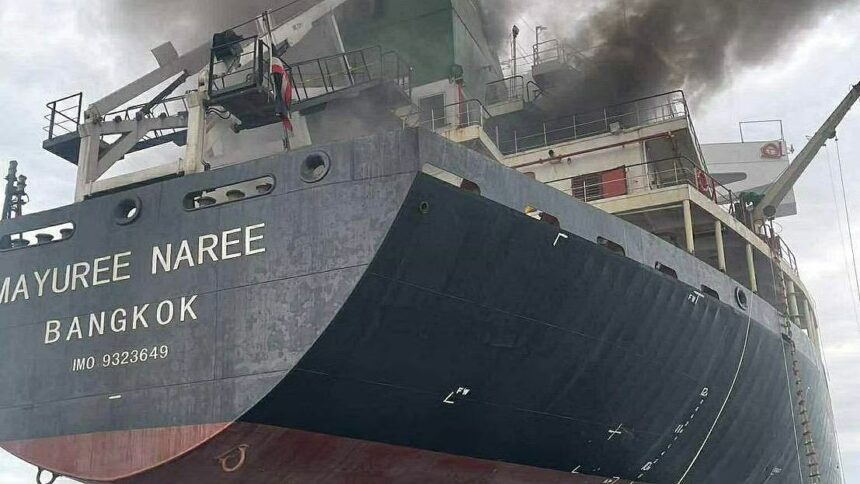
An India-bound Thai cargo vessel came under attack in the strategically vital Strait of Hormuz on Wednesday, raising fresh concerns about the safety of global maritime trade routes amid escalating tensions in the Middle East. The vessel, identified as Mayuree Naree, was struck by unidentified projectiles while navigating the narrow waterway, forcing an emergency rescue operation that has so far saved 20 crew members while three remain missing.
According to Thailand’s Transport Ministry and the Royal Thai Navy, the attack occurred shortly after the cargo ship departed from Khalifa Port in the United Arab Emirates and entered the Strait of Hormuz while sailing toward Kandla Port in Gujarat’s Kutch district. Maritime tracking data indicates the ship is a 178-metre-long freighter weighing approximately 30,000 tonnes, operating under the Thai flag.
Images released by the Royal Thai Navy showed thick black smoke rising from the vessel’s hull and superstructure shortly after the attack. Lifeboats and inflatable life rafts were seen drifting near the damaged cargo ship as emergency rescue operations began in the surrounding waters.
Rescue Operation Launched
The Royal Navy of Oman quickly intervened after receiving distress signals from the ship. Omani naval forces launched an emergency rescue mission and managed to recover 20 crew members from the waters, transporting them safely to nearby facilities.
Authorities confirmed that three crew members remain missing, and search operations are ongoing in the surrounding maritime area. Rescue teams are using patrol vessels, helicopters and surveillance equipment to locate the missing sailors.
Thailand’s Transport Ministry said the government is closely monitoring the situation and coordinating with regional authorities to ensure the safety of Thai nationals working aboard ships in the region.
In a statement, the Royal Thai Navy emphasized that it is maintaining continuous communication with rescue agencies and shipping companies operating near the Strait of Hormuz.
India Condemns Attack on Commercial Shipping
India strongly condemned the attack on the cargo ship, describing it as a dangerous escalation that threatens global trade and maritime safety.
India’s Ministry of External Affairs (MEA) released a statement expressing concern over the targeting of commercial vessels in the region. The ministry noted that such incidents have already claimed lives in earlier attacks during the ongoing conflict in West Asia.
The MEA emphasized that attacks on civilian shipping vessels and threats to crew members are unacceptable and must be avoided. It also stressed the importance of ensuring freedom of navigation and protecting international maritime commerce.
Indian officials added that the safety of global shipping routes is critical for the stability of international trade and energy supply chains.
Rising Tensions in the Region
The attack comes amid heightened tensions in the Middle East following the ongoing conflict involving Iran and several regional and international powers.
In recent days, multiple reports have emerged of missile strikes, drone attacks and military operations across the region. Maritime authorities have also reported attacks on commercial ships traveling through key shipping routes.
According to maritime security organizations, at least three vessels were struck by projectiles in or near the Strait of Hormuz on the same day, indicating that the attacks may be part of a broader escalation affecting international shipping lanes.
Security analysts warn that such incidents could significantly disrupt global trade if shipping companies begin avoiding the region due to safety concerns.
Importance of the Strait of Hormuz
The Strait of Hormuz is widely regarded as one of the most strategically important waterways in the world.
The narrow channel con
Impact on Global Energy and Trade
nects the Persian Gulf with the Arabian Sea, providing the main export route for oil-producing nations in the Middle East. The waterway is approximately 167 kilometres long, with the narrowest section measuring about 33 kilometres.
A designated shipping lane only three kilometres wide is used for inbound and outbound maritime traffic, making the route highly vulnerable to disruptions during geopolitical crises.
Approximately 20 percent of the world’s petroleum supply passes through the Strait of Hormuz every day, making it a critical artery for global energy markets.
Countries such as Saudi Arabia, Iraq, Kuwait, and Iran rely heavily on this route to export crude oil and petroleum products to international markets.
Any disruption in the Strait of Hormuz has immediate consequences for global energy prices and shipping routes.
Energy analysts note that between 17.8 million and 20.8 million barrels of crude oil and petroleum products pass through the strait daily. Even temporary disruptions can lead to volatility in oil prices and shipping costs.
Iran itself exports roughly 1.7 million barrels of oil per day through this route.
The waterway is also critical for non-oil trade. For India, more than 10 percent of total non-oil exports pass through this maritime corridor.
These exports include agricultural and industrial goods such as basmati rice, tea, spices, textiles and engineering products.
Risks to Global Shipping
The latest attack has renewed fears among shipping companies and international trade organizations that commercial vessels could become targets in the escalating regional conflict.
Maritime security experts say ships passing through the Strait of Hormuz may now face higher insurance premiums, additional security requirements and potential route diversions.
Some shipping companies are already reviewing alternative routes to avoid the region, although doing so would significantly increase travel time and transportation costs.
Global trade bodies have urged all parties involved in the conflict to avoid actions that could endanger civilian shipping and disrupt maritime commerce.
International Calls for De-escalation
Several countries and international organizations have called for restraint and dialogue to prevent further escalation.
Diplomatic efforts are underway to ensure that the Strait of Hormuz remains open and secure for commercial shipping.
Security experts warn that prolonged instability in the region could have far-reaching consequences for global trade, energy markets and economic stability.
For now, rescue operations continue near the damaged Thai cargo ship as authorities search for the remaining missing crew members and assess the broader implications of the attack.
The incident highlights the fragile security environment in one of the world’s most important maritime corridors and underscores the urgent need for diplomatic solutions to prevent further disruptions to global trade.