New Delhi, January 10, 2026
The Delhi Government has taken a landmark decision aimed at reshaping the capital’s higher education landscape by accelerating the development of Narela Education City as a world-class education and innovation hub. Announcing the move at a press conference on Saturday, Delhi’s Minister for Education Ashish Sood said the initiative would have a far-reaching impact on students, researchers, and the broader education ecosystem in the years to come.
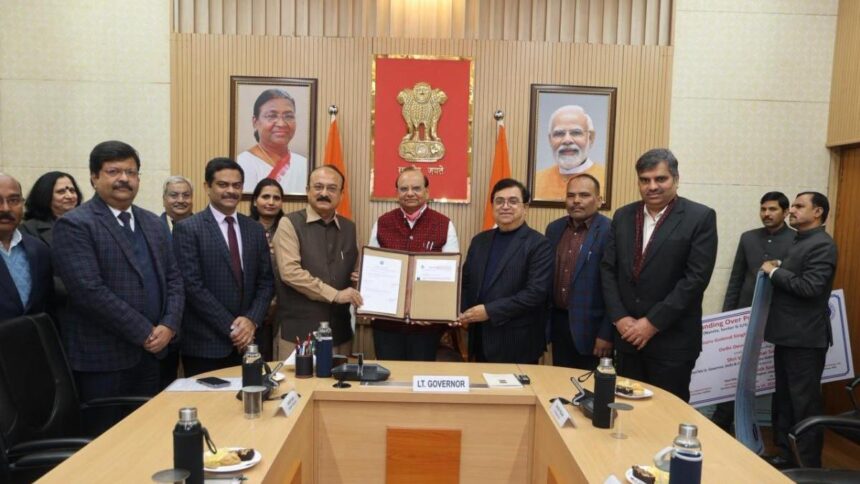
Sood said that under the leadership of Chief Minister Rekha Gupta, the Delhi Government is committed to building Narela Education City as a modern, globally competitive centre for education, research, and innovation. As a major step in this direction, possession letters for land parcels were formally handed over to Delhi Teachers University and Guru Gobind Singh Indraprastha University at Lok Niwas, in the presence of the Lieutenant Governor. Delhi Teachers University has been allotted approximately 12.69 acres of land, while Guru Gobind Singh Indraprastha University has received around 22.43 acres within the Narela Education City project area. According to the Education Minister, the handover of these possession letters will provide concrete momentum to the long-envisioned Education City project.
Highlighting the broader scope of the initiative, Sood said that Indira Gandhi Delhi Technical University for Women had earlier already been allotted 50 acres of land in Narela. With these allocations, the Delhi Government is now moving rapidly towards developing a world-class education and innovation hub spread over nearly 160 acres. He said the vision is to create an integrated academic ecosystem where universities, research institutions, and innovation centres function in close collaboration.
The Education Minister also underlined the financial commitment made by the Delhi Government to ensure the timely execution of the project. He said the government has expedited the payment process to the Delhi Development Authority for the allotted land. While the project initially carried a budgetary provision of ₹500 crore, the government has significantly enhanced the allocation to ₹1,300 crore in the recent budget, keeping long-term requirements and the future of the youth in mind. So far, approximately ₹462 crore has already been paid, and the remaining amount will be cleared within the current financial year, he added.
Sood emphasized that Narela Education City is not being conceived merely as a cluster of academic buildings. Instead, it will be developed on a shared campus model based on global best practices. The plan includes the creation of modern libraries, state-of-the-art laboratories, seminar halls, auditoriums, and advanced research and innovation facilities that can be jointly used by multiple institutions. This shared infrastructure approach, he said, would ensure optimal utilization of resources while enabling a larger number of students and researchers to directly benefit from world-class facilities.
In addition to academic infrastructure, the project also places strong emphasis on residential and support facilities. According to the Education Minister, residential accommodation in the form of LIG, MIG, HIG, and EWS flats will be developed for faculty and staff within the university campuses being established in Narela. Various universities have proposed investments amounting to approximately ₹567 crore for the construction of staff housing, student hostels, and other allied facilities. He said the Delhi Government is relying on scientific studies and guidance from international-level consultants to ensure that planning, design, and execution meet global standards.
Sood also drew attention to Narela’s growing strategic importance in terms of connectivity and urban development. He said work on the Rithala–Narela Metro Corridor is currently in progress, which is expected to significantly enhance connectivity between Narela and the rest of the city. Improved transport links, combined with the establishment of major educational institutions, are likely to give a new dimension to the development of surrounding areas. The Education Minister said the project would also generate large-scale direct and indirect employment opportunities, including teaching and non-teaching jobs, hostel and campus services, and growth in allied sectors.
Reflecting on the government’s overall performance in the education sector, Sood said that within a short tenure of just 11 months, the Delhi Government has taken concrete and transformative steps not only in school education but also in higher and technical education. He stressed that these changes are not limited to policy announcements or promotional campaigns, but are already visible on the ground through infrastructure development, institutional expansion, and increased investment.
The Education Minister also highlighted parallel efforts to promote innovation and entrepreneurship among the youth. He said the Startup Youth Festival commenced in Delhi on January 9, with participation from more than 750 startups. A dialogue session involving the Chief Minister and senior industry experts has also been proposed for January 14. These initiatives, he said, reflect the Delhi Government’s broader commitment to nurturing a strong, modern, and future-ready education and innovation ecosystem for the Amrit Peedhi in the Amrit Kaal.
Sood concluded by reiterating that the development of Narela Education City represents a long-term investment in human capital and knowledge infrastructure, aimed at positioning Delhi as a leading global destination for education, research, and innovation.