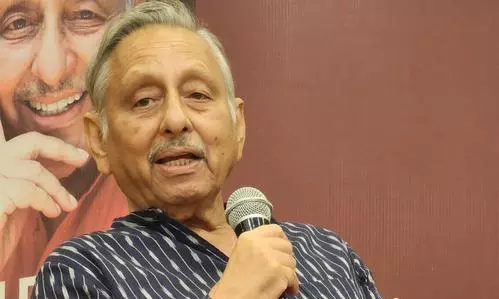
A sharp political confrontation has erupted in New Delhi after senior Congress leader Mani Shankar Aiyar called for an immediate halt to Operation Sindoor and urged the government to resume talks with Pakistan, triggering strong reactions from the Bharatiya Janata Party and mixed responses from leaders across the political spectrum.
The controversy began after a video surfaced of Mani Shankar Aiyar making the remarks during an interview, where he argued that continued military operations would not resolve long-standing tensions between India and Pakistan. According to Aiyar, New Delhi should stop Operation Sindoor without delay and return to diplomatic engagement, suggesting that dialogue remained the only sustainable path forward in managing relations between the two nuclear-armed neighbours.
His comments immediately drew sharp criticism from the BJP, which accused the Congress of undermining national security and demoralising the armed forces. The exchange has once again highlighted deep political divisions over how India should respond to terrorism and cross-border tensions, particularly in the aftermath of recent security operations.
Bjp Attacks Congress As Opposition Defends And Distances Itself
Responding to Aiyar’s remarks, BJP spokesperson Shahzad Poonawalla launched a scathing attack on the Congress, branding it the “Islamabad National Congress.” He accused the party of repeatedly offering what he described as a clean chit to Pakistan and failing to support decisive action against terrorism. According to Poonawalla, such statements weaken India’s position internationally and send the wrong message to both adversaries and allies.
Poonawalla alleged that senior Congress leaders had a history of questioning military operations, referring to earlier comments by Rahul Gandhi on surgical strikes and criticism of Operation Sindoor. He claimed that Aiyar’s latest remarks were part of a broader pattern influenced by the Congress leadership, which, he said, consistently questioned the legitimacy and effectiveness of India’s security actions.
The BJP spokesperson further argued that under the current government led by Narendra Modi, India had adopted a firm stance against terrorism and would not hesitate to respond strongly if provoked. Any call to scale back operations, he said, amounted to undermining the sacrifices of the armed forces.
BJP MP Yogendra Chandolia also weighed in, questioning Aiyar’s authority to comment on national security matters. He pointed to the period when the Congress was in power, asking how many terror incidents occurred during those years and accusing the party of being soft on terrorism. Chandolia said that under the present government, Pakistan would be dealt with firmly if it crossed red lines, leaving no room for ambiguity.
While the BJP maintained a united front in its criticism, reactions from opposition parties were more nuanced. Samajwadi Party spokesperson Fakhrul Hasan Chand suggested that calls for dialogue were not unprecedented, noting that several countries had advocated easing tensions between India and Pakistan following Operation Sindoor. He questioned the consistency of policy, pointing out that while the government had asserted that blood and water could not flow together, sporting engagements like cricket matches continued between the two countries.
From the Rashtriya Janata Dal, spokesperson Mrityunjay Tiwari took a more restrained position, stating that decisions on national interest and foreign policy lay solely with the government of the day. He argued that while individuals were free to express opinions, managing relations with Pakistan was an internal matter of the Union government and should be handled institutionally rather than through public debates.
The Communist Party of India (Marxist) offered a contrasting response, with leader Hannan Mollah defending Aiyar’s right to express his views. He described the remarks as a reasonable opinion and said that in a democracy, diverse perspectives should be allowed. According to him, if the public found merit in the argument, it would gain acceptance; if not, it would be rejected.
Aiyar’s Record Of Controversial Remarks And The Broader Debate
The latest statement has also brought renewed attention to Mani Shankar Aiyar’s long record of controversial comments on domestic and foreign policy issues. Over the years, his outspoken views have frequently placed the Congress on the defensive, particularly on matters involving national security and India’s relations with neighbouring countries.
In August 2025, Aiyar had questioned India’s global outreach following the Pahalgam attack, claiming that despite efforts to expose Pakistan’s alleged role, the international community remained unconvinced. He said that even institutions like the United Nations and the United States had not explicitly held Pakistan responsible, arguing that India had failed to present evidence compelling enough to sway global opinion. Those remarks had drawn criticism from within and outside his party, with many accusing him of weakening India’s diplomatic stance.
Earlier in March 2025, Aiyar had stirred controversy by questioning the educational background of former Prime Minister Rajiv Gandhi. In an interview, he remarked on Gandhi’s academic record and expressed surprise at how someone with such credentials became Prime Minister. The comments had sparked outrage among Congress supporters and reignited debates over internal dissent and discipline within the party.
In January 2025, Aiyar had also made headlines by suggesting that former Bangladeshi Prime Minister Sheikh Hasina should be allowed to stay in India indefinitely. Praising her contributions to India-Bangladesh relations, he said that India should be willing to host her for life if needed. While some viewed the statement as humanitarian, others criticised it as an overreach into sensitive diplomatic territory.
Against this backdrop, Aiyar’s call to stop Operation Sindoor fits into a broader pattern of advocating dialogue and restraint in foreign policy. Supporters argue that his views reflect a long-standing belief in diplomacy as a tool to resolve conflicts, while critics see them as disconnected from current security realities and public sentiment.
Operation Sindoor itself has become a focal point of political debate, symbolising the government’s assertive approach towards Pakistan in response to terrorism. For the BJP, the operation represents decisive leadership and a break from what it portrays as the Congress era’s perceived indecisiveness. For critics, including Aiyar, it raises questions about escalation, international perception, and the long-term effectiveness of military responses.
The clash over Aiyar’s remarks underscores how national security has become one of the most polarising issues in Indian politics. Statements by individual leaders often trigger broader battles over patriotism, responsibility, and the limits of dissent. In this case, the BJP has sought to frame the Congress as sympathetic to Pakistan, while opposition voices have attempted to balance criticism with calls for democratic debate.
As the political storm continues, the episode highlights the enduring tension between hardline security policies and diplomatic engagement in India’s approach to Pakistan. It also reflects the challenges faced by political parties in managing internal diversity of opinion, especially when senior leaders speak out on sensitive issues that resonate strongly with public emotions.