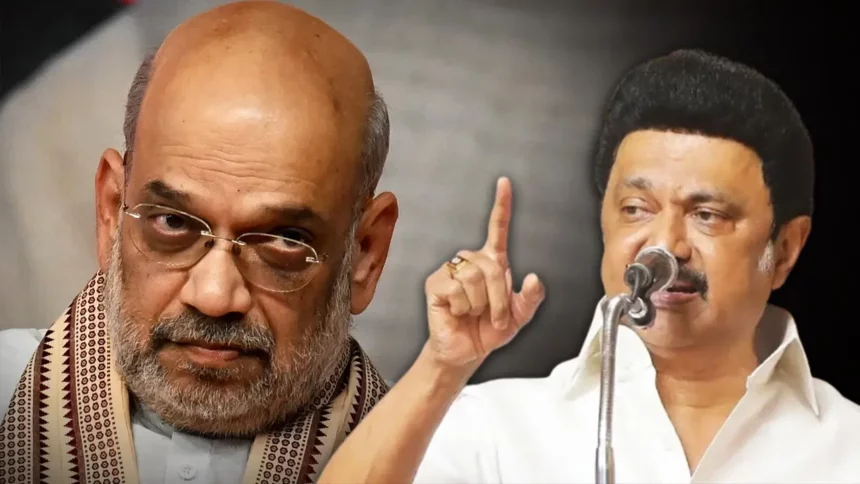
The debate over Hindi’s role in Tamil Nadu has once again intensified, with the state and central governments locking horns over language policies. Over the past few days, several political parties and leaders in Tamil Nadu have accused the central government of attempting to impose Hindi in the state through the National Education Policy. Tamil Nadu Chief Minister M. K. Stalin has taken an uncompromising stance on the issue, repeatedly voicing his opposition to Hindi at various public platforms. In his latest remarks, he compared the central government’s approach to an LKG student lecturing a PhD holder, emphasizing his belief that Tamil Nadu’s education system is far superior to what is being promoted under the policy.
Union Home Minister Amit Shah has now countered these allegations, dismissing M. K. Stalin’s claims while highlighting the central government’s efforts to promote regional languages. Speaking at the 56th Raising Day ceremony of the Central Industrial Security Force in Thakkolam, near Ranipet, he asserted that the Tamil Nadu government had failed to take adequate steps for the development of the Tamil language. He further stressed that the Narendra Modi-led central government has introduced major reforms in recruitment policies to support regional languages, making them a part of national-level examinations.
Amit Shah explained that, until recently, there was no provision for mother tongue-based exams in Central Armed Police Forces recruitment, but Prime Minister Narendra Modi has now ensured that candidates can appear for these exams in all languages listed in the Eighth Schedule of the Indian Constitution, including Tamil. He urged M. K. Stalin to take similar steps and facilitate the introduction of medical and engineering courses in Tamil to further strengthen the language in professional education.
M. K. Stalin had earlier accused the central government of attempting to enforce Hindi through the National Education Policy, claiming that Tamil Nadu had already achieved the educational benchmarks that the central policy aims to reach by 2030. He argued that Dravidian ideology does not take directives from Delhi but instead sets a path for the nation to follow, reflecting his party’s strong opposition to any perceived imposition of Hindi.
In a significant move, Amit Shah also announced that the Central Industrial Security Force training center at Thakkolam would be renamed after the great Chola warrior Rajaditya Chola, honoring Tamil Nadu’s rich heritage. He emphasized that Tamil culture and traditions are an integral part of India’s broader cultural identity and paid tribute to Rajaditya Chola, acknowledging his valor and contributions to the Chola dynasty’s legacy. This move is seen as an effort by the central government to strengthen its connection with Tamil sentiments amid the ongoing language controversy.