New Delhi, December 2025
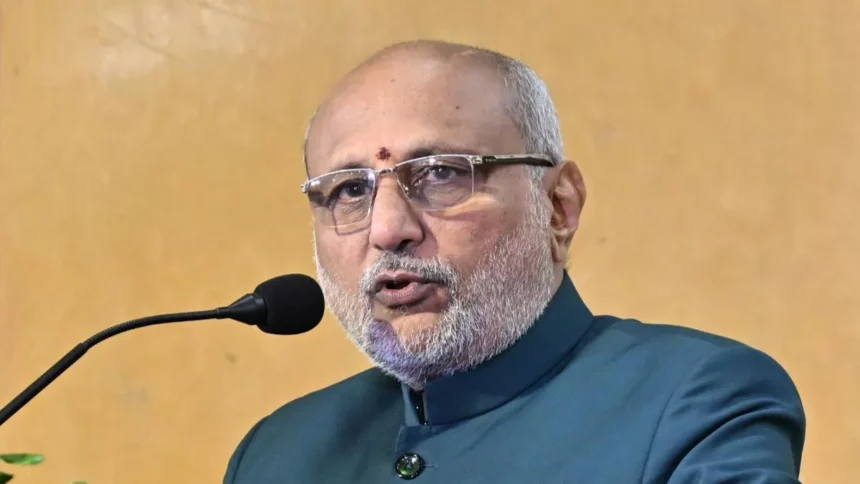
With the gracious presence of the Hon’ble Vice President of India, C. P. Radhakrishnan, Guru Gobind Singh Indraprastha University (GGSIPU) organised its flagship National Conclave on “AI Evolution – The Maha Kumbh of AI” at the Dr. Ambedkar International Centre, Janpath, New Delhi.
On the occasion, the Hon’ble Education Minister, Ashish Sood, highlighted that today’s generation is at a civilisational crossroads where Artificial Intelligence (AI) is emerging as a transformative force reshaping education, governance, and decision-making. He emphasised that technology alone does not guarantee progress; it is the values with which it is deployed that determine whether it leads to empowerment or exclusion. He stated, “Education is about liberation—from ignorance, inequality, poverty, and limited aspirations. That is why AI in evaluation is critical. Evaluation shapes behaviour, influencing what learners prioritise, what teachers emphasise, and what institutions reward.”
Sood noted that GGSIPU has already demonstrated foresight by exploring Large Language Model (LLM)-based academic tools to support curriculum design, research assistance, multilingual content creation, and formative assessment, while maintaining academic integrity and human oversight. He explained that today’s focus on AI evaluation is a continuation of the University’s engagement with advanced AI systems rather than a new departure.
He further elaborated that AI has the potential to make assessment more diagnostic, adaptive, transparent, and humane, transforming the educational landscape. Referring to Hon’ble Prime Minister Narendra Modi’s vision of “Double AI”—Artificial Intelligence and Aspirational India—he said the combination of technology and aspiration can serve as a powerful multiplier for national transformation.
For Delhi, Sood clarified, AI is not about mechanising classrooms or replacing educators but about strengthening the human purpose of education. By automating repetitive tasks, data processing, and administrative duties, AI allows teachers to mentor, guide, inspire, and nurture curiosity. “Our approach is clear: AI must empower learners, strengthen teachers, and improve learning outcomes, particularly for students left behind by traditional systems. India and Delhi are committed to AI for All,” he asserted.
Sood highlighted global evidence showing that AI-enabled personalised learning improves outcomes, especially for students struggling in conventional classrooms. He discussed the Delhi Government’s initiatives under the Vidya Samiksha Kendra, leveraging AI for early diagnostics, real-time interventions, and customised learning support tailored to each child’s pace and context. AI-powered education dashboards are also being developed to monitor learning outcomes.
In addition, GGSIPU has launched AI Grind India, a city-centric AI innovation initiative engaging students from Class 6 to higher education to develop solutions for civic challenges. The initiative aims to reach nearly five lakh children, fostering discussion on AI-driven problem-solving at home and cultivating a new generation of AI Youth Ambassadors.
Addressing concerns over employment displacement due to AI, Sood recalled student protests during the introduction of computers, highlighting how technology, despite initial apprehensions, transformed lives. He emphasised that ethical, constructive, and governance-oriented use of AI remains a priority, guided by Hon’ble Prime Minister Narendra Modi and Chief Minister Rekha Gupta.
He concluded that through initiatives engaging students and families in addressing urban challenges such as pollution, traffic, and inclusive education, the government aims to foster an ethical, inclusive, and empowering AI-driven future.
This conclave underscores India’s commitment to harnessing AI responsibly in education, combining technological innovation with ethical governance and social empowerment.