New Delhi, January 2, 2026:
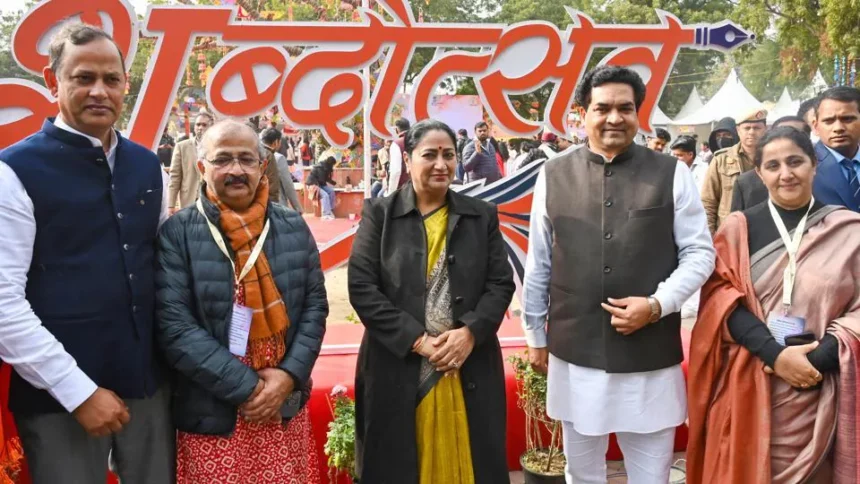
Delhi witnessed the grand inauguration of its biggest three-day cultural festival, ‘Delhi Shabdotsav 2026’, at Major Dhyan Chand Stadium near India Gate on Thursday. The festival, scheduled from January 2 to January 4, was inaugurated with the ceremonial lighting of the lamp by Delhi Chief Minister Rekha Gupta. The inauguration ceremony was attended by Union Minister of State Harsh Malhotra, Delhi Government Minister for Art, Culture, Language and Tourism Kapil Mishra, Art Secretary K. Mahesh, RSS Akhil Bharatiya Prachar Pramukh Sunil Ambekar, Rajeev Tuli of Suruchi Publications and Harshvardhan Tripathi. Thousands of literature lovers, youth, students, scholars and citizens were present on the occasion, marking a strong public response to the cultural initiative.
Addressing the gathering, Chief Minister Rekha Gupta said that Delhi Shabdotsav reflects India’s continuous dialogue with its past, present and future. She stated that from the Vedic era to the digital age, India’s long civilizational journey finds a living expression through this festival. According to her, such a large-scale and comprehensive cultural event has never before been organised from a government platform in Delhi.
The Chief Minister said that India has faced several invasions and repeated attacks on its civilization, culture and education over centuries, yet it has always rebuilt itself due to the strength of its roots. Emphasising that India has never bowed down and never will, she said that times may change, but the soul of India remains eternal. Based on the theme ‘Bharat Abhyudaya’, Delhi Shabdotsav reflects a future-oriented India that is firmly grounded in its civilizational values.
Rekha Gupta underlined that the biggest challenge of the present era is maintaining a balance between modernity and values. She said that while science and technology are essential, culture and values must hold equal importance. She described the festival as an answer for parents who are concerned about connecting their children with Indian culture amid rapidly changing modern lifestyles.
Calling Delhi a living example of ‘Ek Bharat, Shreshtha Bharat’, the Chief Minister highlighted that over the past ten months, the Delhi Government has celebrated festivals like Chhath, Ganesh Chaturthi, Dandiya, Kanwar Yatra, Diwali, Durga Puja and several state festivals with the same authenticity as they are celebrated in their native regions. She recalled that for the first time, Diwali was celebrated at Kartavya Path by lighting 1.25 lakh lamps, uniting the entire city through hymns in praise of Lord Ram.
She informed that Delhi Shabdotsav will witness the release of 40 books, along with classical dance performances, bhajans, music programmes, poets’ conferences, open mic sessions and ideological discussions. These activities, she said, will strengthen democratic awareness and cultural consciousness. Expressing concern over the growing disconnect from cultural roots, she remarked that when Indians speak ill of the country abroad, it reflects a lack of cultural grounding. Referring to The Kerala Story book, she said that stronger cultural awareness could have prevented many lives from going astray.
The Chief Minister stated that India is emerging as a global economic, political, strategic and cultural power, and in this journey, heritage must progress alongside development. She announced that although this is the first edition of Delhi Shabdotsav, it will be organised every year on an even grander scale.
Union Minister of State Harsh Malhotra said that the association of Sunil Ambekar with the festival has given it special dignity. He praised Chief Minister Rekha Gupta for her sensitive and proactive approach to governance and said that Shabdotsav goes far beyond books and literature. After visiting the venue, he said, it became evident that the festival is a vibrant display of India’s ancient and rich cultural heritage. Drawing references to Nalanda and Takshashila, he said that India had been a Vishwaguru thousands of years ago as well. He stressed that education without values is incomplete and said that festivals like Shabdotsav play a vital role in connecting youth with Indian culture.
Minister for Art, Culture, Language and Tourism Kapil Mishra said that the presence of Sunil Ambekar as the chair of the festival has added immense prestige. He stated that art and culture in Delhi were earlier either neglected or diverted in anti-cultural directions, but Chief Minister Rekha Gupta’s vision has reversed this trend. He said that the grand celebration of Chhath, Diwali at Kartavya Path, Kanwar Yatra, Teej, Navratri at Delhi University, Garba, Dandiya and now the country’s biggest Shabdotsav are all outcomes of the government’s cultural vision to establish Delhi as India’s cultural capital.
Kapil Mishra asserted that Shabdotsav is not an ordinary literary festival. He said that violence, terrorism and extremism are born in the mind before manifesting physically, and ideological terrorism is the root cause of such threats. According to him, Delhi Shabdotsav is a cultural and ideological response to this challenge. He informed that the festival features over 100 speakers, the release of more than 40 books and participation from over 50 colleges and universities. Around 60,000 registrations have already been recorded on BookMyShow. Poets’ conferences, cultural programmes, youth forums, publication stalls and food courts together make the event a comprehensive cultural experience.
During the programme, Chief Minister Rekha Gupta, along with Harsh Malhotra, Kapil Mishra, Social Welfare Minister Ravindra Indraj Singh, K. Mahesh, Rajeev Tuli and Harshvardhan Tripathi, visited various publication and creative stalls. The large-scale participation of people has firmly established Delhi Shabdotsav 2026 as a landmark cultural and ideological festival in the capital.