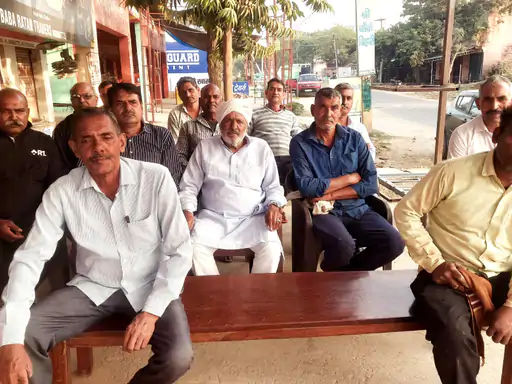
A fresh wave of tension surfaced in Greater Noida’s Bhattā village on Friday as local farmers forcefully opposed a proposed Satyagraha movement announced by farmer leader Manveer Teotia. The villagers, many of whom were part of earlier land rights protests, publicly stated that they no longer wished to participate in any agitation that could disrupt the region’s fragile peace or obstruct the ongoing development work. With this rejection, a clear divide has emerged within the farming community, reflecting shifting priorities, changing economic realities, and a growing fatigue toward prolonged confrontations with authorities.
Farmers Express Strong Disapproval of New Agitation Plans
The announcement of a new Satyagraha, made earlier this week by farmer leader Manveer Teotia, was expected to draw support from multiple villages of the Yamuna Expressway Industrial Development Authority (YEIDA) region. Teotia had alleged that many issues regarding compensation, land acquisition transparency, and rehabilitation packages remained unresolved even after years of negotiations. He declared that the “struggle must continue” until all farmers received what he called “fair justice and rightful compensation.”
However, the situation took an unexpected turn when Bhattā village—historically one of the strongholds of farmer mobilization—issued a collective statement through its elders, panchayat members, and women representatives, clearly rejecting the proposed movement. According to local accounts, villagers held an extended internal meeting that lasted several hours before finalizing their stance. During the meeting, a significant majority of participants argued that the earlier protests had already caused considerable emotional stress, financial loss, and tension within families.
Many farmers also voiced that the region had witnessed relative economic improvement in recent years due to increased development activity, infrastructure expansion, and rising land value. They expressed concern that any new agitation might jeopardize the opportunities that had begun opening for youths and local businesses.
In a detailed briefing following the internal meeting, senior villager Rajendra Bhati stated, “Our village has always stood united in the interest of our farmers. But today, circumstances have changed. The younger generation is working in new jobs, small industries have begun to grow, and families want stability. We cannot return to the confrontational path every few months.”
Several women in the village supported this sentiment, noting that the previous protests led to disruptions in education, delay in social functions, and increased police presence in the area. One resident, Sunita Devi, said that although farmers still had grievances, the path of agitation was not the answer anymore. She emphasized that discussions and negotiations must replace prolonged street demonstrations.
The farmers also questioned the timing of the proposed Satyagraha. Many villagers felt that raising the issue during ongoing development projects—particularly ahead of new YEIDA industrial allotments and road improvement phases—would unnecessarily strain relations between villagers and authorities. Some residents also pointed to the district administration’s recent assurances regarding re-assessment of pending compensation cases, stressing that they wished to wait for official communication before considering any protest activity.
Teotia Faces Internal Dissent as Elders Accuse Him of Politicizing Farmer Issues
Following the public rejection from Bhattā villagers, several other neighboring villages also began debating their participation in the proposed agitation. While some still expressed solidarity with Teotia, the larger sentiment indicated a growing skepticism toward repeated mobilization efforts under the same leadership.
A group of senior citizens from the region accused Teotia of turning farmer issues into a personal political platform rather than focusing on collective community benefit. They cited past instances where protests escalated into unnecessary confrontations that resulted in police cases, arrests, and economic setbacks for ordinary farmers while leaders “remained untouched.”
In a strongly worded statement, a former panchayat pradhan remarked, “Movements cannot be launched every time a leader wants to remain visible or politically relevant. The farmers have suffered enough. We want stability, not continuous disturbance.”
Some farmers also raised concerns about financial transparency behind earlier protests. They questioned how funds were collected and distributed, alleging that there had never been a public audit of contributions made by villagers. Although these concerns were not formally documented, they added to the growing distrust surrounding new agitation calls.
Adding to the internal tensions, a section of youth from Bhattā village expressed the view that today’s farmer issues require modern negotiation methods such as digital petitions, data-based advocacy, and structured engagement with local authorities rather than long, indefinite Satyagraha movements. They argued that such movements often create a narrative of confrontation rather than collaboration, which ultimately weakens bargaining power.
Some young residents also pointed out that several demands—such as better educational opportunities, improved housing facilities under YEIDA policies, and more government-run skill development programs—could be pursued through administrative channels rather than through street-level protests. They argued that the region’s future depended on balancing agrarian concerns with industrial employment opportunities that were gradually emerging.
Meanwhile, Teotia dismissed the allegations and maintained that the proposed Satyagraha was intended purely to address unresolved farmer grievances. He insisted that many compensation claims from the original land acquisition phase still needed rectification and argued that the farming community had the right to demand fairness even if some villagers disagreed. However, his statement did not appear to strengthen his position among those who had already made up their minds.
A fresh update from late evening suggests that Teotia has requested a dialogue with Bhattā village elders to understand their concerns. Sources close to the meeting preparation indicate that he now intends to propose a scaled-down version of the movement—one that focuses on symbolic demonstrations instead of prolonged sit-ins or road blockades. Whether this revised approach will receive any support remains uncertain.
Further updates from YEIDA officers reveal that the administration has taken note of the internal disagreements within the farmer community. Officials have reportedly begun compiling a list of pending compensation files to expedite certain cases, potentially to diffuse the growing divide.
Local police authorities have also increased their vigilance to ensure that no external elements attempt to exploit the situation by creating unnecessary tension or misinformation within the villages.
With several communities in the region now re-evaluating their participation, Teotia faces the most significant internal opposition to his leadership in recent years. Farmers, meanwhile, continue to debate the path forward—balancing long-standing grievances against new economic opportunities that the region is beginning to witness.