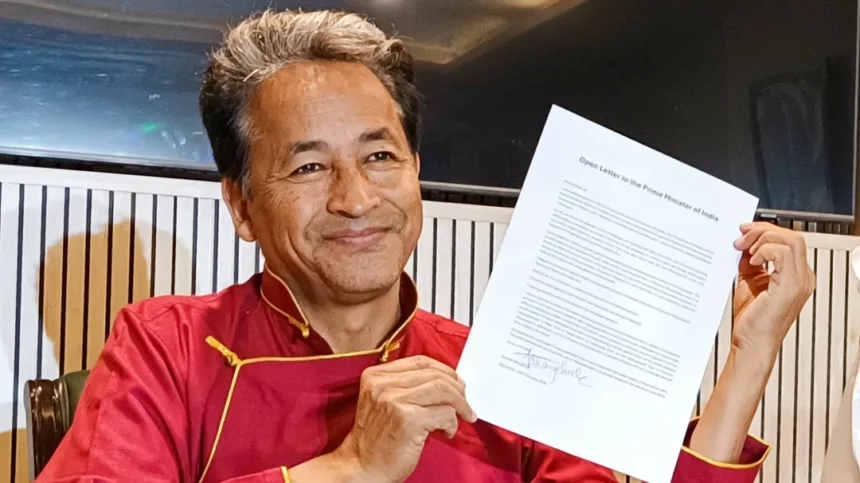
The recent arrest of activist Sonam Wangchuk in Ladakh has reignited debates across the nation about the boundaries between activism and national security. Exclusive sources from the government have described his actions as a deliberate challenge to state authority in a region of critical strategic importance. According to officials, the arrest was “absolutely right and was required to know the sudden reason of this aggression before talks,” framing Wangchuk’s protests as a destabilising force due to his activities, foreign funding, and the region’s proximity to the sensitive China border. Delhi views his activism through a strict national security lens, asserting that Wangchuk’s rhetoric has actively encouraged street agitation over constructive dialogue, thereby raising severe red flags in a territory where absolute control is prioritised.
Wangchuk’s activism and the escalation of unrest
Government sources argue that Wangchuk’s actions were not merely expressions of peaceful dissent but were instead linked to international movements, including the Arab Spring and Nepal’s Gen Z uprisings. His references to these movements are interpreted as explicit blueprints for mass unrest, with authorities warning that such framing encourages public agitation rather than measured, lawful dialogue. While Wangchuk had positioned his fast as Gandhian and nonviolent, officials hold that his rhetoric directly contributed to escalating tensions, which resulted in four reported deaths, incidents of arson, and attacks on state buildings. By this account, his public persona as a peaceful reformist was undermined by the real-world consequences of his agitation.
Officials have further highlighted that the government’s actions against Wangchuk’s organisations, including the cancellation of SECMOL’s FCRA licence and the initiation of a CBI investigation, were “not without reasons.” These steps are tied to scrutiny over foreign funding and potential violations of regulatory norms. For authorities, these measures represent necessary steps to ensure that foreign funds are not being channelled in ways that could compromise India’s security or exacerbate tensions in border regions. In particular, Wangchuk’s opposition to infrastructure projects—ranging from roads and industrial corridors to Army-linked facilities—is seen as weakening India’s preparedness against potential threats from China. The government maintains that such positions place him in direct conflict with national security priorities at a time when strategic vigilance is essential.
Officials also point to the potential for unrest in Leh to be interpreted as broader instability by adversaries. Any prolonged disturbance in India’s northernmost region, which serves as a frontline against Chinese activities, carries the risk of being exploited for geopolitical leverage. Government sources emphasise that the stakes in Ladakh are unique; disruptions in this area do not merely have local implications but may influence the strategic calculations of neighbouring powers and international observers alike.
Shift in local sentiment and accusations of “fake activism”
Adding weight to the government’s stance is a reported change in local sentiment toward Wangchuk. Sources indicate that many residents are beginning to accuse him of dividing communities, stalling job creation, and radicalising young people rather than advancing legitimate regional concerns. According to officials, this mounting local anger over what is described as “fake activism” strengthens the argument that Wangchuk’s motivations are rooted more in personal grievances than in the broader cause of Ladakh’s development. His credibility as a reformist is questioned, with authorities suggesting that his activism, while framed in terms of environmental or civic concern, is increasingly being perceived as counterproductive to both local stability and national interests.
Officials argue that Wangchuk’s high-profile campaigns against infrastructure and development projects have wider implications beyond immediate protests. The government frames his resistance as weakening India’s strategic posture along a sensitive border, with potential ramifications for national security. By opposing facilities that support both civilian development and military readiness, Wangchuk is portrayed as inadvertently—or deliberately—challenging state priorities in a theatre where vigilance is paramount.
The intersection of local discontent, foreign funding scrutiny, and strategic vulnerability has, according to sources, made the state’s intervention unavoidable. Officials maintain that measures such as the arrest and financial investigation are part of a comprehensive approach to prevent further escalation. By acting decisively, authorities seek to curtail any opportunity for unrest to gain momentum or for external actors to exploit domestic agitation in the border region.
In this context, government sources insist that Ladakh’s residents must be protected from influences that could jeopardise both peace and security. The portrayal of Wangchuk’s activities as “personal loss masquerading as reform” underscores the state’s argument that activism cannot come at the expense of stability in such a strategically vital area. Delhi’s approach, as articulated by sources, combines legal accountability, regulatory oversight, and a focus on national security imperatives. This strategy, they argue, is essential to ensure that protests and activism in Ladakh do not become platforms for broader instability or foreign exploitation.