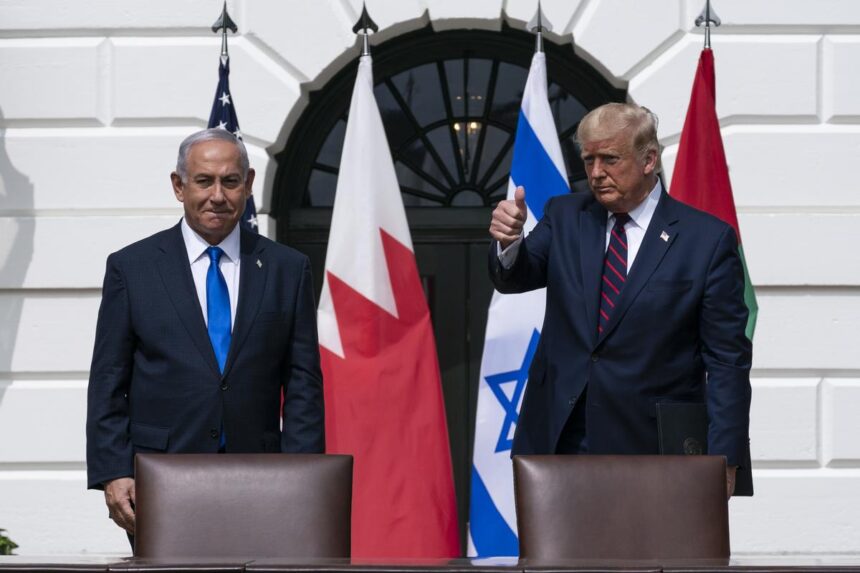
US President Donald Trump has announced that a breakthrough in the ongoing Gaza conflict is imminent, claiming that negotiators are close to finalising an agreement that would secure the release of hostages and bring an end to the prolonged war. Speaking to reporters, Trump expressed optimism that the deal would achieve both humanitarian and strategic objectives. “It’s looking like we have a deal on Gaza… I think it’s a deal that will get the hostages back. It’s going to be a deal that will end the war… It’s going to be peace,” the President said. His remarks come as global attention intensifies on the conflict, which has now spanned nearly two years and has seen Israeli forces push deep into Gaza City, considered by Israel as the “last stronghold of Hamas.”
Trump’s diplomatic push and the promise of peace
President Trump’s statements underscore Washington’s ongoing efforts to mediate between Israel and Palestinian authorities amid mounting civilian casualties and geopolitical tensions. Trump’s focus on hostage recovery is particularly significant, as families of those detained in Gaza have consistently called for international intervention. The US administration has been engaged in shuttle diplomacy, coordinating with regional players and leveraging contacts within Israel and Palestinian leadership to facilitate negotiations. According to Trump, the imminent agreement is designed to ensure both the safe return of hostages and a cessation of hostilities, framing it as a critical step toward restoring stability in the region.
The broader diplomatic context includes coordination with other international stakeholders, including Egypt, Qatar, and the United Nations, which have acted as intermediaries in prior ceasefire discussions. Trump’s comments suggest that these backchannel negotiations have reached a critical stage, with key logistical and security provisions reportedly finalised. While specific details of the agreement remain confidential, the administration has emphasised the dual objectives of humanitarian relief and long-term security, highlighting the release of hostages as a non-negotiable priority. Analysts suggest that such a deal, if successful, would mark a rare instance of high-level diplomacy resolving a deeply entrenched conflict that has eluded previous mediation efforts.
Trump’s pronouncements have also come at a time when the US faces domestic and international scrutiny over its handling of the conflict. Critics argue that while diplomatic initiatives are crucial, the scale of civilian suffering in Gaza necessitates immediate humanitarian intervention alongside political negotiations. The President’s insistence that a peace deal is near reflects a strategic effort to balance the urgency of humanitarian concerns with the political imperative of ending hostilities.
Netanyahu’s UN address and the broader conflict dynamics
Coinciding with Trump’s remarks, Israeli Prime Minister Benjamin Netanyahu delivered a fiery address to the United Nations General Assembly, highlighting the security threats facing Israel and the wider region. His speech was marked by disruption, as dozens of delegates walked out in protest, underscoring the contentious nature of the ongoing conflict. Netanyahu accused Iran of orchestrating a “terror axis” that includes the Houthis, Hezbollah, and Hamas, asserting that Israel has successfully targeted leaders of these groups in ongoing military operations. He also directly addressed hostages held in Gaza, symbolically pointing to a QR code on his lapel to signify the government’s determination to continue the fight and secure their release.
Netanyahu’s address combined rhetoric aimed at reassuring domestic audiences with messaging directed at the international community. He emphasised that Iran’s support for militant groups posed a threat not only to Israel but to global stability. “The families of our hostages languishing in Gaza… Iran’s terror axis threatens the peace of the entire world, the stability of our region, and the very existence of my country, Israel,” Netanyahu declared. This framing situates the Gaza conflict within a broader geopolitical narrative, portraying Israel’s military actions as defensive and preventive in nature.
The Prime Minister also addressed criticisms regarding civilian casualties, asserting that Israel has made concerted efforts to minimize harm to non-combatants. He noted that the Israeli military had dropped “millions of leaflets” urging Gaza’s population to evacuate targeted areas. This position stands in stark contrast to recent United Nations reports accusing Israel of committing acts that could constitute genocide. Netanyahu further condemned international moves to recognise a Palestinian state by the United Kingdom and France, describing such decisions as “sheer madness” that ignore the security imperatives facing Israel.
The humanitarian toll of the conflict is staggering. According to Gaza’s Hamas-run health ministry, the death toll since October 7, 2023, has reached 65,502. The prolonged nature of the fighting, combined with airstrikes, ground operations, and blockades, has severely affected civilian infrastructure, healthcare access, and basic living conditions. International observers continue to express concern over the escalating humanitarian crisis, calling for immediate measures to protect non-combatants and facilitate the delivery of aid.
Netanyahu’s speech also underscored Israel’s broader strategic calculus, framing military operations as a means to dismantle the operational capabilities of militant groups in Gaza. While domestic political considerations influence the timing and rhetoric of his address, the broader message emphasises Israel’s intent to secure its borders and neutralise perceived threats. This narrative complements Trump’s diplomatic efforts, as Washington seeks to secure a ceasefire while ensuring that Israel’s security concerns are addressed in any negotiated settlement.