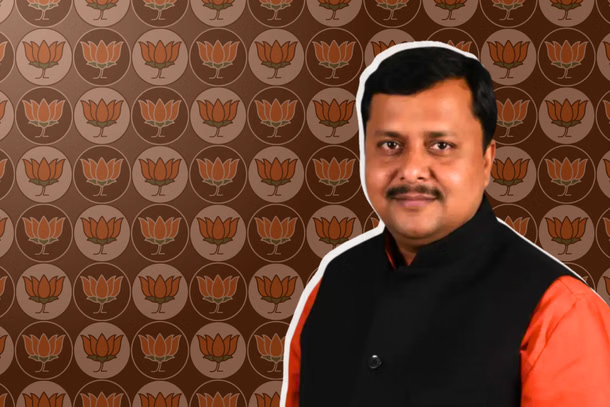
India’s ruling political party, the Bharatiya Janata Party, is poised for a key organisational moment as it prepares to announce its new national president on January 20, marking a significant transition in leadership at the helm of the party’s central structure. The development comes at a time when the BJP is focused on consolidating its internal organisation, strengthening state units, and aligning leadership for upcoming political and electoral challenges. With nominations indicating a smooth and uncontested process, the transition reflects a deliberate and consensus-driven approach that the party has traditionally followed during leadership changes.
Consensus-driven process and the rise of Nitin Nabin within the party
The process to elect the new BJP national president has unfolded in a tightly structured and methodical manner, underscoring the party’s emphasis on organisational discipline and internal democracy. Nominations for the top post were filed at the party headquarters as per schedule, followed by scrutiny in line with established party rules. With no competing nominations emerging, Nitin Nabin has emerged as the sole candidate, setting the stage for his election as the party’s next national president without contest.
Nitin Nabin’s rise within the BJP has been shaped by years of organisational work and legislative experience. A seasoned leader from Bihar, he has served multiple terms as a legislator and has been closely involved in party organisation at both state and national levels. His role as the party’s national working president placed him at the centre of key organisational decisions, offering him exposure to the BJP’s nationwide structure and strategic priorities. This background has been a significant factor in building confidence among party leaders and state units regarding his suitability for the top organisational role.
Support for Nabin’s candidature has come from across the party spectrum, including endorsements from senior leadership and key state units. The backing of leaders such as Prime Minister Narendra Modi and Union Home Minister Amit Shah has effectively consolidated consensus, leaving little room for internal contestation. Such unified support signals continuity in leadership philosophy and organisational direction, while also highlighting the party’s preference for stability during leadership transitions.
Within the BJP’s internal framework, the election of a national president is overseen by an electoral college comprising representatives from national and state councils. While the process allows for contestation, unopposed elections are not uncommon when a candidate commands widespread backing. In this instance, the absence of rival nominations has been interpreted by party insiders as a sign of cohesion and shared confidence in Nabin’s leadership abilities.
The timing of the leadership change is also notable. As the BJP continues to govern at the Centre and in several states, organisational alignment between the party president and the central leadership becomes crucial. The party’s decision to move forward with a consensus candidate reflects a strategic calculation to avoid internal distraction and focus on governance, outreach, and preparation for future electoral battles.
Stratgic significance of leadership change and future direction for the BJP
The impending appointment of Nitin Nabin as national president carries broader strategic implications for the BJP beyond the symbolism of a leadership change. At a relatively young age for such a senior role, his elevation is widely seen as part of the party’s effort to balance experience with generational renewal. While veteran leaders continue to shape policy and political direction, organisational leadership under Nabin is expected to emphasise grassroots mobilisation, cadre engagement, and adaptability to evolving political dynamics.
As national president, Nabin will be responsible for steering the BJP’s organisational machinery, including coordination with state units, overseeing membership drives, and shaping the party’s internal communication strategy. These responsibilities are critical as the party seeks to maintain electoral momentum, expand its footprint in regions where it aims to grow, and defend its position in states where competition is intensifying. The president’s role as a bridge between the central leadership and grassroots workers is particularly important in a party that places strong emphasis on cadre-based organisation.
Political observers also view the transition as reinforcing the BJP’s narrative of internal discipline and merit-based advancement. By elevating a leader who has spent years within the organisational structure, the party reinforces its claim of promoting leaders through sustained work rather than dynastic considerations. This message has been a recurring theme in the BJP’s political positioning and is likely to be reiterated as part of its broader communication strategy.
The leadership change also comes at a time when national politics is witnessing shifts in voter expectations, communication platforms, and issue-based mobilisation. As party president, Nabin’s challenge will be to adapt organisational strategies to these changes while remaining aligned with the party’s ideological core. Strengthening digital outreach, energising younger cadres, and ensuring coordination between the party organisation and government machinery are likely to feature prominently in the agenda ahead.
Internally, the smooth and unopposed nature of the election is expected to contribute to organisational stability. Such stability is often viewed as essential for long-term planning, allowing the party to focus on policy outreach, governance narratives, and election preparedness rather than internal contests. Senior leaders are expected to play a mentoring role, ensuring continuity while allowing the new president space to assert his organisational vision.
As the formal announcement approaches, attention within political circles remains focused on how the new leadership will articulate priorities and manage the complex demands of leading a national party in a rapidly evolving political landscape. While continuity appears to be the dominant theme of the transition, subtle shifts in organisational emphasis and strategy may emerge over time, reflecting the leadership style and priorities of the new president.
The BJP’s decision to proceed with a consensus-driven leadership change underscores its broader organisational philosophy, one that seeks to balance internal democracy with unity and strategic clarity. As Nitin Nabin prepares to assume the role of national president, the transition marks not just a change of guard, but a reaffirmation of the party’s approach to leadership, organisation, and political continuity.