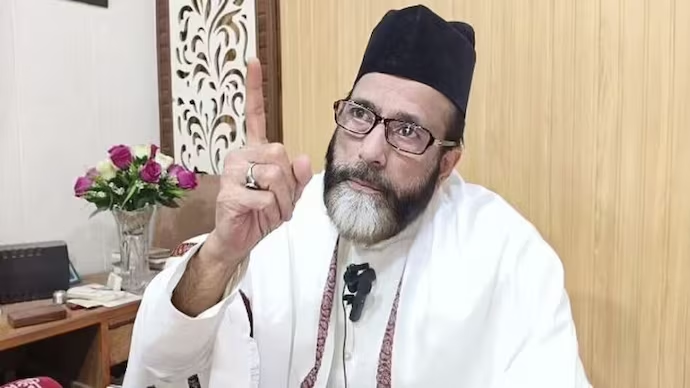
The Uttar Pradesh Police detained prominent cleric and Ittehad-e-Millat Council chief Maulana Tauqeer Raza Khan following violent clashes in Bareilly linked to the “I Love Muhammad” campaign. His detention, along with that of more than two dozen others, came after Friday prayers erupted into confrontation between police and a large crowd carrying banners and posters in support of the campaign. According to officials, the cleric is under interrogation, and his role in the sequence of events is being closely scrutinised. The Bareilly incident has reignited debates over religious mobilisation, law and order, and the state’s handling of communal flashpoints in western Uttar Pradesh.
The sequence of events leading to Bareilly unrest
According to police accounts and eyewitness testimonies, the unrest unfolded shortly after Friday prayers when large groups of supporters gathered outside Maulana Tauqeer Raza Khan’s residence in the Kotwali area of Bareilly. The cleric, who heads the Ittehad-e-Millat Council and has been a vocal religious and political figure in the region, had earlier announced the postponement of a planned demonstration in support of the “I Love Muhammad” campaign. The campaign, seen as an assertion of religious sentiment in the face of alleged disrespectful remarks and actions against the Prophet, had gained traction among sections of the Muslim community in the state.
Police sources maintain that this abrupt postponement, coupled with charged emotions, had the unintended effect of intensifying frustrations among those who had mobilised for the event. Instead of dispersing, the crowd swelled outside his residence and soon spilled over toward a nearby mosque in the same Kotwali locality. The police claim that the congregation was not merely a spontaneous expression of devotion but was accompanied by inflammatory slogans and a confrontational mood that quickly escalated into violence.
Security personnel deployed in the area attempted to control the crowd, urging them to leave peacefully. However, tensions rose when barricades were reportedly breached and verbal altercations intensified. Stone-pelting incidents followed, and clashes broke out between sections of the demonstrators and the police. Vehicles were damaged, and several officers sustained minor injuries in the fracas. In the immediate aftermath, police resorted to detentions, taking more than two dozen individuals into custody, including Maulana Raza himself.
The cleric’s role has become the focal point of the investigation. While his supporters argue that he had tried to defuse tensions by postponing the demonstration, police officials contend that the very announcement of postponement acted as a trigger that aggravated the crowd. Interrogators are now examining whether his words amounted to indirect incitement, given his influence in Bareilly and beyond.
The cleric’s influence and the politics of religious mobilisation
Maulana Tauqeer Raza Khan is not an unfamiliar name in Uttar Pradesh’s socio-political landscape. As the head of the Ittehad-e-Millat Council, a Muslim political outfit, he has often combined religious leadership with political commentary, making him a figure who commands both reverence and controversy. His statements on communal issues have frequently drawn strong reactions, both supportive and critical, and his mobilisation capacity has made him an important local actor during moments of tension.
The “I Love Muhammad” campaign, which has been at the heart of the current unrest, is part of a broader religious assertion movement. Emerging in response to perceived insults to the Prophet Muhammad, it seeks to unite Muslims around the message of love, devotion, and defense of their faith. In Uttar Pradesh, where communal tensions can easily flare up, such campaigns carry the potential to rally large crowds, particularly after Friday prayers when emotions are heightened.
Government sources argue that such gatherings, while ostensibly peaceful, often blur the line between religious expression and political mobilisation. The presence of banners and posters, the sheer size of the crowd, and the cleric’s stature created conditions ripe for confrontation. The police’s apprehension was not without precedent: Bareilly has witnessed similar communal flare-ups in the past, often linked to processions, slogans, or public demonstrations around religious identity.
The current situation is further complicated by the interplay of local and state politics. Opposition leaders have previously accused the ruling establishment of either failing to protect minority rights or using heavy-handed tactics to suppress dissent. In contrast, officials in the administration insist that maintaining law and order is paramount, particularly when gatherings carry the risk of spiraling into communal clashes. The arrest of a high-profile cleric like Maulana Raza, therefore, is not just a law enforcement decision but a political one, sending a message about the state’s zero-tolerance approach to unrest.
In the days following the clashes, debates intensified around whether the cleric had genuinely attempted to calm the situation or whether his words added fuel to the fire. His supporters stress that he never called for violence and had, in fact, delayed the demonstration to avoid escalation. But detractors argue that a leader of his stature cannot be absolved of responsibility when his statements act as catalysts for unrest. In their view, the act of postponement created a vacuum of expectation that transformed into anger among those gathered.
Wider implications for communal harmony and state response
The Bareilly unrest has once again highlighted the fragile equilibrium of communal harmony in Uttar Pradesh, a state with a long and complex history of religious tensions. Incidents like these are not isolated; they feed into broader narratives of mistrust, political opportunism, and the challenges of managing diversity in India’s most populous state. Each such flare-up serves as a reminder of the delicate line between freedom of expression and provocation, between religious identity and law and order.
For the police and administration, the immediate priority has been to restore calm. Security has been tightened across Bareilly, with additional forces deployed to sensitive areas. Senior officers have engaged in community outreach, meeting religious leaders and urging restraint. Appeals for peace have been made from both sides, with assurances that grievances can be addressed within legal and democratic frameworks. However, the underlying tensions remain palpable, raising concerns about whether such clashes could recur in the coming weeks.
The detention of more than two dozen people, including Maulana Raza, is both a preventive measure and a symbolic act. By holding him for interrogation, the state signals that no individual, however influential, is above accountability when violence erupts. Yet, such actions carry risks: the possibility of further alienating sections of the Muslim community who view the cleric as their representative voice. If perceived as selective or heavy-handed, the state’s response could deepen fissures rather than heal them.
Beyond the immediate law-and-order dimension, the incident has political reverberations. Uttar Pradesh’s politics is deeply shaped by communal issues, and any disturbance has implications for electoral narratives. The ruling party will likely project its firmness in dealing with the Bareilly unrest as evidence of its commitment to security and stability. Opposition parties, on the other hand, may frame it as excessive state interference in religious expression, attempting to mobilise sympathy for those detained.
The broader “I Love Muhammad” campaign, meanwhile, is likely to continue resonating among its supporters, even as authorities attempt to regulate its expression. What remains uncertain is whether its leaders can channel that energy into peaceful avenues or whether it risks being repeatedly hijacked by anger and confrontation.