Greater Noida:
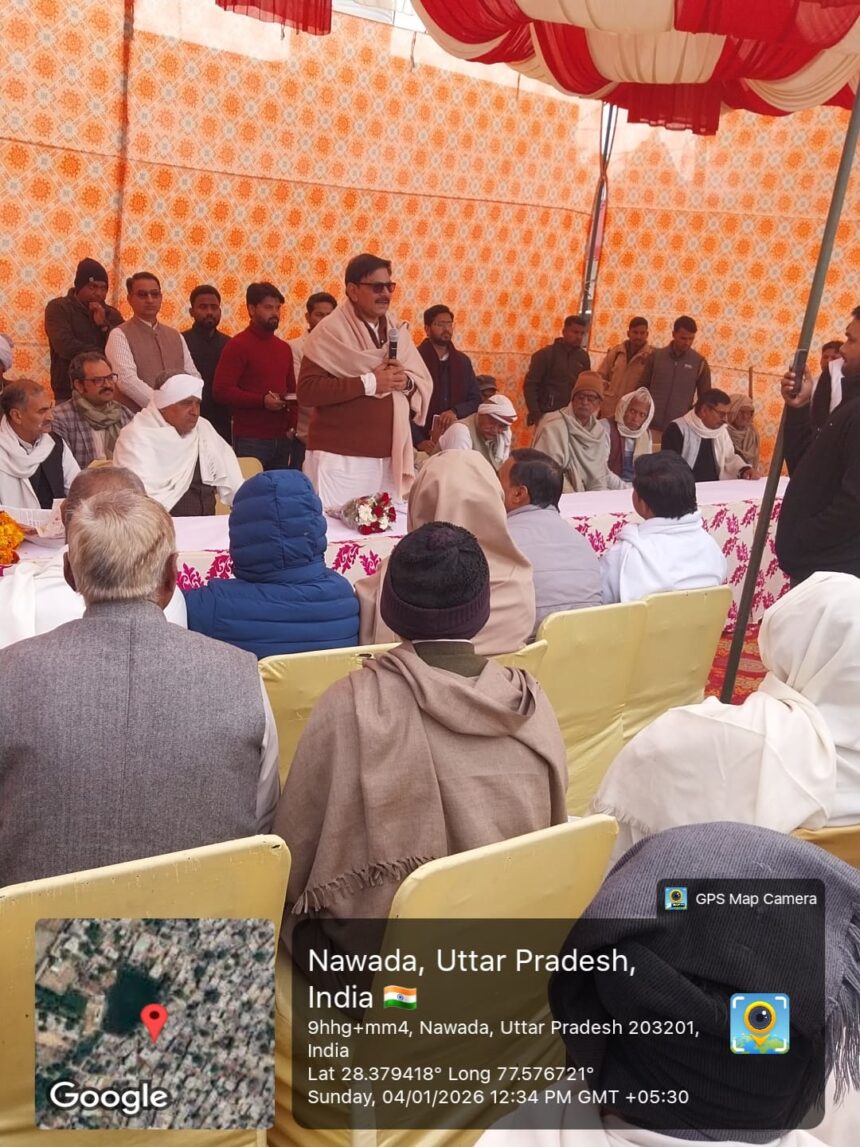
The Greater Noida Authority has initiated the process of establishing e-libraries in four villages of the Greater Noida region by laying the foundation stone for new buildings on Sunday. The foundation-laying ceremony was held in the presence of local villagers and Jewar MLA Dhirendra Singh. The new buildings will be constructed in place of old and dilapidated panchayat houses that were built several years ago and have since fallen into disrepair due to lack of maintenance.
As part of this initiative, new e-library buildings will be constructed in the villages of Nawada, Barsaat, Ghanghaula and Hatewa. According to officials, the construction work has already begun following the completion of the tender process and the issuance of work orders to the selected agency. The authority has set a timeline of six months for the completion of these e-library buildings.

Officials from the Greater Noida Authority stated that this project falls under the jurisdiction of Work Circle-8, where a total of 13 e-libraries are planned to be developed in the first phase across different villages. Out of these, four severely damaged panchayat houses will be demolished and replaced with newly constructed buildings, while the remaining nine e-libraries will be set up by renovating existing panchayat houses that are still in usable condition.
The new e-library buildings will include one reading room, a verandah, and separate toilet facilities for men and women. In addition to the structural construction, the authority will also provide furniture and other essential amenities required for the smooth functioning of the libraries. The total estimated cost for this phase of the project is approximately ₹1.12 crore, and the work is expected to be completed within the stipulated six-month period.

An official from the authority explained that in the notified areas under the Greater Noida Authority, the traditional panchayat election system no longer exists. As a result, the responsibility for providing basic infrastructure and civic amenities such as electricity, water supply, roads and schools lies entirely with the authority. Over the years, many panchayat houses in these villages have become neglected and structurally unsafe due to the absence of regular upkeep. To address this issue and ensure productive use of these buildings, the authority conceptualized the plan to convert panchayat houses into e-libraries.
The initiative has also received positive feedback and support from local residents, who have been demanding better educational and learning facilities in their villages. In some villages, libraries are already being run within panchayat houses through community cooperation, highlighting the need for formal infrastructure and official support to expand and strengthen such facilities.

Senior Manager Nagendra Singh said that new buildings will be constructed in Nawada, Barsaat, Ghanghaula and Hatewa, while renovation work will be carried out in nine other villages to make the existing panchayat houses suitable for use as e-libraries. The cost of renovation for these nine panchayat houses has been estimated at ₹95.47 lakh. Once renovated, these facilities will also be equipped with necessary infrastructure to function as modern e-libraries.
Officials further stated that the work on the e-library project has now commenced in earnest across the Greater Noida Authority area. In villages where panchayat houses are structurally sound, renovation will be undertaken to upgrade them for library use. In contrast, in villages where the buildings are beyond repair, entirely new structures will be constructed.
The authority believes that the establishment of e-libraries in rural areas will play a crucial role in promoting education and digital awareness among village residents, especially students and youth. By providing access to reading materials, digital resources and a dedicated learning environment, the e-libraries are expected to encourage a culture of education and self-learning in the region.
With the foundation stone now laid and construction underway in four villages, the Greater Noida Authority aims to complete the first phase of this ambitious project within the next six months, marking a significant step towards strengthening educational infrastructure in its rural areas.