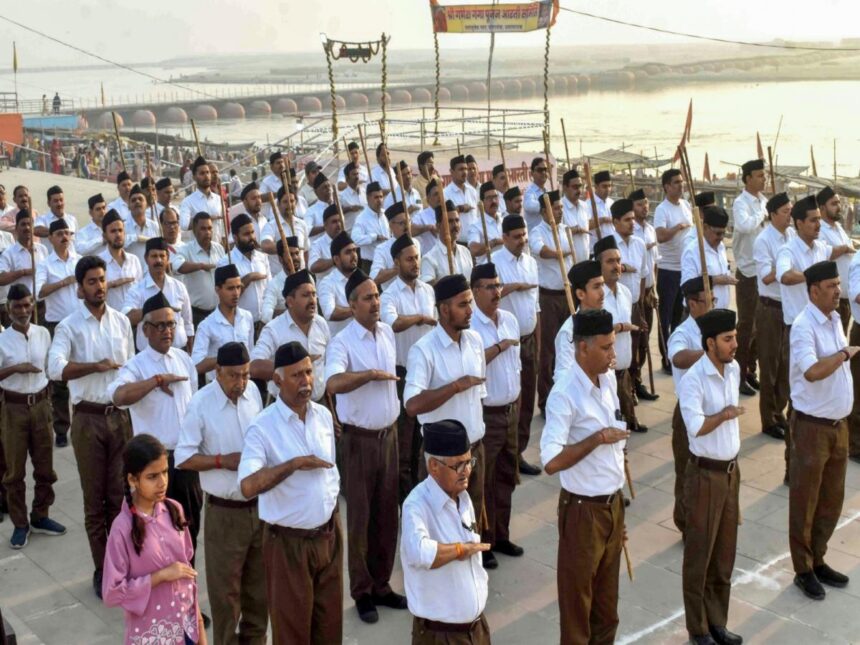
A fresh political and diplomatic controversy has emerged after 275 former judges, civil servants, and armed forces veterans sharply criticised the latest report of the United States Commission on International Religious Freedom, or USCIRF, for recommending action linked to the Rashtriya Swayamsevak Sangh. In a strongly worded joint statement, the signatories described the recommendation as prejudiced, politically motivated, and analytically unsound, while urging the U.S. government to scrutinise the contributors behind the report. Their intervention has turned what might otherwise have remained a foreign watchdog’s rights assessment into a larger debate over India’s sovereignty, institutional credibility, and the legitimacy of external commentary on Indian social and political organisations. USCIRF’s 2026 annual report was released in early March, and its India-related materials continue to present a highly critical view of religious freedom conditions under the current Indian political environment.
USCIRF report triggers backlash over RSS and foreign scrutiny
The immediate trigger for the backlash is the perception that USCIRF has once again crossed from criticism of policy and rights conditions into a sweeping political judgment about Indian institutions and organisations. USCIRF’s India page says the Indian government “tolerates and perpetrates widespread harassment and violence against religious minorities” and links this to legislation such as the CAA, NRC-related frameworks, UAPA, and state-level anti-conversion and cow slaughter laws. Against that backdrop, any recommendation seen as targeting the RSS was bound to provoke a strong reaction from those who view the organisation as a major social and cultural force rather than a subject for foreign sanction advocacy.
The joint statement by the 275 signatories, as described in the text you shared, frames the issue not just as disagreement with a report but as evidence of bias and hostile intent. Their core argument is that critique of a body like the RSS must be grounded in verifiable evidence and broader context, not broad generalisations. That line of argument is politically important because it shifts the conversation from whether criticism is permissible to whether the criticism itself meets standards of fairness, proportion, and analytical credibility.
This response also reflects a recurring Indian objection to USCIRF: that the commission applies an externally constructed lens to a complex society and often evaluates India primarily through conflict, grievance, and majoritarianism, while paying insufficient attention to democratic contestation, judicial oversight, and the scale of Indian institutional life. Whether one agrees with that objection or not, it has become a consistent part of the Indian response whenever USCIRF issues hard-hitting observations on India.
The official USCIRF website makes clear that the commission is a U.S. government-created body mandated by Congress to assess threats to freedom of religion or belief around the world. It also says its annual report documents what it considers “systematic, ongoing, and egregious” violations during the previous year. That institutional positioning gives USCIRF formal visibility, but it also ensures that its findings are read in India not as neutral academic commentary, but as part of a larger U.S. political ecosystem. This is one reason the signatories’ demand for scrutiny of the report’s contributors is significant: they are effectively asking whether the commission’s recommendations are shaped by ideological or geopolitical agendas rather than balanced rights assessment.
Sovereignty, democratic institutions and the politics of international criticism
The broader force of the joint statement lies in its defence of India’s democratic and institutional capacity. The signatories reportedly argued that India, as the world’s largest democracy with a robust judiciary, parliamentary oversight, and long-tested institutions, leaves limited room for violations of religious rights to go entirely unchecked. That claim is central to the sovereignty argument. It does not say problems never exist. It says India possesses constitutional mechanisms to address them, and that foreign bodies should not behave as though Indian society is institutionally incapable of self-correction.
This is where the debate becomes more than just one about the RSS. It becomes a dispute over who gets to define India’s democratic health and on what terms. Supporters of USCIRF-style scrutiny would argue that international religious freedom monitoring is legitimate precisely because domestic institutions do not always protect vulnerable groups adequately. Critics, by contrast, argue that such bodies often flatten political context, overlook social complexity, and privilege selective narratives that reinforce pre-existing ideological assumptions. USCIRF’s own India page, for example, presents an unequivocally critical account of state policy toward minorities. For many in India, that language confirms not neutrality but predisposition.
The signatories’ praise for the RSS also matters in this context. By emphasizing the organisation’s social service work, disaster response contributions, and longstanding grassroots presence, they are contesting the very frame in which it is discussed. Their claim is not simply that RSS should be defended from outside hostility, but that it has played a meaningful role in nation-building and social mobilisation since its founding in 1925. That historical framing is meant to establish the RSS as a deeply rooted Indian institution whose significance cannot be reduced to the terms in which foreign critics describe it.
Their use of demographic comparisons with Pakistan and Bangladesh appears intended to strengthen the broader rebuttal by suggesting that India’s minority record must be viewed comparatively rather than in isolation. That comparison is politically resonant in Indian debate, though it is also interpretive and tends to shift the discussion from rights conditions in India to regional contrasts. Even so, it shows how domestic rebuttals to international criticism often rely not only on legal or factual objections, but on civilisational and geopolitical framing.
In practical terms, the controversy is unlikely to alter USCIRF’s posture in the near future. The commission has consistently maintained a critical stance on India in recent years, and its current public materials continue in that direction. What this backlash does change is the political meaning of the report inside India. It gives opponents of USCIRF a high-profile institutional voice, drawn from retired judges, bureaucrats, and veterans, to argue that such reports should be treated not as impartial diagnoses but as contested political documents.
That makes the story larger than a single recommendation. It is now part of a continuing struggle over narrative authority: whether India’s internal religious and political tensions should be interpreted principally through foreign human-rights watchdog frameworks, or through domestic constitutional, democratic, and civilisational lenses. In that contest, the statement by the 275 signatories is less a routine rebuttal than a declaration that external moral scrutiny of Indian institutions will itself be publicly challenged as a matter of national legitimacy.