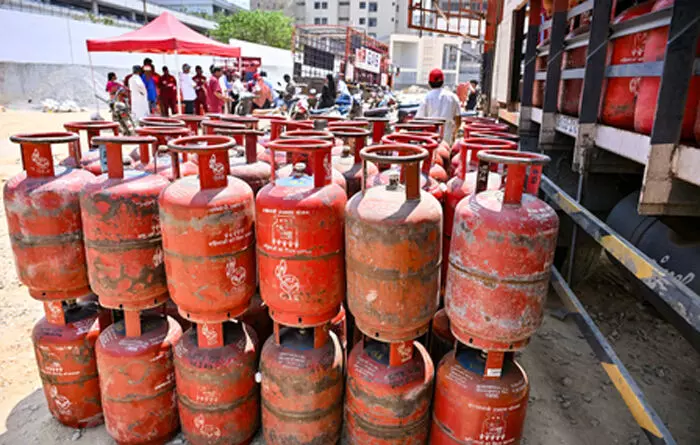
The Centre’s decision to increase commercial LPG allocation to States and Union Territories by an additional 20% from March 23 marks an important intervention in managing fuel supply for key service sectors while carefully steering them toward a longer-term transition to piped natural gas. With this latest revision, the cumulative allocation rises to 50% of pre-crisis levels, offering immediate relief to businesses that depend heavily on commercial LPG, particularly restaurants, dhabas, hotels, industrial canteens, food processing units, and community kitchens. Yet the policy is not simply about expanding supply. It is equally about tightening oversight, formalising consumer data, and using allocation as a lever to accelerate PNG adoption. The result is a system that combines short-term operational support with long-term structural reform, even as it places new compliance burdens on commercial users.
Extra LPG allocation offers relief but with tighter conditions
The latest announcement has clear practical significance because commercial LPG remains essential for a wide range of food service and industrial users. By raising the allocation by another 20%, the Centre is responding to ongoing pressure from sectors where uninterrupted fuel supply affects daily operations, pricing stability, and service continuity. The decision takes total allocation to 50% of pre-crisis levels, building on the earlier 30% framework that included a base allocation and a subsequent increase linked to reforms supporting PNG expansion. That progression suggests that the Centre is trying to calibrate supply rather than fully restore the old system, using phased increases to influence state-level compliance and consumption patterns.
The choice to prioritise restaurants, dhabas, hotels, and industrial canteens is especially telling. These sectors sit at the intersection of public consumption, employment, and local economic activity. Any disruption in their access to fuel can quickly ripple outward through food prices, worker welfare, and small business viability. Dhabas and budget food establishments, in particular, serve not only travellers and customers in transit but also workers, transport operators, and lower-cost urban and semi-urban consumers. Ensuring that such establishments receive priority access reflects an understanding that fuel distribution policy can directly affect the everyday food economy.
The inclusion of food processing and dairy units, subsidised food outlets run by states or local bodies, community kitchens, and 5 kg free trade LPG cylinders for migrant labourers broadens the policy’s welfare dimension. This is not just a business support measure. It is also an attempt to shield socially important services and vulnerable populations from supply strain. Community kitchens and migrant workers often fall outside the spotlight of mainstream policy debate, but their inclusion here indicates that the government wants the allocation framework to carry social as well as economic value.
At the same time, the new system introduces tighter controls that make clear this is not an unconditional relaxation. States have been directed to prevent diversion of supplies, and commercial as well as industrial LPG consumers must now register with oil marketing companies to qualify under the revised quota. That requirement is significant because it shifts the allocation process toward a more formal, traceable model. By maintaining databases on sector, end-use, and annual consumption needs, oil marketing companies will be better placed to monitor usage patterns and limit misuse. In policy terms, the Centre appears to be trading additional supply for greater administrative visibility.
This move also reflects a broader governance logic. Scarcity or restricted allocation regimes often create space for leakage, misclassification, and inefficient targeting. By insisting on registration and documentation, the Centre is trying to ensure that the additional 20% reaches the intended users rather than being absorbed by opaque or non-priority demand. That may improve accountability, but it could also create friction for smaller establishments that are less equipped to handle formal compliance quickly. The success of the policy will therefore depend not only on the intent behind the rules but also on how efficiently they are implemented on the ground.
PNG transition becomes central to the Centre’s fuel strategy
The most important structural feature of the revised framework is the mandatory linkage between expanded LPG allocation and readiness for piped natural gas. The Centre has made it compulsory for all commercial and industrial LPG consumers to apply for PNG connections with the relevant city gas distribution entities. More than that, consumers must complete the necessary steps to become ready to receive PNG before they can fully benefit from LPG allocation under the expanded quota. This turns what might otherwise have been a temporary relief measure into an instrument of transition policy.
That strategy reveals the government’s larger objective. Commercial LPG is being treated less as a permanent entitlement and more as a managed bridge toward wider PNG adoption. From the Centre’s perspective, this makes sense. PNG offers advantages in distribution efficiency, monitoring, and potentially long-term cost stability in areas where infrastructure exists or is expanding. By attaching conditions to LPG allocation, the government is trying to create incentives for commercial consumers to move into the PNG network rather than remain indefinitely dependent on cylinder-based fuel supply.
The reference to earlier allocation increases linked to ease-of-doing-business reforms for PNG expansion reinforces this interpretation. The Centre is not merely adjusting supply in isolation; it is using allocation policy to nudge states toward broader energy infrastructure changes. In this sense, commercial LPG has become part of a conditional reform framework. States that improve the policy environment for PNG, and consumers who move toward readiness, are better positioned to access relief. This creates a layered system in which energy availability is tied to compliance, infrastructure transition, and administrative responsiveness.
There is a practical logic to this, but also a challenge. PNG coverage remains uneven, and many commercial users, especially in smaller towns or fringe urban areas, may not have the same access, timelines, or installation ease as establishments in better-served cities. For them, the requirement to apply for PNG and reach operational readiness may feel more burdensome than enabling. The policy’s fairness will therefore depend on whether the supporting gas distribution infrastructure expands at a pace that matches the compliance demands being imposed. Otherwise, businesses may feel pushed into a transition they cannot realistically complete on time.
Still, the Centre’s emphasis on dhabas, hotels, and industrial canteens shows it is aware of where the immediate pressure points lie. Food service establishments cannot afford uncertain fuel access, and their operations affect both public convenience and local livelihoods. By prioritising these sectors, the government is trying to reduce disruption in visible and socially sensitive parts of the economy. That makes the additional 20% politically as well as economically significant.
What emerges from this revised LPG framework is a policy balancing act. The Centre is offering partial supply relief at a time of demand pressure, but it is doing so within a model designed to formalise usage, prevent diversion, and accelerate a shift toward PNG. This makes the announcement more consequential than a routine allocation order. It reflects a larger effort to reshape how commercial fuel supply is managed, who gets priority, and under what conditions businesses can continue to depend on LPG in the years ahead.