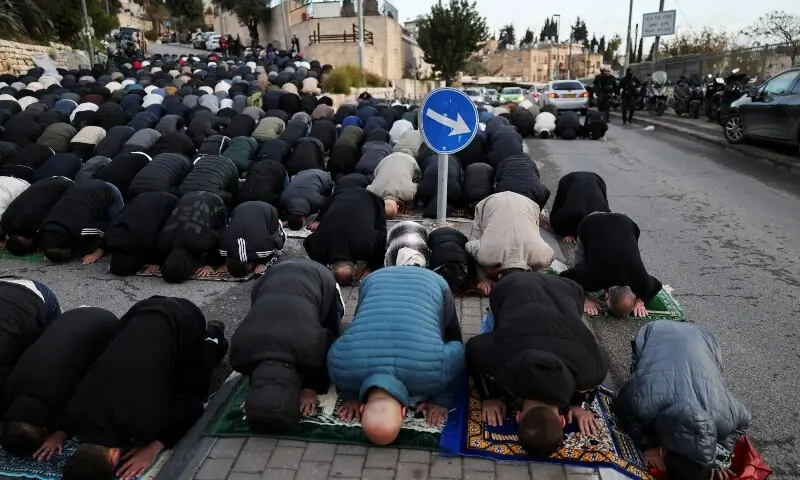
The reported closure of the Al-Aqsa Mosque compound for Eid prayers marks an extraordinary and deeply symbolic moment in Jerusalem’s modern history. According to the report you shared, the holy site was fully closed for Eid al-Fitr prayers for the first time since the 1967 Middle East war, when Israel captured East Jerusalem and the Old City. If so, this is not merely an administrative restriction or a security measure; it represents a rupture in one of the most sensitive religious spaces in the world. Al-Aqsa is not only the third-holiest site in Islam but also part of a hilltop compound revered by Jews as the Temple Mount. Any full closure of the site inevitably carries significance far beyond a single prayer gathering, raising questions about access, control, and the increasingly fragile balance surrounding Jerusalem’s contested sacred geography. Recent AP reporting had noted that Al-Aqsa remained open for Ramadan Friday prayers in February 2026, though under heavy Israeli restrictions and with sharply reduced attendance.
A closure with historical and political weight
What makes this development so striking is the historical benchmark attached to it. The claim that the compound has not been fully closed for Eid prayers since 1967 places the event in a category of exceptional gravity. Since Israel captured East Jerusalem and the Old City in the 1967 war, the status of the site has remained one of the most sensitive issues in the Israeli-Palestinian conflict. The compound is administered by the Islamic Waqf, while Israeli security forces control access around it. That uneasy arrangement has long depended on a delicate and often contested status quo. Any complete closure cuts directly into that arrangement and is likely to be interpreted not just as a temporary act of control, but as a symbolic assertion over one of the most emotionally charged spaces in the region.
The importance of Eid prayers intensifies that symbolism. Eid al-Fitr is not an ordinary day in the Muslim religious calendar. It marks the end of Ramadan and carries both spiritual and communal meaning. For worshippers, gathering at Al-Aqsa on such an occasion is not simply about ritual observance; it is about presence, belonging, and continuity in a city where access itself has become political. A full closure on Eid therefore resonates as more than a security response. It becomes a visible sign of how deeply contested worship and mobility have become in Jerusalem.
This is especially significant because AP had reported only weeks earlier that tens of thousands of Palestinians attended the first Friday prayers of Ramadan at Al-Aqsa under tight Israeli restrictions. Israel had limited entry from the West Bank and imposed age-based conditions, while the Islamic Waqf said attendance was far lower than in normal times. That reporting already showed a site functioning under severe constraints rather than open religious normalcy. Against that backdrop, a full Eid closure appears not as an isolated incident but as a sharp escalation in restriction at a place that has repeatedly served as a flashpoint in the broader conflict.
Al-Aqsa as a barometer of wider conflict
The meaning of Al-Aqsa has never been confined to worship alone. The compound often functions as a barometer of the political climate across Jerusalem, the occupied territories, and the wider region. Palestinians see restrictions there as a measure of their shrinking rights and vulnerability in East Jerusalem. Many also view heightened Israeli policing and the growing visibility of religious and nationalist Jewish visits as provocations linked to fears of changing arrangements at the site. AP’s February reporting noted exactly these anxieties, along with Israeli denials that it intends to alter the compound’s governing framework.
That is why a closure of this magnitude matters so much. Even if justified officially in security terms, it is unlikely to be received as a neutral action. At Al-Aqsa, the line between security policy and political symbolism is almost impossible to maintain. Every gate closure, every access restriction, and every visible deployment of force is read through a much larger struggle over sovereignty, faith, and rights in Jerusalem.
The closure also reflects how the aftershocks of the Gaza war and the broader Israel-Hamas conflict continue to transform daily realities far beyond Gaza itself. AP’s reporting from February described a somber Ramadan atmosphere shaped by two years of war, destruction, and displacement. In that environment, religious spaces such as Al-Aqsa carry even greater emotional and political weight. They are among the few remaining anchors of collective life, continuity, and identity. Closing such a site on Eid sends an especially powerful message because it interrupts one of the most visible expressions of religious and communal endurance.
It is also worth noting that I could confirm recent AP reporting about tight restrictions at Al-Aqsa in February 2026, but I did not find a second independently opened source in this turn that verified the exact Eid closure details you provided. The core framing of your text may be accurate, but that specific point should be treated with care until corroborated more broadly.