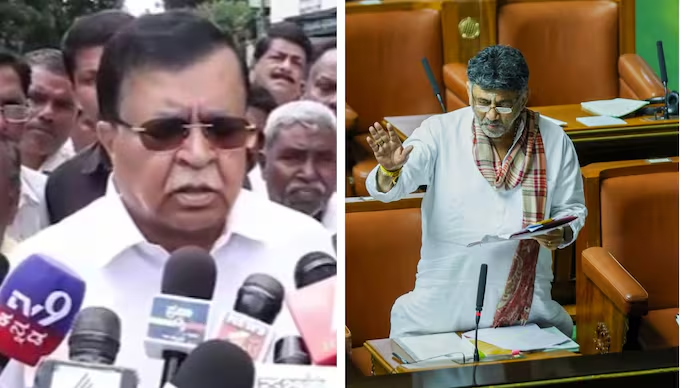
Karnataka politics witnessed another storm as former state minister and Congress MLA KN Rajanna launched a blistering critique of Deputy Chief Minister DK Shivakumar following the latter’s unexpected performance of a well-known RSS song during a legislative assembly debate. The incident occurred amid heated discussions over the tragic Chinnaswamy Stadium stampede, which claimed 11 lives, and has since triggered widespread debate over DK Shivakumar’s political consistency, affiliations, and ideological stance. KN Rajanna, speaking to the media, accused DK Shivakumar of repeatedly demonstrating contradictions in his political behaviour, raising serious questions about his loyalty to the Congress party and his ideological coherence, especially in the context of interactions with influential figures from opposing political and socio-cultural spheres.
The Assembly Incident and Public Reactions
The controversy began when DK Shivakumar, during an intense debate in the Karnataka Assembly concerning the Chinnaswamy Stadium stampede, spontaneously sang an RSS song. The song, known for its deep association with the Rashtriya Swayamsevak Sangh, took many legislators and political observers by surprise. BJP lawmakers responded to the performance with enthusiastic applause, laughter, and desk-thumping, creating a stark contrast to the silence observed by Congress members. The response highlighted the political sensitivities surrounding DK Shivakumar’s gesture and amplified the debate about his ideological alignment, particularly as he occupies a senior position within the Congress-led government.
The backdrop to this incident was already tense, as DK Shivakumar had been accused by BJP legislators of indirectly contributing to the chaos during the stampede by accompanying the Royal Challengers Bangalore cricket team from the airport to the stadium in a celebratory procession. BJP leaders argued that the cavalcade added to the crowd management challenges, escalating the risks that ultimately led to the tragic stampede. DK Shivakumar’s act of singing an RSS anthem, therefore, added fuel to the political fire, sparking scrutiny not just of the incident itself but of his broader political and ideological choices.
In his statement to the press, KN Rajanna questioned the apparent contradictions in DK Shivakumar’s behaviour, suggesting that his actions indicate an ambiguous stance on ideological matters. KN Rajanna emphasised that DK Shivakumar’s willingness to perform an RSS song publicly, while simultaneously holding a senior position in the Congress party, reflects a troubling inconsistency. “He can do whatever he wants. He can sing RSS songs, share the dais and sit with Amit Shah and Sadhguru. He said that if you go to Prayagraj and take a holy bath, the poor will be fed, and he goes there. Rahul Gandhi himself is hesitant to accept the marriage of Ambani’s son, but he goes to such a marriage with his family. All this is there, and people will decide on it,” Rajanna said, framing the issue as one of political accountability and public trust.
DK Shivakumar himself later sought to clarify the situation, asserting that there was no intentional or indirect message behind his singing of the song and reaffirming his allegiance to the Congress party. He pointed out that his actions were informed by research into the political strategies of various parties and institutions in Karnataka, including the RSS. “I have made research on all political parties. I know how RSS is building institutions in Karnataka. They are acquiring every school in district and Taluk. I am a Congressman and will be in Congress,” DK Shivakumar stated, highlighting that his loyalty to the Congress party remains unwavering despite appearances that may suggest otherwise.
Political Implications and Questions of Ideology
The incident has sparked significant political discourse in Karnataka, drawing attention to the complex dynamics of party allegiance, ideological consistency, and political symbolism. DK Shivakumar’s actions have been interpreted in multiple ways: some view them as an attempt to appeal to broader social and cultural audiences, while others, particularly within Congress, see them as potentially undermining the party’s ideological foundations. By performing a song with deep RSS affiliations, DK Shivakumar inadvertently opened himself to criticism from former colleagues and political observers who argue that such gestures, especially in public and in official settings, must be weighed carefully against political and ethical responsibilities.
KN Rajanna’s critique also reflects broader anxieties within the Congress party regarding loyalty and coherence. The former minister’s remarks underline a perception that high-ranking party officials must adhere consistently to the party’s core principles, especially when addressing matters of ideology and public representation. The debate raises fundamental questions about the extent to which individual politicians can engage with symbols, ideas, or events associated with rival political or cultural institutions without creating confusion among the public and party members alike.
The episode additionally highlights the intersection of politics and public performance in Indian governance. In contemporary legislative settings, actions such as singing an anthem or participating in public cultural rituals carry symbolic weight and can be interpreted as indicators of political alignment. DK Shivakumar’s gesture, therefore, became more than a spontaneous performance—it evolved into a politically charged act, scrutinized by both party insiders and the media, and framed within the larger discourse of Karnataka’s governance and political culture.
Furthermore, the incident has fueled debates about the expectations of political figures in India regarding consistency, transparency, and public perception. In a climate where political symbolism is often as influential as policy actions, DK Shivakumar’s actions have invited discussions on how legislators balance personal beliefs, political pragmatism, and party loyalty. KN Rajanna’s statements, in particular, underline the view that public officeholders are accountable not only for administrative decisions but also for gestures and appearances that may influence public trust and ideological clarity.
Beyond the immediate political fallout, the controversy also reflects a broader trend in Indian politics, where party affiliations, personal networks, and ideological symbols intersect in complex ways. DK Shivakumar’s interactions with figures such as Amit Shah and Sadhguru, combined with his participation in events outside the traditional Congress domain, illustrate the porous boundaries of political engagement and the challenges of maintaining consistent ideological narratives. KN Rajanna’s comments, therefore, underscore the tension between individual political agency and collective party expectations, a recurring theme in India’s multi-party democracy.
As the Karnataka political landscape continues to evolve, the incident serves as a reminder of the nuanced pressures faced by senior leaders. The scrutiny over DK Shivakumar’s actions reveals the heightened sensitivity surrounding ideological gestures in high-profile political contexts, emphasizing that even seemingly minor acts can have major repercussions for public perception, inter-party relations, and internal coherence within political organizations. KN Rajanna’s critique, in turn, exemplifies the role of former political leaders and insiders in shaping public discourse and holding current officeholders accountable for both their policy decisions and symbolic acts.
The controversy also raises important questions about the nature of political allegiances in India. DK Shivakumar’s interactions across ideological divides reflect a pragmatic approach to politics, where engagement with a broad spectrum of social, cultural, and political figures is often seen as necessary for coalition-building and influence. However, KN Rajanna’s criticism highlights the inherent risk in such pragmatism: when actions are perceived as inconsistent with party ideology or public expectations, they invite questions about loyalty, authenticity, and political intent. The incident illustrates the delicate balancing act that senior leaders must perform, navigating the tension between personal initiative, party allegiance, and public accountability.
The episode at the Karnataka Assembly also serves as a case study in how political symbolism, media coverage, and legislative action interact in shaping public narratives. DK Shivakumar’s song performance, amplified by media reports and political commentary, has transformed a local legislative debate into a statewide discussion about ideology, allegiance, and leadership credibility. This reflects the contemporary reality of Indian politics, where symbolic gestures often carry as much weight as legislative votes, policy announcements, or public statements, underscoring the importance of perception management in political life.
While DK Shivakumar has reiterated his commitment to the Congress party and clarified the non-political intent behind his actions, the incident remains a point of contention in Karnataka politics. KN Rajanna’s critique has framed the discussion in terms of ideological fidelity, political accountability, and public trust, emphasizing the broader implications of symbolic acts in governance. As political observers continue to analyze the event, it stands as an important reminder of the complexities of political leadership, the significance of public gestures, and the ongoing negotiations between personal agency and party expectations in contemporary Indian politics.