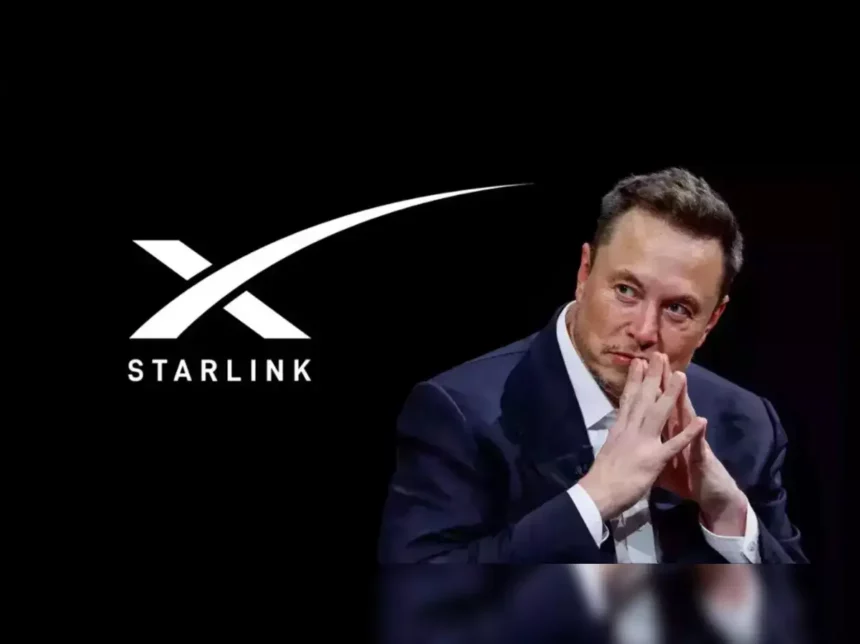
In a major development marking India’s ongoing digital transformation, Elon Musk’s satellite internet venture Starlink has been granted official permission to launch its services in the country. As the nation commemorates 30 years since its first cellular call, the government announced a sweeping update on the state of its telecom sector, highlighting exponential growth in mobile and internet connectivity, a dramatic fall in data prices, a thriving 5G rollout, and a push towards technological self-reliance, with Starlink’s entry seen as a pivotal step in that journey.
Union Telecom Minister Jyotiraditya Scindia confirmed on Thursday that Starlink has been awarded a Unified License to provide satellite-based internet services in India. Alongside this, the framework for satellite spectrum allocation and ground gateway infrastructure has been finalised, paving the way for a smooth rollout. Starlink joins a competitive satellite communications (satcom) space, with Bharti-backed Eutelsat OneWeb and Jio SES also in line, pending spectrum assignment.
Jyotiraditya Scindia’s announcement came on the eve of the 30th anniversary of India’s first cellular phone call, made in 1995. Speaking at an industry event, the minister used the milestone to reflect on how far India has come in building one of the world’s most affordable and extensive digital networks. “From remote villages to bustling cities, digital access has empowered citizens, bridged divides, and made India a global leader in affordable, inclusive technology,” Jyotiraditya Scindia said.
India’s telecom growth story by the numbers
The data shared by the telecom minister paints a staggering picture of growth. Telephone connections in India now stand at 1.2 billion, and internet subscriptions have skyrocketed by 286 per cent to reach 970 million. Broadband connections, in particular, have seen explosive expansion—rising from 60 million in 2014 to 944 million in 2025, marking a 1,450 per cent increase.
Most striking is the drop in mobile data prices. From being one of the most expensive in the world a decade ago, India now offers the cheapest data globally at just Rs 8.9 per GB—a 96.6 per cent decrease. This affordability has fueled massive data consumption, making India the top consumer of mobile internet per capita, with 5G users averaging over 32 GB of data each month.
Jyotiraditya Scindia also lauded the revival of the state-run telecom company BSNL, which reported back-to-back net profits for the first time in 18 years—Rs 262 crore and Rs 280 crore respectively in FY 2024-25. He credited this success to over 83,000 4G towers being installed across the country, of which 74,000 are already operational. Notably, the technology behind these towers is fully indigenous. He also highlighted service improvements brought about by AI-powered monitoring systems, “Crack Teams” for fault resolution, and a new benchmark of resolving fibre faults within 12 hours.
5G expansion and India’s 6G ambitions
India’s rollout of 5G technology has also been a landmark achievement. According to the telecom ministry, 99.6 per cent of the country’s districts are now covered by 5G services. A total of 4.74 lakh 5G towers have been installed, and the network already serves 300 million users.
India’s ambitions do not stop at 5G. Jyotiraditya Scindia noted that the country is among the top six in the world for 6G patent filings. As part of building a future-ready telecom ecosystem, the government has also set up 100 “Use Case Labs” aimed at developing and testing next-gen telecom applications.
The minister also cited the success of the Production Linked Incentive (PLI) scheme, which has attracted investments worth Rs 4,305 crore and generated sales of Rs 85,391 crore. These have translated into over 28,000 new jobs. Foreign Direct Investment in the telecom sector has also seen a sharp jump, nearly tripling from USD 282 million to USD 710 million.
Industry stakeholders echoed the government’s optimism. SP Kochhar, Director General of the Cellular Operators Association of India (COAI), said that since the first mobile call in 1995, India has transformed into the second-largest telecom market globally, boasting over 1.2 billion subscribers and some of the lowest tariffs in the world. “Today, an Indian user consumes over 21 GB of data per month on average, thanks to world-class infrastructure built by domestic operators,” he said.
HFCL Managing Director Mahendra Nahata remarked that India had followed the global curve during the 2G and 3G era, caught up in the 4G phase, and then outpaced the world in 5G deployment. “With our eyes now set on 6G, India is not just adopting new technology—it is helping define global standards,” he said.
Paritosh Prajapati, CEO of GX Group, called this a defining moment for India. “From a country once dependent on foreign technology, India is now building its own. Thanks to initiatives like PLI, we are creating a self-reliant telecom ecosystem that designs, develops, and manufactures for the world,” he said. He added that the next three decades will belong to an Atmanirbhar Bharat leading the global telecom innovation space.
The entry of Elon Musk’s Starlink into the Indian market is expected to bring new competition and accelerate the expansion of internet access in hard-to-reach rural and remote regions. Starlink’s satellite-based internet technology offers a potential solution to India’s long-standing last-mile connectivity challenges, making it a timely addition to the country’s digital ambitions.