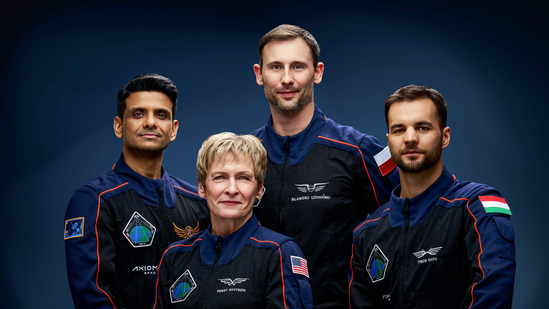
After several delays, the highly awaited Axiom Mission 4 is now ready for launch, with Indian astronaut Shubhanshu Shukla among the four-member crew heading to the International Space Station (ISS). The mission, scheduled for Wednesday, June 25 at 2:31 am EDT (around 12:00 noon IST), marks a major milestone for India, Poland, and Hungary, each sending a government-backed astronaut to space for the first time in over four decades. The mission will be launched from Launch Complex 39A at NASA’s Kennedy Space Center in Florida, using SpaceX’s Falcon 9 rocket.
India Returns to Human Spaceflight After Four Decades
The Axiom-4 mission holds special significance for India, Poland, and Hungary. All three nations are participating in a government-supported human spaceflight mission for the first time since the 1980s. For India, it’s only the second time an Indian will travel to space after Rakesh Sharma’s historic mission in 1984. This time, the honour goes to Shubhanshu Shukla, an Indian Space Research Organisation (ISRO) astronaut who will serve as the mission’s pilot.
Shubhanshu Shukla will be joined by three international crew members: Peggy Whitson, a veteran NASA astronaut and now the director of human spaceflight at Axiom Space, will command the mission. Slawosz Uznański-Wiśniewski, a project astronaut from the European Space Agency representing Poland, and Hungarian astronaut Tibor Kapu will both serve as mission specialists.
The crew will spend time aboard the ISS conducting scientific research, technology demonstrations, and educational outreach projects. According to Axiom Space, the mission represents a return to orbit for these countries and a leap forward for global collaboration in space.
Global Research Collaboration Onboard
The Ax-4 mission is not just about sending astronauts to space; it’s a massive scientific initiative. Around 60 experiments and research activities representing 31 countries will be carried out during the mission. These include nations like India, the US, Hungary, Poland, Brazil, Saudi Arabia, UAE, Nigeria, and others across Europe.
Each astronaut will contribute to different areas of study, ranging from human physiology and space medicine to advanced technology demonstrations that may help future long-duration space missions. Notably, Indian astronaut Shubhanshu Shukla will also take part in seven key experiments, some of which are designed to understand the impact of microgravity on the human body and test indigenous space research instruments.
SpaceX confirmed via a social media post that all systems are in place for launch, with weather conditions 90% favourable for liftoff. The Falcon 9 rocket, a tried-and-tested vehicle, will ferry the astronauts to orbit in what SpaceX and Axiom hope will be a flawless mission.
The launch of Axiom-4 not only underlines the rise of private space missions but also showcases the expanding global participation in space exploration. It signals a new era where nations collaborate beyond borders to explore the frontiers of science, technology, and human endurance.