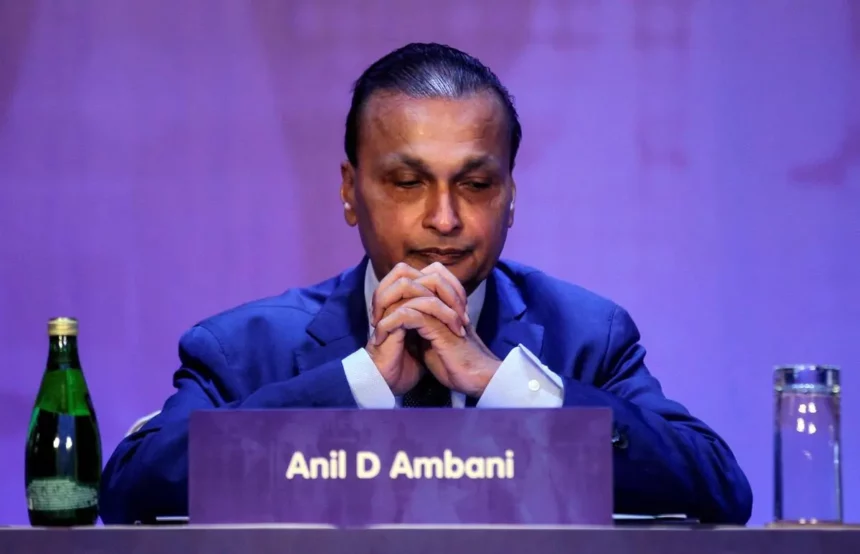
The Enforcement Directorate (ED) has issued a fresh summons to industrialist Anil Ambani in connection with its ongoing probe into alleged money laundering and financial irregularities related to Reliance Communications Limited (RCOM). The agency’s investigation has revealed that before insolvency proceedings began, the Anil Ambani-led Reliance Group allegedly manipulated the loan mechanism to influence the corporate insolvency resolution process (CIRP) and diverted borrowed funds through mutual funds, related parties, and infrastructure companies under its control. This case marks one of the most significant financial probes against a major Indian business group, with alleged irregularities running into tens of thousands of crores and involving several major banks.
Fresh summons and the expanding scope of the probe
According to officials familiar with the development, the ED has directed Anil Ambani to appear before investigators on November 14 in connection with the money-laundering case. This is not the first time the industrialist has faced questioning; he was earlier interrogated on August 5 concerning other ongoing investigations related to Reliance Group companies. The new summons follows a series of attachment orders by the agency targeting high-value assets belonging to Ambani and his companies.
The financial probe agency’s investigation is based on a First Information Report (FIR) registered by the Central Bureau of Investigation (CBI) in August. The FIR and subsequent ED probe focus on allegations that RCOM and its related entities fraudulently availed credit facilities worth over ₹40,000 crore from a consortium of banks and later diverted or misused the funds. The State Bank of India (SBI) alone reportedly incurred a loss of ₹2,929.05 crore due to unpaid loans and the alleged diversion of funds by RCOM.
The ED, in a recent attachment order issued under the Prevention of Money Laundering Act (PMLA) on November 3, attached properties worth ₹4,462 crore, including 132 acres of land at Dhirubhai Ambani Knowledge City (DAKC) in Navi Mumbai. This was in addition to ₹3,083 crore worth of other assets—such as Anil Ambani’s Pali Hill residence in Mumbai and the Reliance Centre in Delhi—attached in earlier cases. The total value of attached assets linked to Anil Ambani now exceeds ₹7,500 crore, highlighting the scale of the alleged financial misappropriation.
The agency’s findings suggest that the Reliance Group, even before insolvency proceedings against RCOM commenced, took strategic steps to retain influence over the resolution process. ED officials stated that related party non-banking financial companies (NBFCs) were allegedly used to acquire outstanding loans from lenders, enabling the group to become part of the Committee of Creditors (CoC). This move, they claim, allowed the Reliance Group to indirectly control the insolvency process and protect its business interests despite facing massive debt.
The ED’s investigation also covers the utilization of credit facilities sanctioned by multiple banks, including HDFC Bank, Standard Chartered, Yes Bank, HSBC, ICICI Bank, Axis Bank, Deutsche Bank, DBS Bank, and the Industrial and Commercial Bank of China, among others. The loans were allegedly obtained between April 2013 and March 2017, during which the group is said to have orchestrated a series of interlinked transactions across different entities to conceal the diversion of funds.
Loan diversion, alleged fraud, and money trail under scrutiny
According to the findings in the ED’s attachment order, the Reliance–Anil Dhirajlal Ambani Group (RAAG) had misused the credit facilities extended to its companies, including RCOM, Reliance Telecom Limited (RTL), and Reliance Infratel Limited (RITL). The agency claimed that loans taken by one company were being used to repay the loans of another within the same group, thereby violating the terms of the sanction letters issued by banks. Furthermore, parts of these funds were reportedly invested in mutual funds, transferred to related parties, or diverted to infrastructure firms controlled by Anil Ambani, such as Reliance Infrastructure Limited and CLE Private Limited.
The ED also alleged that certain loans were siphoned off abroad through outward remittances, signaling a potential international money-laundering trail. Investigators believe these financial movements were deliberately structured to obscure the flow of funds and avoid scrutiny. The agency’s analysis revealed that the fraudulent utilization of loans was not limited to a single entity but was a coordinated effort involving multiple subsidiaries and cross-company transactions.
The investigation has further highlighted that even before the formal initiation of insolvency proceedings, the Reliance Group appeared to anticipate the financial collapse of its telecom arm. The group, according to ED officials, had devised a strategy to acquire the outstanding loans of RCOM, RTL, and RITL through its related NBFCs. By doing so, it aimed to gain voting rights and decision-making power within the Committee of Creditors—an influential body that determines the fate of companies undergoing insolvency resolution. This move, the ED noted, effectively allowed the group to exert control over the outcome of the CIRP and mitigate the risk of losing assets during bankruptcy proceedings.
The agency’s attachment order detailed how this mechanism worked in practice. Loans sanctioned to one group company were systematically redirected to repay dues of another entity. This practice, the ED said, amounted to circular financing—an illegal act under banking norms and the PMLA. It also violated the fundamental lending conditions set by banks, which prohibit inter-company transfers without prior approval.
The findings point to a pattern of “misrepresentation and deception” by senior executives and key decision-makers within the group. Officials stated that these individuals conspired to mislead financial institutions, presenting manipulated financial statements and false justifications for credit utilization. The funds, once disbursed, were allegedly rerouted into various channels that had little to do with the stated business purposes of the loans.
Further complicating the case is the involvement of multiple banking institutions—both consortium and non-consortium lenders—making the money trail complex and multilayered. The ED has traced credit facilities availed from several domestic and international banks, suggesting that the network of financial irregularities extended beyond Indian borders. Some of the loans, investigators say, were repaid using funds obtained from entirely different sources, indicating an effort to create a web of financial transactions designed to conceal misuse.
The ED’s report also notes that Reliance Communications and its group companies underwent a complex corporate restructuring in the years leading up to insolvency. During this period, several inter-company transactions took place that remain under scrutiny for potential financial impropriety. The agency suspects that this restructuring exercise may have been aimed at diverting assets or liabilities in a way that benefited related entities at the expense of lenders.
While Anil Ambani has consistently maintained his innocence in various cases and has denied any wrongdoing, the ED’s latest action marks an escalation in the ongoing investigation. The attachment of high-value assets and the issuance of fresh summons underscore the agency’s determination to hold key figures accountable for alleged financial misconduct within the group.
The unfolding case against Anil Ambani and Reliance Communications adds to a growing list of high-profile investigations in India involving large corporate groups accused of loan defaults and financial misappropriation. For the ED, this case has become a critical test of its ability to unravel complex corporate frauds that involve multiple jurisdictions, shell entities, and sophisticated financial instruments. The outcome of this probe is likely to have significant implications for India’s broader efforts to strengthen accountability and transparency in corporate finance and banking practices.