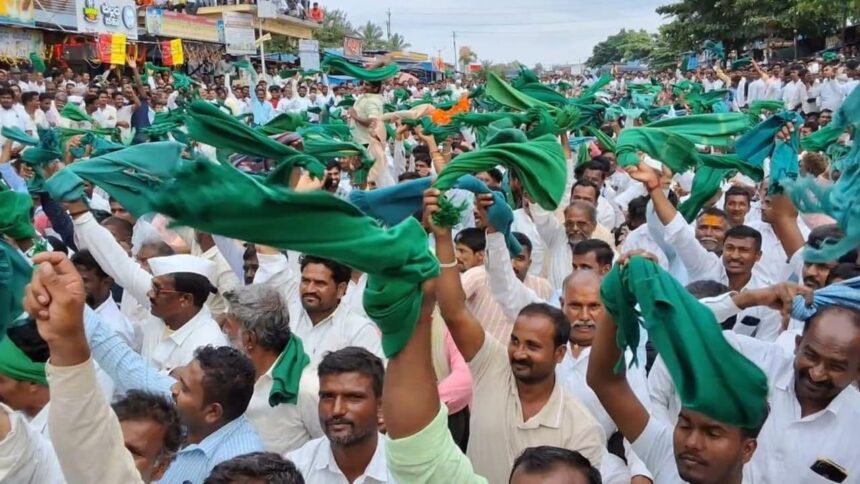
The ongoing agitation by sugarcane farmers in Karnataka took a dramatic turn on November 6 when slippers were allegedly thrown at State Minister Shivanand Patil’s car in Belagavi. The farmers, who have been protesting for over a week demanding a higher price for their produce, confronted the minister during his visit to the protest site. What began as a peaceful demonstration has now grown into a powerful movement reflecting the deep-rooted frustrations of farmers who say their demands have long been ignored by both state and central authorities. The confrontation marks a flashpoint in the state’s agricultural crisis, as thousands of farmers rally for fair compensation for their sugarcane crops amid rising production costs and stagnant prices.
Tensions rise in Belagavi as farmers demand fair price
The protest, now in its eighth day, has become the focal point of rural Karnataka’s discontent with government policies concerning sugarcane pricing. When Minister for Medical Education and Skill Development Shivanand Patil arrived to address the protesting farmers, he was met with anger and frustration from the crowd. Reports suggest that as the minister was leaving the site after his discussions with the farmers, some protesters hurled slippers at his vehicle, expressing their dissatisfaction over what they perceived as an inadequate government response.
Minister Patil, however, maintained composure and appealed for calm, urging the protesters not to escalate the situation. Addressing the gathering and the media, he clarified that the authority to fix sugarcane prices lies not with the Karnataka government but with the Central Government. “I am here to make an appeal, not to escalate the situation. The power to fix sugarcane prices does not lie with the state government—it is under the jurisdiction of the Central Government,” Patil explained.
He went on to elaborate that the Fair and Remunerative Price (FRP) of sugarcane is determined by the Centre, not the state. “The Union Minister for Sugar, who is also from our state, has not yet taken any initiative. The authority and responsibility to resolve this issue rest with the Central Government,” he added, highlighting the administrative complexities that often blur accountability in agricultural matters.
Despite his assurances, the minister’s remarks failed to pacify the crowd, as farmers continued to insist on an immediate and decisive intervention by the state. The ongoing deadlock has put pressure on the Siddaramaiah government to find a way to address the grievances of thousands of farmers across the state, especially in sugar-producing districts such as Belagavi, Bagalkote, and Vijayapura.
Minister Patil later announced that Chief Minister Siddaramaiah would personally intervene in the issue by holding a meeting with sugar mill owners on Friday. “Tomorrow, the Chief Minister has convened a meeting with all sugar mill owners across the state. A final decision will be taken there. Based on that outcome, we will determine how best to extend support to our farmers,” he stated.
Patil also praised the farmers for conducting their protest peacefully and reaffirmed the government’s commitment to their cause. “The farmers’ protest so far has been sincere, and we will make every effort to strengthen their movement. I will personally visit the protest site tomorrow,” he said. However, the situation remains volatile as farmer leaders warn of intensifying their agitation if their demands are not met in the upcoming meeting.
Chief Minister Siddaramaiah’s intervention and plea to the Centre
Amid growing unrest, Chief Minister Siddaramaiah has reached out to Prime Minister Narendra Modi, seeking his urgent intervention in resolving the crisis. In a letter dated November 6, the Chief Minister requested an immediate appointment with the Prime Minister to discuss what he described as a “serious situation arising out of the ongoing agitation by sugarcane farmers” in North Karnataka.
In his communication, Siddaramaiah highlighted the geographical spread and intensity of the protests, pointing out that the agitation has engulfed several key districts, including Belagavi, Bagalkote, Vijayapura, Vijayanagara, Bidar, Gadag, Hubli-Dharwad, and Haveri. The Chief Minister underlined that despite continuous efforts by the state government to engage both farmers and sugar mill owners in dialogue, the situation has worsened. “There is growing unrest among the farming community,” he noted, emphasizing the urgent need for coordinated action between the state and central governments.
The Karnataka government has been under pressure to announce an interim relief package or an enhanced state advisory price (SAP) to supplement the FRP set by the Centre. Farmers argue that the current FRP is insufficient to cover rising input costs such as labour, fuel, and fertilizers, leaving them with little to no profit margins. The state’s sugarcane growers have demanded an increase in the procurement price and the immediate release of pending dues from sugar mills, which amount to several hundred crores.
The Chief Minister’s upcoming meeting with sugar mill owners is expected to play a pivotal role in determining the next steps of the agitation. Sources indicate that the government is considering a proposal to set up a price stabilization fund or extend subsidies to mills to ensure timely payments to farmers. However, these measures will depend largely on discussions with industry representatives and the financial feasibility of additional state support.
Farmer unions have warned that if no concrete decision emerges from Friday’s meeting, they will intensify their protest, potentially leading to statewide demonstrations and blockades of major highways. Some groups have already hinted at staging sit-ins outside government offices and sugar mills if their demands remain unmet.
The crisis has also taken on a political dimension, with opposition parties criticizing the government for its delayed response and accusing both the state and Centre of neglecting the agrarian community. In the Belagavi district, which is a significant sugarcane-producing region, political tensions are particularly high given the upcoming local body elections.
As the agitation enters its ninth day, the administration is on alert to prevent further escalation. Security has been tightened in and around protest sites, especially in Belagavi, where thousands of farmers have gathered. Police have also been deployed along National Highways to prevent possible blockades, as some unions had earlier threatened to halt vehicular movement to draw attention to their demands.
The issue of sugarcane pricing has long been a contentious one in Karnataka, a state that ranks among the top producers of sugar in India. Farmers have repeatedly complained that the FRP announced by the Centre fails to account for regional variations in cultivation costs and market dynamics. In previous years, similar protests have forced the government to intervene and announce ad hoc measures to placate farmers, but long-term solutions have remained elusive.
This year, however, the situation appears more volatile due to the convergence of multiple factors—a delayed monsoon, increasing operational costs, and mounting arrears owed by private sugar mills. The resulting economic distress has deepened resentment among farmers, who now view the current protest as a decisive struggle for fair compensation and dignity.
The outcome of the upcoming meeting between the Chief Minister and sugar mill owners will therefore be critical not only for resolving the immediate crisis but also for shaping Karnataka’s broader agricultural policy. As the government attempts to balance political pressure, fiscal constraints, and farmer expectations, the Belagavi protest stands as a stark reminder of the continuing challenges faced by India’s agricultural sector in ensuring fair remuneration for its cultivators.