Congress leader P. Chidambaram has once again found himself at the center of a political storm after questioning the official narrative around the Pahalgam terror attack. His comments suggesting a lack of concrete evidence proving Pakistani involvement in the attack prompted a sharp rebuke from the BJP, just hours before Parliament was to begin its debate on India’s response under Operation Sindoor. The heated exchange highlights the increasing polarization over national security discourse in India.
P. Chidambaram Questions Investigation, BJP Reacts Sharply
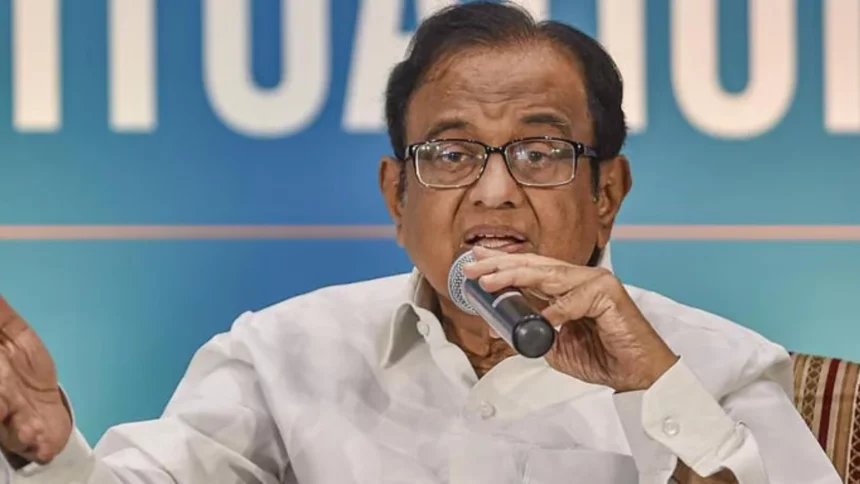
P. Chidambaram, a senior Congress leader and former home minister, stirred controversy when he stated in a media interview that there was no public evidence yet confirming the Pahalgam terrorists were Pakistani nationals. He also raised the possibility that the attackers could be “homegrown terrorists,” which drew a harsh response from BJP leaders, particularly Amit Malviya, the head of the party’s IT cell.
Malviya took to X (formerly Twitter) late Sunday night, accusing the Congress of habitually giving a “clean chit” to Pakistan in matters of cross-border terrorism. Posting a selectively clipped portion of P. Chidambaram’s interview with The Quint, Malviya wrote, “Once again, the Congress rushes to give a clean chit to Pakistan.”
This reaction came on the eve of an important Parliamentary discussion surrounding Operation Sindoor, India’s strategic and diplomatic response to the Pahalgam attack. P. Chidambaram, a Rajya Sabha member, responded hours later with a post of his own, alleging that his words were being taken out of context and manipulated to create outrage.
P. Chidambaram tweeted, “Trolls are of different kinds and use different tools to spread misinformation. The worst kind is a troll who suppresses the full recorded interview, takes two sentences, mutes some words, and paints the speaker in a black colour.”
Debate Over Evidence and Accountability
In the full version of the interview, P. Chidambaram elaborated on what he viewed as gaps in the government’s handling of the investigation. He argued that India should present irrefutable evidence to international stakeholders to ensure that Pakistan is held accountable globally, rather than relying solely on domestic assessments.
“When it comes to national security, there should be no ambiguity,” P. Chidambaram said, warning against premature conclusions without adequate public disclosure. He emphasized the need for transparent communication, especially in incidents that carry both domestic political implications and international diplomatic consequences.
In response, Amit Malviya doubled down, stating that the Congress’s stance routinely demonstrates an eagerness to question India’s institutions while ignoring the actions of its adversaries. He wrote, “With the Congress, there never is [clarity] – they always bend over backwards to protect the enemy.”
The political fallout of the remarks intensified as the Lok Sabha prepared to take up the debate on Operation Sindoor. The Rajya Sabha is scheduled to address the same the following day.
Operation Sindoor, which outlines India’s counter-offensive strategy and diplomatic push following the Pahalgam terror incident, has already garnered wide political and public attention. The debate is expected to touch on various aspects including intelligence response, foreign policy coordination, and cross-border accountability mechanisms.
Meanwhile, the National Investigation Agency (NIA) has maintained that the terrorists involved were Pakistani nationals, though they have yet to officially name them. This detail was central to P. Chidambaram’s argument about transparency and evidentiary standards, which the BJP interpreted as undermining national unity during a sensitive time.
As tempers flare and political lines harden, the Parliament session is poised to be one of the most heated of the current term, with national security once again at the heart of political contention.