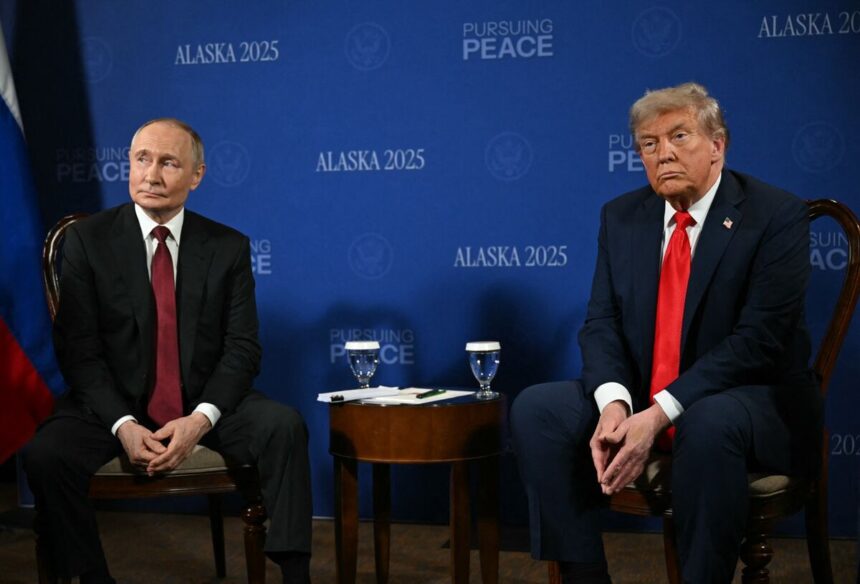
In a major geopolitical development, United States President Donald Trump brushed off Russian President Vladimir Putin’s warning over new American sanctions, asserting that the real impact of the move would be visible within six months. The sanctions, announced against Russia’s two biggest oil giants—Rosneft and Lukoil—mark the first Ukraine-related restrictions imposed by Donald Trump during his second term, signalling a tougher stance against Moscow amid the ongoing war in Ukraine. As Russia warns of retaliation and vows not to yield to external pressure, the diplomatic standoff between Washington and Moscow has intensified, with global oil prices already reacting sharply to the development.
Donald Trump Responds to Vladimir Putin’s Reaction on Sanctions
During a press briefing at the White House on Thursday, President Donald Trump downplayed Moscow’s sharp reaction to the sanctions, which target Russia’s energy sector and key financial operations. When asked by a reporter about President Vladimir Putin’s remarks that the sanctions would not significantly harm Russia’s economy, Donald Trump replied confidently, “I am glad he feels that way. I’ll let you know about it in six months from now. Let’s see how it all works out.”
The remark came just a day after Donald Trump’s administration announced sweeping sanctions on two of Russia’s largest oil corporations—Rosneft and Lukoil—in a move aimed at restricting Russia’s ability to fund its ongoing war efforts in Ukraine. The restrictions will effectively sever these companies’ access to international monetary transactions that rely on the American dollar, thereby tightening Russia’s economic isolation from global markets.
Donald Trump’s statement signalled a measured yet assertive response to Moscow’s defiance, reflecting Washington’s intent to keep economic pressure mounting on the Kremlin. For months, Donald Trump’s administration has faced domestic and international scrutiny over its handling of the Ukraine crisis, and the new sanctions appear to represent a shift toward a more aggressive diplomatic posture.
In Moscow, however, President Vladimir Putin dismissed the latest sanctions as an “unfriendly act that does nothing to strengthen Russian-American relations.” He called them a “futile attempt to put pressure on Russia,” adding that “no self-respecting country ever does anything under pressure.” His words echoed the Kremlin’s long-standing position that Western sanctions only strengthen Russia’s resolve to pursue independent foreign and economic policies.
Vladimir Putin’s statements, delivered to Russian journalists in Moscow, also included a stern warning to Washington. He said that Russia would deliver a “strong response” if Ukraine were to use US-supplied Tomahawk missiles against Russian forces, calling such an act a “red line” that would provoke severe consequences. The Russian leader further reiterated that his country would never “bow down” to US coercion, declaring that Moscow would continue to safeguard its national interests at any cost.
The exchange highlighted a renewed phase of hostility between the two nuclear powers, raising concerns about escalating tensions not only in Ukraine but also in broader global diplomatic relations. Analysts noted that Donald Trump’s tone—firm yet somewhat dismissive—suggested that Washington was ready to test Moscow’s resilience under prolonged economic strain, particularly in the oil sector, which forms the backbone of Russia’s economy.
Washington’s Sanctions and the Global Impact
The sanctions announced on Wednesday are among the most severe measures the United States has imposed on Russia since the beginning of the Ukraine conflict. By targeting Rosneft and Lukoil—companies that dominate Russia’s energy exports—the US aims to weaken Moscow’s primary source of revenue, which funds both its domestic operations and military campaigns.
According to reports by Reuters, global oil prices surged by nearly five percent following Donald Trump’s announcement, reflecting market concerns over potential supply disruptions. Analysts predict that while the sanctions may take months to show full economic impact, they could gradually erode Russia’s access to foreign exchange reserves and global trading networks.
For President Donald Trump, the move represents a pivotal shift in his second-term foreign policy approach. In his first term, Donald Trump often advocated for dialogue with Russia and maintained that engagement, rather than isolation, was the best path toward resolving conflicts such as the war in Ukraine. However, recent developments suggest that the White House has adopted a harder line, emphasizing punitive economic measures as tools of strategic leverage.
Speaking to reporters on Wednesday, Donald Trump explained the rationale behind his decision: “We had planned a meeting with President Vladimir Putin in Budapest, but it just didn’t feel right. It didn’t feel like we were going to get to the place we needed to get. So, I cancelled it. But we’ll meet again in the future.” The statement underscored Donald Trump’s apparent frustration with Moscow’s continued aggression in Ukraine and its refusal to engage in meaningful peace talks.
In addition to affecting Russia directly, the sanctions are expected to reverberate through global energy markets, particularly impacting countries that import large volumes of Russian oil. India and China—two of Russia’s biggest energy partners—could be significantly affected as the sanctions restrict payments made in US dollars. Under the new measures, Russian oil companies will be largely cut off from the global financial network dominated by the dollar, compelling refiners in Asia to explore alternative payment mechanisms or reduce their imports.
While there has been no official statement from New Delhi, reports suggest that several Indian refiners are currently reviewing their Russian oil purchases and awaiting government guidance on future contracts. Donald Trump has previously stated that India would “cut down significantly” on Russian oil imports, a claim that has yet to be confirmed by Indian authorities. Nevertheless, given the sweeping nature of the US sanctions, experts believe that Indian and Chinese refiners will face mounting difficulties in conducting business with Russian energy companies.
The implications extend beyond trade and economics. Strategically, the sanctions are designed to isolate Moscow and pressure it to reconsider its military actions in Ukraine. However, Russia’s leadership appears determined to resist. Vladimir Putin’s rhetoric in recent weeks suggests that Moscow will seek to deepen energy cooperation with non-Western allies and develop new trade routes that bypass Western financial systems. This could accelerate the global shift toward alternative currency blocs and non-dollar-based trade frameworks, particularly among nations wary of US economic dominance.
For Washington, the challenge now lies in balancing the sanctions’ intended impact with their potential blowback. Higher global oil prices could strain consumer economies, including the United States, while pushing Russia closer to strategic partnerships with countries like China and Iran. Nevertheless, senior officials within the Donald Trump administration maintain that the sanctions are a necessary step to uphold global order and counter Russia’s “unlawful aggression.”
As the situation unfolds, much depends on how resilient Russia’s economy remains in the face of sustained financial pressure. Previous rounds of sanctions in the past decade have pushed Moscow to diversify its trade and develop domestic production capacities, reducing its dependence on Western imports. Still, energy exports remain its economic lifeline, and the latest restrictions could deliver a deeper, more lasting blow if enforced rigorously across allied nations.
At the diplomatic level, Washington’s move has also sparked debates among European allies. Some EU member states have expressed concern that heightened sanctions could further destabilize energy markets already under strain. Others, however, have backed the US decision, arguing that a firm stance is essential to deter Russia’s continued aggression.
Back in Moscow, the Kremlin remains defiant. In his Thursday address, Vladimir Putin reiterated that Russia would never succumb to Western economic pressure and would instead focus on strengthening domestic industries and expanding partnerships with “friendly nations.” He emphasized that while sanctions may create short-term disruptions, they also serve as “a catalyst for national resilience and innovation.”
As both leaders hold their ground, the next six months Donald Trump’s own timeline for evaluating the sanctions’ impact—will be crucial. Whether the measures succeed in forcing Russia to alter its course or further entrench Moscow’s defiance remains uncertain. Yet, one thing is clear: the geopolitical fault lines between the United States and Russia have deepened, setting the stage for a prolonged confrontation that could redefine global power dynamics in the years ahead.