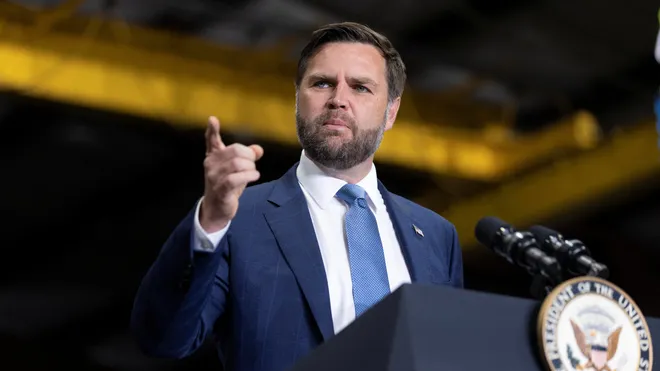
The political landscape in the United States is currently witnessing heightened speculation over the health of President Donald Trump, prompting a rare and pointed statement from Vice President JD Vance. In a recent conversation with USA Today, JD Vance addressed questions regarding his readiness to assume the presidency in the unlikely event of a severe medical emergency affecting President Donald Trump. While emphasizing that the president remains in “great health,” JD Vance assured the public that he has received extensive experience and on-the-job training over the past 200 days, preparing him to step in at a moment’s notice should a “terrible tragedy” occur. This statement has added a new dimension to discussions surrounding presidential health, succession planning, and the stability of the current administration, especially amid media scrutiny of Donald Trump’s recent physical appearances and health disclosures.
Over the past several weeks, the health of the 77-year-old president has become a topic of considerable public interest. Reports of visible bruising on his hand, observed during high-profile meetings such as the encounter with South Korean President Lee Jae Myung, have fueled speculation about his physical well-being. The White House has consistently sought to address these concerns, framing the bruises as a benign consequence of routine handshakes and the use of aspirin. Nevertheless, observers and political analysts alike have pointed to these developments as part of broader discussions about the president’s fitness to serve, succession protocols, and the role of the vice presidency in times of uncertainty.
JD Vance’s remarks, while measured, reflect the unique position he occupies in American governance. As the 41-year-old vice president, he has been intricately involved in the day-to-day functions of the administration since assuming office, gaining insight into executive decision-making, policy priorities, and international diplomacy. His acknowledgment of the potential need to assume presidential duties underscores the constitutional and procedural mechanisms in place to ensure continuity of government in the United States. By highlighting his preparedness and training, JD Vance simultaneously reassures the public about continuity while projecting confidence in President Donald Trump’s current health and capacity to fulfill his duties.
JD Vance Ready to Assume Presidency If Required Amid Public Speculation
In his interview, JD Vance sought to balance reassurance with readiness, stating unequivocally that he believes President Donald Trump is in excellent health and capable of completing the remainder of his term effectively. “I feel very confident the president of the United States is in good shape, is going to serve out the remainder of his term and do great things for the American people,” JD Vance remarked, emphasizing both his faith in the president and his own commitment to national service.
At the same time, JD Vance did not shy away from addressing the constitutional realities of succession. The 25th Amendment of the United States Constitution clearly delineates the procedures for presidential succession in the event of incapacity or unforeseen circumstances. JD Vance noted that the experience he has gained over the last 200 days provides him with the operational knowledge necessary to assume leadership, should circumstances demand it. He described his role as one of both support and preparedness, reflecting the dual responsibilities inherent in the office of the vice president: assisting the president while remaining ready to act decisively in moments of crisis.
While JD Vance’s comments are careful not to alarm the public, they inevitably feed into ongoing political discussions regarding the president’s physical condition. Observers have noted that even minor medical concerns, when magnified by media coverage, can impact perceptions of leadership stability and governance. The discussion surrounding Donald Trump’s health gained momentum following the appearance of a bruise on his hand, first noted in July, which raised questions despite reassurances from the White House. Press Secretary Karoline Leavitt emphasized that the bruise resulted from “frequent, forceful handshakes and the use of aspirin,” noting that President Donald Trump meets more Americans daily than any other president in history.
These explanations are bolstered by medical assessments. White House physician Dr. Sean Barbabella has diagnosed the president with chronic venous insufficiency, a benign condition common among individuals over the age of 70. This diagnosis is characterized by visible swelling in the lower extremities and is generally considered non-life-threatening. Dr. Barbabella’s assessment has been used to reassure both the public and political stakeholders about the president’s capacity to continue his duties without disruption.
Despite these reassurances, political analysts suggest that the visibility of even minor health issues can have outsized effects on public perception. In modern media environments, images and videos of political leaders are scrutinized extensively, and minor anomalies can become points of speculation or concern. The bruise on President Donald Trump’s hand, while medically insignificant, became a focal point of discussion and added urgency to conversations about JD Vance’s preparedness to assume presidential duties.
JD Vance’s statement, therefore, serves multiple purposes: it reinforces confidence in President Donald Trump’s health, demonstrates continuity planning within the executive branch, and reassures the American public that the government remains capable of responding to unforeseen events. By acknowledging the possibility of a “terrible tragedy” while emphasizing his training and preparedness, JD Vance signals both loyalty to the president and a commitment to the constitutional responsibilities of the vice presidency.
Balancing Public Perception, Constitutional Duties, and Political Realities
The role of the vice president in the United States is multifaceted, encompassing both ceremonial functions and critical constitutional responsibilities. Historically, vice presidents have occasionally had to step into the presidency under emergency circumstances, from sudden illnesses to unexpected deaths. JD Vance’s acknowledgment of this potential underscores the importance of preparedness, particularly in an administration where public attention is heightened and media scrutiny is intense.
From a political perspective, JD Vance’s remarks are also a strategic reassurance to party members, voters, and international observers. The continuity of governance is a fundamental concern for allies, investors, and global stakeholders, and a clear message from the vice president about readiness can mitigate potential uncertainties. In the current geopolitical environment, where the United States is engaged in multiple international initiatives and strategic dialogues, such reassurances carry both domestic and international significance.
In addition to addressing potential succession, JD Vance’s comments highlight the broader framework of executive responsibility. His reference to the past 200 days of “on-the-job training” points to a hands-on understanding of policy implementation, crisis management, and diplomatic engagement. This experience, he suggests, equips him to step into the role of president seamlessly, ensuring that governance and policy continuity remain uninterrupted.
The administration’s handling of President Donald Trump’s health-related queries has also involved careful coordination among medical advisors, press officials, and political aides. By emphasizing the benign nature of the chronic venous insufficiency diagnosis and framing the visible bruising as a routine consequence of public engagements, the White House aims to balance transparency with reassurance. This approach reflects a broader understanding of the political and social optics surrounding a president’s health, recognizing that public confidence in leadership is influenced as much by perception as by medical reality.
JD Vance’s statements, therefore, function as a bridge between reassurance and readiness. They acknowledge public curiosity and concern while reinforcing the constitutional safeguards in place. The vice president’s preparedness, coupled with the medical team’s assurances regarding the president’s health, provides a layered approach to maintaining stability.
Furthermore, the comments underscore the evolving nature of media scrutiny in political discourse. In an era of 24/7 news cycles, social media amplification, and rapid dissemination of images, even minor health-related developments can generate significant attention. By addressing these concerns proactively, JD Vance ensures that the narrative remains controlled, emphasizing both trust in President Donald Trump and the institutional readiness of the vice presidency.
This interplay between perception, preparedness, and political messaging exemplifies the delicate balance that high-ranking officials must maintain. JD Vance’s approach reflects an understanding of constitutional duty, public expectation, and strategic communication, providing insight into the responsibilities of leadership in contemporary American governance.
Beyond the immediate context of succession planning, these developments also highlight broader themes in political leadership, health transparency, and the dynamics of public trust. Leaders are increasingly expected to maintain visibility regarding personal well-being, particularly when health can intersect with performance in office. Vice President JD Vance’s remarks situate this discourse within the constitutional framework while acknowledging the practical realities of leadership and governance.