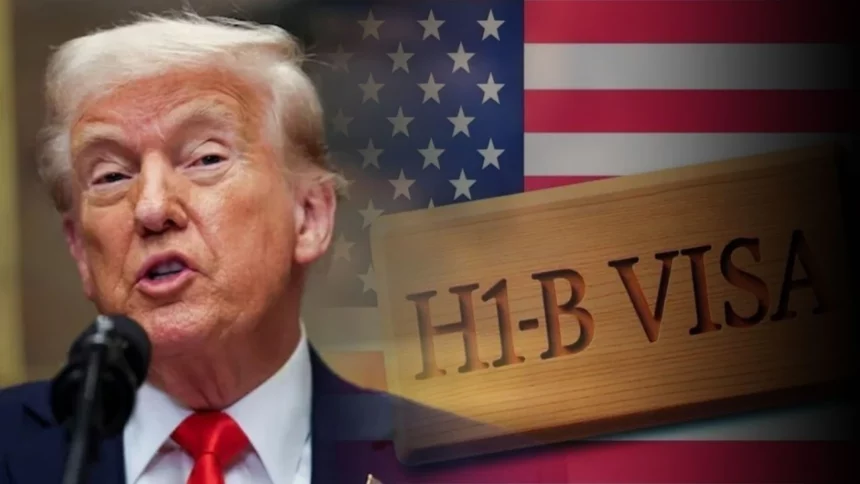
The White House has doubled down on President Donald Trump’s controversial decision to hike H-1B visa fees to $100,000, asserting that the move is aimed at tackling widespread fraud in the system and protecting American workers. The announcement comes amid mounting legal challenges from the US Chamber of Commerce, various unions, employers, and religious organizations, who argue that the fee increase is unlawful and threatens the competitiveness of US industries. As the debate escalates, the administration maintains that the fee hike is necessary to strengthen and refine the H-1B program while ensuring that American wages and employment opportunities are safeguarded.
White House Defends Donald Trump’s Fee Hike and Anti-Fraud Measures
In a media briefing on Thursday, White House Press Secretary Karoline Leavitt defended the administration’s decision, highlighting that the H-1B visa system has been plagued by fraudulent activities for years. According to Leavitt, this widespread abuse has contributed to driving down American wages, creating an unfair advantage for employers exploiting loopholes in the visa system. She emphasized that the administration’s main priority has always been to put American workers first while refining the H-1B program to ensure it operates efficiently and fairly.
“The administration will fight these lawsuits in court. The president’s main priority has always been to put American workers first and to strengthen our visa system. For far too long, the H-1B visa system has been spammed with fraud, and that’s driven down American wages,” Leavitt stated. She reiterated that the new fee and related policies are lawful, necessary, and part of a broader effort to improve the integrity of the visa system.
Leavitt further explained that the administration views the fee hike not as a punitive measure, but as a corrective tool to curb systemic abuse. Under the revised regulations, companies seeking to hire skilled foreign workers under the H-1B program would be required to pay the $100,000 fee in addition to existing vetting charges. This step, according to the administration, ensures that only genuinely qualified employers with legitimate hiring needs utilize the system, thereby reducing fraudulent petitions and maintaining wage standards for American workers.
The White House emphasized that the fee hike also aligns with Donald Trump’s broader immigration and economic agenda, which focuses on prioritizing domestic employment, increasing wage growth, and addressing systemic inefficiencies. By taking this approach, the administration asserts that it is providing a fairer, more balanced framework for both employers and workers.
Legal Challenges and Industry Pushback
The announcement of the $100,000 H-1B fee has sparked immediate backlash from the business community and advocacy groups. The US Chamber of Commerce filed a lawsuit challenging the legality of the fee increase, arguing that it violates provisions of the Immigration and Nationality Act, which governs the H-1B program. According to the Chamber, the Act stipulates that fees must be calculated based on the government’s actual costs for processing visas, not as a revenue-generating measure or regulatory tool.
Neil Bradley, Executive Vice President and Chief Policy Officer at the US Chamber, warned that the fee hike could make the H-1B program prohibitively expensive for many US employers, particularly start-ups and small-to-medium enterprises. “The new $100,000 visa fee will make it cost-prohibitive for US employers, especially start-ups and small and midsize businesses, to utilize the H-1B program, which Congress created expressly to ensure that American businesses of all sizes can access the global talent they need to grow their operations here in the US,” Bradley said.
Several unions, religious organizations, and employer associations have also filed lawsuits in federal courts across California and Washington DC, describing the fee hike as “unlawful, unfair, and detrimental” to American business growth. They argue that such steep fees could discourage employers from sponsoring skilled foreign workers, ultimately harming industries that rely on specialized talent, including technology, healthcare, and engineering sectors.
Despite the legal opposition, the Donald Trump administration maintains that its policies are justified and necessary to ensure the program’s integrity. The White House contends that previous H-1B visa rules allowed exploitation, where fraudulent applications were used to undercut wages and bypass legal hiring practices. By imposing the $100,000 fee, the administration aims to filter out non-compliant or exploitative employers while creating a fairer market for American and foreign workers alike.
Experts note that the fee hike could have broader economic implications beyond the immediate H-1B program. Companies that rely heavily on international talent may face increased operational costs, potentially slowing innovation and hiring. Conversely, proponents argue that the changes could strengthen domestic labor markets, protect wages, and encourage companies to invest more in American talent development programs.
The administration’s strategy also ties into broader efforts to address immigration reform and economic competitiveness. By implementing stricter fees and vetting mechanisms, the White House claims it is modernizing the visa system, reducing fraud, and ensuring that skilled foreign workers complement rather than compete with the American workforce.
Additionally, the Donald Trump administration has framed this policy as part of a comprehensive agenda to boost domestic economic growth, attract investment, and streamline regulatory burdens. According to the White House, these reforms will ultimately strengthen the US economy while maintaining a balance between access to international talent and the protection of domestic employment opportunities.
The ongoing legal battles will test the administration’s ability to enforce the fee hike while defending its rationale in federal courts. The outcomes could set significant precedents for the future of the H-1B visa program, potentially reshaping the way US employers access skilled global talent. As the litigation unfolds, stakeholders from business, labor, and policy circles will closely monitor whether the Donald Trump administration’s claims of curbing fraud and protecting American wages withstand judicial scrutiny.
The broader implications for the US labor market are also substantial. Industries heavily dependent on H-1B visas, such as technology and healthcare, may face talent shortages or increased costs, potentially slowing growth and innovation. At the same time, the administration’s focus on anti-fraud measures is intended to ensure that opportunities under the H-1B system are fairly allocated, promoting both economic efficiency and equity for American workers.