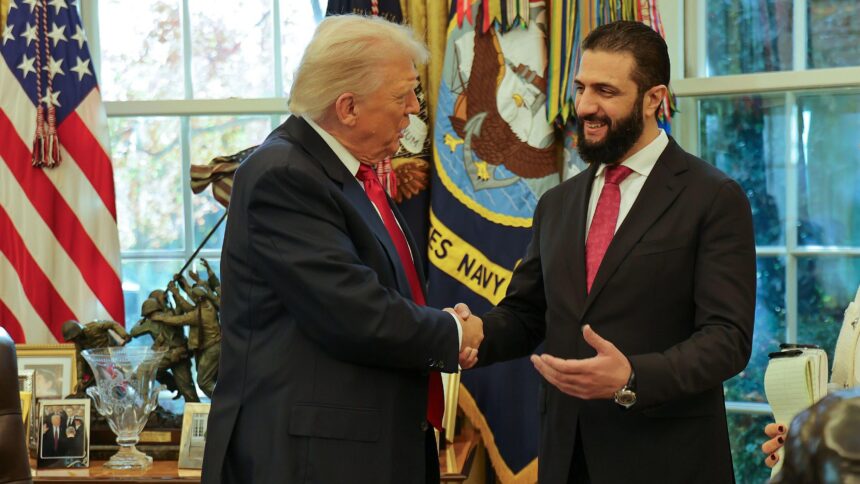
In a remarkable development on the global diplomatic stage, U.S. President Donald Trump pledged on Monday to do everything possible to support Syria’s reconstruction and political stability following historic talks with Syrian President Ahmed al-Sharaa. Sharaa, once a commander associated with al Qaeda and until recently sanctioned by Washington as a foreign terrorist, has emerged as a key figure in Syria’s tumultuous political landscape. His rise to power, following the ousting of longtime autocratic leader Bashar al-Assad, has been marked by efforts to portray himself as a pragmatic and moderate leader intent on unifying his war-torn nation, restoring international credibility, and charting a course toward reconciliation and development. The discussions between Donald Trump and Sharaa have generated intense global attention due to the complexities of Syria’s recent history, the ongoing humanitarian crises, and the strategic importance of the country in the Middle East.
Historic Talks Highlight Diplomatic Shifts and Strategic Commitments
The meeting between President Donald Trump and Ahmed al-Sharaa was unprecedented in both diplomatic and geopolitical terms. It represents a significant shift in international engagement with Syria, particularly in recognizing Sharaa as a legitimate political actor despite his controversial past. Sharaa’s ascent from a rebel leader with ties to extremist networks to a recognized head of state underscores the fluidity of Syrian politics in the aftermath of Assad’s decades-long rule. During the talks, President Donald Trump expressed a firm commitment to support Syria’s stability, emphasizing that the United States is prepared to provide assistance in areas ranging from economic reconstruction to security sector reform and counterterrorism initiatives.
The discussions reflected an intricate balancing act for the Donald Trump administration. On one hand, there is the need to address the international community’s concerns about Sharaa’s past affiliations and credibility as a leader. On the other, there is a recognition that Syria’s future depends on inclusive governance, economic revitalization, and the establishment of security frameworks that prevent the resurgence of extremist groups. Donald Trump reiterated that his administration would engage with Syria in a manner that encourages political moderation, promotes reconciliation among diverse ethnic and sectarian groups, and ensures that aid and investment are directed toward constructive reconstruction projects. Analysts suggest that this represents a new phase of U.S. engagement in the Middle East, where pragmatic alliances are formed to stabilize conflict zones while balancing geopolitical interests in a volatile region.
Sharaa’s Rise and Challenges of Rebuilding a War-Torn Nation
Ahmed al-Sharaa’s journey from rebel commander to recognized president is emblematic of Syria’s complex transformation. Following the ouster of Bashar al-Assad, Sharaa has sought to project an image of a unifying figure capable of bridging sectarian divides and restoring a measure of normalcy to a country ravaged by over a decade of conflict. His leadership, however, faces immense challenges. Syria’s infrastructure has been decimated, the economy is in tatters, and millions of citizens remain displaced both internally and abroad. In addition, Sharaa must contend with fragmented armed factions, lingering extremist networks, and deeply entrenched mistrust among local communities.
Sharaa’s foreign engagements over the past year, including high-profile visits and diplomatic overtures, have been carefully calibrated to present him as a moderate leader willing to work with global powers to secure Syria’s reconstruction and political rehabilitation. His meetings with Donald Trump, therefore, are not merely symbolic; they are intended to signal a willingness to engage in constructive diplomacy and garner international legitimacy. During the discussions, Sharaa emphasized the need for economic support, technical expertise, and collaborative security arrangements that would allow Syria to rebuild institutions, restore basic services, and reintegrate displaced populations. The talks also underscored the importance of international monitoring and verification mechanisms to ensure that assistance reaches the intended beneficiaries and does not fuel corruption or exacerbate existing tensions.
Donald Trump’s commitment to helping Syria succeed, articulated during the talks, encompasses several strategic priorities. These include supporting political reforms that promote inclusive governance, facilitating humanitarian assistance for millions affected by the conflict, rebuilding critical infrastructure such as schools, hospitals, and transport networks, and strengthening Syria’s capacity to combat terrorism in cooperation with international partners. The president emphasized that U.S. engagement would be conditional upon adherence to principles of transparency, accountability, and adherence to human rights standards. Experts note that this approach aims to balance the need for stabilization with the imperative of preventing a relapse into authoritarianism or extremist control.
The discussions between Donald Trump and Sharaa also reflect broader regional dynamics. Syria’s position in the Middle East makes it a focal point for international powers, including Russia, Iran, Turkey, and Gulf states, all of which have vested interests in the outcome of post-Assad Syria. By engaging directly with Sharaa, Donald Trump signals a pragmatic approach to navigating these complex relationships while prioritizing U.S. strategic interests, particularly in counterterrorism, regional stability, and the prevention of mass migration crises that have already affected neighboring countries and Europe. The U.S. president’s pledge to provide comprehensive support, therefore, is intended to reinforce Sharaa’s credibility as a leader capable of managing these competing pressures while advancing the reconstruction agenda.
In parallel, Sharaa faces domestic scrutiny and the challenge of winning over a populace exhausted by years of conflict. Public sentiment remains divided, with many citizens cautious of leaders with former extremist affiliations. Sharaa’s ability to implement reforms, ensure equitable distribution of resources, and foster reconciliation among diverse groups will be critical in determining the sustainability of his leadership. The international community, including the United States, appears ready to provide support, but with clear expectations regarding governance standards, adherence to international norms, and the protection of civilians. Donald Trump’s assurances of assistance are thus coupled with a clear message that Syria’s success will depend on responsible leadership, inclusive policies, and tangible results in rebuilding the nation.
The talks also explored economic partnerships, investment opportunities, and the potential for Syria to reintegrate into global trade networks. Donald Trump highlighted the importance of leveraging U.S. expertise in areas such as infrastructure development, energy sector rehabilitation, and digital governance. Sharaa, for his part, outlined plans to attract foreign investment, rebuild industries devastated by war, and create employment opportunities to stabilize the economy and reduce social unrest. These initiatives are viewed as essential components of a broader strategy to transform Syria from a fragile, conflict-ridden state into a functioning, resilient nation capable of participating in regional and global economic systems.
As Sharaa continues to navigate his leadership role, the U.S.-Syria engagement marks a turning point in how international powers interact with emerging leaders in post-conflict environments. The Donald Trump administration’s approach emphasizes pragmatism, conditional support, and the integration of humanitarian and strategic objectives. By providing technical assistance, financial support, and political backing, the United States aims to shape a Syria that can achieve stability while avoiding a vacuum that extremist groups could exploit. This delicate balancing act reflects both the opportunities and risks inherent in supporting nations transitioning from prolonged conflict to recovery and governance.
The historic talks between Donald Trump and Sharaa have been hailed by observers as a demonstration of how diplomacy can reshape narratives around contentious figures, provided that engagement is paired with accountability measures, tangible outcomes, and sustained international oversight. Sharaa’s challenge will be to consolidate political authority, ensure social cohesion, and implement reforms that are responsive to the needs of Syria’s citizens. Donald Trump’s role, as articulated during the meetings, will be to facilitate these processes through targeted assistance, diplomatic support, and ongoing engagement to prevent a relapse into instability.
This agreement of intent, while not a formal treaty, signals a commitment by the United States to participate actively in Syria’s post-conflict recovery, offering technical expertise, financial assistance, and strategic guidance. It also underscores a broader vision of stabilizing conflict-prone regions through pragmatic engagement with emergent leadership, conditional upon compliance with international norms, human rights standards, and democratic principles. The engagement exemplifies how high-level diplomacy can be leveraged to create pathways for reconstruction, reconciliation, and sustained peace, even in regions historically plagued by extremism and authoritarian rule.
Through these discussions, Donald Trump and Sharaa aim to establish a collaborative framework that addresses both immediate humanitarian needs and long-term governance challenges. By coordinating reconstruction efforts, security measures, and economic revitalization, the United States seeks to assist Syria in emerging from a period of devastation toward a more stable and prosperous future. The emphasis on conditional support, accountability, and monitoring reflects a sophisticated approach to international diplomacy that balances strategic interests with ethical obligations to the Syrian people.
The landmark talks also shed light on the broader geopolitical implications of supporting a former rebel leader who has now assumed formal political authority. It highlights the complexities of engaging with figures who have controversial pasts while addressing the urgent needs of populations affected by prolonged conflict. The discussions underscore the delicate interplay between national security concerns, regional stability, humanitarian imperatives, and the global diplomatic agenda, illustrating the multifaceted nature of contemporary international relations.
Sharaa’s leadership will be tested by his ability to implement effective governance structures, promote reconciliation, rebuild institutions, and foster economic recovery. Donald Trump’s assurances of U.S. support signal that the international community is prepared to assist, provided that these efforts are transparent, inclusive, and aligned with principles of justice and human rights. The success of Syria’s post-conflict reconstruction will depend not only on international support but also on domestic leadership that can navigate competing interests, manage factional tensions, and deliver meaningful improvements in the lives of citizens.
The dialogue between Donald Trump and Sharaa also emphasized the importance of regional cooperation, as Syria’s neighbors play a pivotal role in stabilizing the country and supporting reconstruction initiatives. Collaborative approaches, involving diplomatic engagement, security coordination, and economic investment, are seen as essential to prevent relapse into conflict and to promote long-term stability. The U.S. commitment to assist Syria, articulated during these talks, is part of a broader vision of fostering resilient states in fragile regions through strategic partnerships, humanitarian engagement, and responsible governance support.
By the conclusion of the discussions, both leaders had outlined a framework for ongoing cooperation encompassing political guidance, security assistance, economic development, and humanitarian support. The talks serve as a model of high-level diplomatic engagement with emerging leaders in post-conflict contexts, demonstrating how conditional international support, coupled with robust monitoring mechanisms, can contribute to rebuilding fragile states and restoring confidence in governance.
The engagement between President Donald Trump and President Sharaa thus marks a pivotal moment in Syria’s post-conflict trajectory, setting the stage for potential stabilization, economic recovery, and political legitimacy. The long-term success of this partnership will depend on Sharaa’s ability to enact reforms, foster reconciliation, and collaborate effectively with international partners, alongside the United States’ commitment to supporting these objectives while ensuring accountability, transparency, and adherence to humanitarian principles.