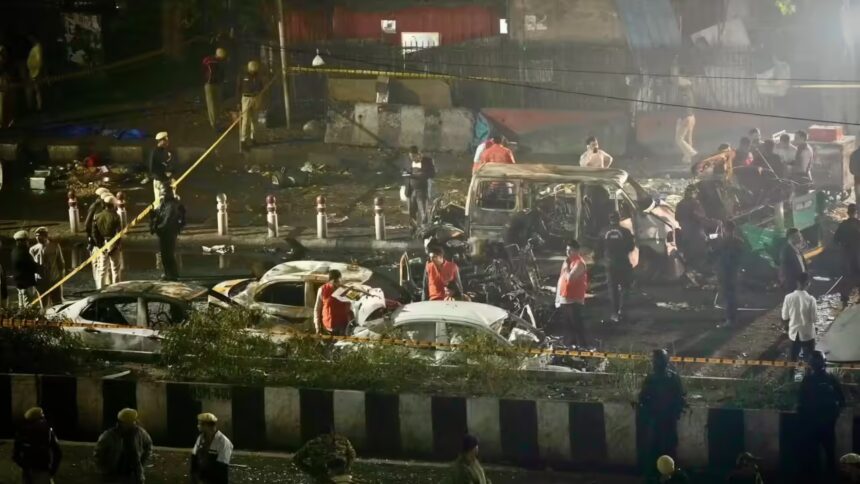
The deadly explosion near Delhi’s Red Fort on Monday evening that claimed 13 lives and left 21 injured has taken a chilling turn. Delhi Police investigators have traced the white Hyundai i20 car involved in the blast to a Kashmir-based doctor allegedly connected with a terror module operating across multiple states. The module is reportedly linked to the recent seizure of nearly 2,900 kilograms of explosive materials in Faridabad, pointing toward a larger terror conspiracy spanning Delhi, Haryana, and Jammu and Kashmir.
Links Between Red Fort Blast and Faridabad Module Emerge in Probe
According to two senior officials from the Delhi Police Special Cell, the i20 used in the explosion has been traced to Dr. Umar Un Nabi, a resident of Pulwama, Jammu and Kashmir. Umar, they said, was part of a network involving two other doctors from Kashmir—identified as Muzammil Shakil and Adil Ahmed—both of whom were arrested earlier for suspected links to terror outfits. The initial probe suggests Umar was driving the car when the explosion occurred near a traffic signal close to Sunehri Masjid, just minutes before 7 pm.
The officers revealed that the blast was so powerful that it engulfed multiple nearby vehicles, leading to a scene of chaos and destruction in the heart of Delhi. “Our initial assessment suggests that Umar was inside the i20 at the time of the explosion. He appears to have been the one who planned and executed the attack, possibly in retaliation or panic after his associates were arrested,” said one of the investigating officers on condition of anonymity.
The police have registered a First Information Report (FIR) under multiple sections of the Unlawful Activities (Prevention) Act (UAPA), the Bharatiya Nyaya Sanhita (BNS) provisions on murder and attempt to murder, and the Explosives Act. Forensic teams, National Investigation Agency (NIA) officials, and Delhi Police Special Cell investigators are jointly examining the evidence to determine whether the explosion was part of a planned terror strike or an accidental detonation during transportation.
One officer detailed the trail that led to Umar. The car, initially registered in the name of a man named Salman, changed hands several times. Salman told investigators he sold the car to a man named Devender, who in turn sold it to a person identified as Taariq. The chain eventually led police to Umar. “It was a long and complex trail before we reached him. When we began tracking Taariq, we discovered the car’s last known user was Umar. Soon after, we confirmed that Umar was driving it at the time of the explosion,” the officer explained.
The second officer added that preliminary identification from mortuary reports indicates Umar might have died in the explosion. “We have cross-verified details with the Jammu and Kashmir Police, who have confirmed his identity and terror links. Umar worked within the same module as the two doctors previously arrested. Their connection is now established,” the officer stated.
Investigators further discovered that Umar and his associates were inspired by radical propaganda circulated online by proscribed terror outfits like Jaish-e-Mohammad (JeM) and Ansar Ghazwat-ul-Hind (AGuH). According to intelligence inputs, the group aimed to carry out low-intensity strikes in major cities to cause public panic and disrupt security establishments.
Trail of Explosives Leads to Faridabad Raids
The ongoing investigation into the Red Fort blast has revived focus on the Faridabad terror module that was dismantled earlier this month. Raids conducted by Haryana and Jammu and Kashmir Police—alongside central investigative agencies—had unearthed nearly 2,900 kilograms of ammonium nitrate, detonators, and other bomb-making materials from multiple locations, including Dhauj and Fatehpur Taga villages in Faridabad.
Officials confirmed that these seizures were linked to the same network operating under the influence of banned outfits JeM and AGuH. The trail began in October when multiple threatening posters bearing the insignia of these groups were found in the Bunpora area of Nowgam, Srinagar. The posters called for anti-India activities and warned security forces of imminent attacks.
Based on these leads, police traced one of the key suspects, Adil Ahmed, to Sharanpur in Uttar Pradesh, from where he was arrested. Another suspect, Muzammil Shakil—a fourth-year MBBS student studying in Faridabad—was apprehended from Pulwama. Interrogation of these men led to the recovery of huge caches of explosives, automatic rifles, and incriminating materials pointing toward an active terror module planning coordinated strikes in northern India.
The latest findings linking Umar and the Red Fort blast to the Faridabad network indicate that the group’s operations were far more expansive than initially believed. Investigators are now examining whether Umar’s move to Delhi was premeditated or an act of desperation after the arrests of his associates disrupted the module’s plans.
According to one senior intelligence officer, “The Faridabad module was not an isolated cell. It had logistical and financial backing from handlers operating through encrypted communication channels. The Red Fort blast appears to be an extension of the same chain, possibly intended to avenge the crackdown or divert attention from ongoing raids.”
CCTV footage reviewed by the police showed that the white Hyundai i20, with registration number HR26CE7674, was parked in a nearby lot around 4 pm before being driven toward the Chhata Rail Chowk. The car then took a U-turn and approached Lower Subhash Marg. At around 6:52 pm, just as the vehicle slowed near a red light, the explosion occurred. The visuals captured a sudden flash followed by plumes of smoke and debris scattering across the busy stretch.
Experts from the National Security Guard (NSG) and forensic teams have suggested that the magnitude of the blast points to a high-grade explosive, possibly ammonia gel or a similar compound. The intensity of the fire and the spread of shrapnel indicate a deliberate device rather than an accidental CNG tank rupture, as initially suspected. However, final confirmation awaits the completion of chemical analysis from the Forensic Science Laboratory (FSL).
Meanwhile, the Delhi Police have tightened security around major landmarks and deployed additional Quick Response Teams (QRTs) across the capital. Enhanced checks have been ordered for vehicles entering Delhi, especially those with registration numbers from neighboring states. Central agencies are also verifying whether the network had sleeper cells in Delhi-NCR.
Sources have revealed that five additional suspects, including a cleric believed to have facilitated communication between module members, have been detained for questioning. Digital devices recovered from their possession are being analyzed for encrypted chats, transaction records, and contact lists. The investigators are particularly focused on tracing financial routes that funded the procurement of explosive materials and vehicles used in the operations.
The joint team of Delhi Police, NIA, and intelligence agencies is now working on reconstructing the sequence of events leading up to the blast—from the acquisition of the vehicle and explosive materials to the final execution. “We are looking at a carefully orchestrated plan that combined medical professionals’ expertise in chemicals with radicalized ideology and logistical support from handlers outside India,” said an officer involved in the investigation.
Officers have not ruled out the possibility that Umar and his group were experimenting with homemade explosives when the device accidentally detonated inside the car. “There’s evidence suggesting that the blast could have been unintentional, caused by premature detonation during transportation. However, given the links to known terror modules, we cannot treat it as an accident until the probe is complete,” the officer added.
The blast near Red Fort has sent shockwaves through national security circles, given its proximity to a high-security zone that includes several government buildings and tourist landmarks. The timing of the explosion, just as evening crowds began gathering, underscores the potential for mass casualties had the explosion been more powerful.
As the investigation deepens, agencies are piecing together how a seemingly innocuous vehicle found its way into one of the most secure areas in Delhi. The revelation that a trained medical professional with no prior criminal record could have been part of a terror plot has further unsettled authorities. It has also raised concerns about radicalization among educated youth in conflict-prone regions.
For now, the Delhi Police and central agencies remain on high alert, with the probe expanding across multiple states. The discovery of the Faridabad explosives cache and the linkage to the Red Fort blast represent one of the most significant terror investigations in recent years, potentially exposing a vast and coordinated network seeking to destabilize the region.