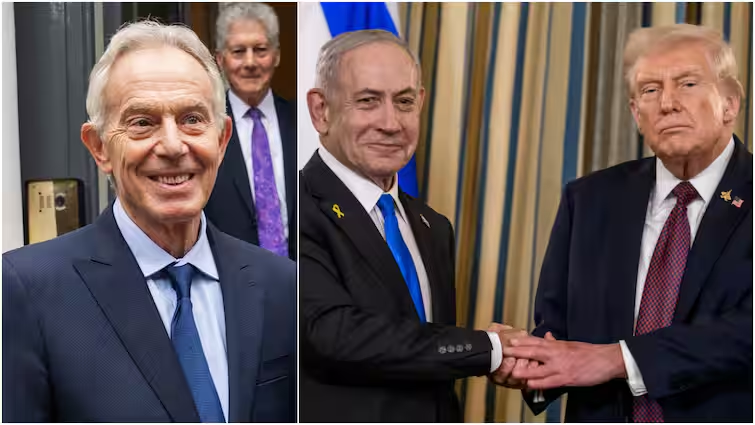
US President Donald Trump and former British Prime Minister Tony Blair have jointly unveiled a 20-point plan for Gaza, intended to bring stability to the besieged enclave. While proponents present it as a roadmap for humanitarian relief and conflict resolution, critics argue that the plan could fundamentally undermine Palestinian sovereignty and identity, transferring control of Gaza into the hands of an international corporate-style “Board of Peace.” The proposal, which has already received Israeli approval from Prime Minister Benjamin Netanyahu, has been characterized by ambiguity, vague timelines, and heavy concessions to Israel, raising concerns about its practical implementation and long-term consequences. Analysts, former diplomats, and Palestinian political observers caution that the plan may disarm Hamas while leaving the Palestinian population vulnerable to occupation, forced displacement, and economic exploitation, all under the guise of international oversight.
Disarming Gaza and Humanitarian Promises: An Uncertain Path
The Donald Trump-Tony Blair plan outlines the disarmament of Hamas and the removal of its influence from Gaza, effectively taking control of the territory out of Palestinian hands. While it includes provisions that may be appealing to some in Palestinian society, such as the release of 250 life-sentence prisoners and 1,700 detainees held since October 2023, the plan’s effectiveness remains highly uncertain. The proposal notes that women and children detained in this context would be freed, implicitly acknowledging that they were used as bargaining tools. Additionally, the plan promises immediate humanitarian aid via neutral agencies such as the UN and Red Crescent, bypassing Israeli-associated organizations. However, the lack of clear timelines and specific implementation measures introduces flexibility for Israel, potentially allowing it to delay withdrawals or maintain military control over key areas, including Rafah, Khan Younis, Jabalia, and Beit Hanoun.
Analysts note that the proposed deployment of an International Stabilisation Force (ISF) to oversee Gaza could be more symbolic than substantive, as details of milestones, timelines, and enforcement mechanisms remain vague. Daniel Levy, a British-Israeli analyst and former peace negotiator, emphasizes that the ambiguity is intentional, allowing Israel to shift blame or resume military operations if it chooses to do so. Former US State Department official Annelle Sheline also highlights the plan’s similarity to past US-led agreements, noting the absence of penalties for Israel if the terms are not met, a pattern that undermines accountability and effective conflict resolution. Critics argue that while the plan offers humanitarian incentives, including the potential for infrastructure rebuilding and aid distribution, these measures are insufficient without robust enforcement mechanisms and guarantees of Palestinian autonomy.
The Corporate Board and Governance: Gaza Under International Oversight
Central to the plan is the establishment of a “Board of Peace” to govern Gaza during a transitional period. Donald Trump is slated to head this board, with Tony Blair serving in a supportive role, alongside other international figures. Leaked reports indicate that the board would consist primarily of billionaires and business leaders at the top, with highly vetted “neutral” Palestinian administrators occupying lower-level positions. Analysts argue that the structure resembles a corporate hierarchy rather than a governance framework designed for a national territory. The plan’s language emphasizes management, trade, and economic development, leaving little room for political agency, cultural identity, or Palestinian self-determination.
Palestinian observers warn that the corporate-style governance framework effectively strips Gaza of its political institutions, undermining both Hamas and the Palestinian Authority, which currently administers parts of the West Bank. Abed Abou Shhadeh, a political analyst based in Jaffa, notes that the exclusion of existing Palestinian political entities reflects a deliberate attempt to prioritize corporate and economic control over the rights and history of the Palestinian people. Similarly, Qossay Hamed, an academic specializing in Hamas, emphasizes that the plan’s vague approach to governance, displacement, and infrastructure rebuilding may create conditions that force Palestinians to leave voluntarily due to unlivable conditions, even if forced expulsion is not explicitly mentioned. The destruction of Gaza’s tunnel networks, hinted at in the proposal, is one such example of measures that could make the enclave increasingly inhospitable.
Beyond governance, the plan envisions interfaith dialogue and efforts to foster peaceful coexistence between Palestinians and Israelis. However, critics note the absence of corresponding measures to address radicalization or the broader societal attitudes in Israel that continue to support mass killings, displacement, and food deprivation in Gaza. The plan’s focus on Palestinian behavior and reform, rather than Israeli accountability, has raised concerns about fairness and balance, with analysts arguing that it reflects a power imbalance favoring Israel while minimizing the agency and sovereignty of Gaza’s population.
The 20-point proposal also leaves open questions about the long-term establishment of a Palestinian state. While it acknowledges the Palestinian desire for an independent state, there are no binding commitments from Israel to facilitate statehood or territorial sovereignty. Observers note that Israeli leadership, particularly Prime Minister Netanyahu, has consistently opposed a viable Palestinian state and is likely to exploit ambiguities in the plan to delay or prevent meaningful autonomy. Critics argue that the plan’s corporate-style governance and emphasis on economic metrics over national identity reflect a broader strategy of controlling Gaza through external actors, rather than enabling Palestinian self-governance and political independence.
Donald Trump and Tony Blair’s Gaza plan presents a complex and controversial approach to conflict resolution. While it includes humanitarian elements and the promise of political reform, the lack of clarity, enforcement mechanisms, and consideration for Palestinian sovereignty raises significant questions about its viability. Analysts caution that by prioritizing corporate-style governance, disarmament of Palestinian political entities, and reliance on international oversight, the plan risks replicating historical patterns of occupation and exploitation. Observers stress that genuine peace and stability in Gaza require measures that address both humanitarian needs and political rights, ensuring that the Palestinian population retains agency, identity, and meaningful participation in governance.
The debate surrounding the plan underscores the challenges of external interventions in protracted conflicts, particularly when proposals prioritize international oversight and economic considerations over political agency and local self-determination. Critics argue that the plan, while framed as a pathway to peace, may effectively cement occupation, reduce Palestinian autonomy, and create conditions in which displacement occurs indirectly through unlivable living circumstances. As analysts, diplomats, and Palestinian observers continue to scrutinize the plan, it remains to be seen whether the 20-point proposal can deliver on its promises or will serve primarily as a vehicle for consolidating control over Gaza while offering only limited and conditional humanitarian relief.
This complex approach, blending humanitarian incentives, corporate-style governance, and vague timelines, highlights the tension between international intervention and local self-determination in Gaza. While Donald Trump and Tony Blair emphasize peace, dialogue, and reconstruction, the plan’s execution, accountability, and impact on Palestinian identity remain highly uncertain. The international community’s response, the willingness of Israel to adhere to the agreement, and the capacity of Palestinians to negotiate meaningful terms will all play crucial roles in determining whether the plan achieves its stated objectives or reinforces existing inequalities, vulnerabilities, and patterns of external control in Gaza.
The Gaza plan, with its focus on corporate governance, international oversight, and selective humanitarian measures, raises broader questions about the role of external actors in shaping the political, social, and economic future of occupied territories. Analysts argue that the emphasis on economic metrics, boards, and management, rather than political legitimacy and sovereignty, may fundamentally alter Gaza’s governance and identity. By prioritizing corporate actors and international oversight over local political institutions, the plan risks perpetuating historical patterns of external control and undermining Palestinian self-determination.
The Donald Trump-Tony Blair Gaza plan exemplifies the complex intersection of international diplomacy, humanitarian relief, corporate-style governance, and local sovereignty in conflict zones. While it presents potential opportunities for short-term aid and structural reform, it raises significant questions regarding Palestinian identity, political representation, and the balance of power in the region. The plan’s ambiguity, lack of enforceable commitments, and reliance on external actors highlight the ongoing challenges of crafting sustainable and equitable solutions for Gaza, where decades of conflict, occupation, and humanitarian crises have left deep social, political, and economic scars.