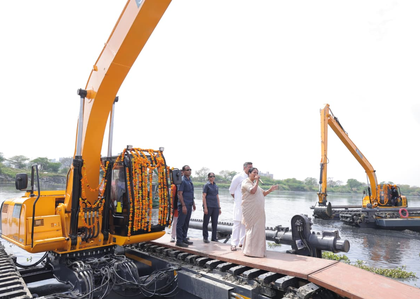
New Delhi | March 13, 2026 — Delhi Chief Minister Rekha Gupta launched advanced amphibious excavator machines for cleaning the Najafgarh drain and Pankha Road drain. The machines will be used for desilting, removing waste, and clearing water hyacinth from major drains to improve water flow and reduce waterlogging during the monsoon season.
The launch took place at Badusarai Bridge, where the Chief Minister flagged off multiple amphibious excavators equipped with long-boom and short-boom configurations.
Speaking at the event, Rekha Gupta said the Delhi government is committed to cleaning the city’s drains and improving the health of the Yamuna River by using modern technology.
Cabinet Ministers Parvesh Sahib Singh and Ashish Sood, along with senior officials from the concerned departments, were also present at the event.
Najafgarh Drain Desilting to Remove Massive Sediment
The Chief Minister said the Najafgarh drain is the largest drainage channel in Delhi and carries nearly 75 percent of the silt generated by the city’s drainage system.
According to estimates, more than 10 million metric tons of silt have accumulated in the Najafgarh drain over the years. Removing this sediment has traditionally been a challenging task.
With the deployment of amphibious machines, officials will now be able to reach the middle sections of the drain and remove long-standing deposits of silt more efficiently.
The Delhi government has also decided to procure additional amphibious machines. One machine had already been deployed earlier, while four new machines were launched during the event. Additional units are expected to be delivered soon.
The Chief Minister said the government is now focusing on year-round desilting operations instead of restricting the activity to the pre-monsoon period.
Improving Drainage and Cleaning the Yamuna
Rekha Gupta said the Delhi government is committed to improving drainage infrastructure and restoring the Yamuna River.
Cabinet Minister Parvesh Sahib Singh said the use of amphibious machines will help remove silt, garbage, sludge, and water hyacinth that have accumulated in the drains over many years.
He noted that improving the flow capacity of drains will help reduce waterlogging during heavy rainfall.
Addressing Long-Standing Issues in Pankha Road Drain
Cabinet Minister Ashish Sood said the beautification and cleaning of the Pankha Road drain was an important commitment made during the assembly elections.
For several years, the lack of proper cleaning had caused waterlogging and foul smell problems for nearby residents during the monsoon season.
After the formation of the government, work began to address the issue. New walls have been constructed along sections of the drain, and initial cleaning and beautification work has already been completed.
Technical Features of Amphibious Excavators
According to the Irrigation and Flood Control Department, the short-boom amphibious machine costs approximately ₹1.27 crore. It features a 6-meter boom, 0.20 cubic meter bucket capacity, and a 65 HP engine, allowing it to operate even in narrow drains.
The long-boom amphibious machine costs around ₹3.15 crore and includes a 15-meter boom, 0.50 cubic meter bucket capacity, and a 135 HP engine capable of working up to nine meters deep.
Both machines are designed to operate in dry, marshy, and water-filled environments and can efficiently remove silt, debris, sludge, and floating vegetation.