New Delhi, December 26, 2025:
The Delhi government has intensified its efforts to control air pollution and reduce traffic congestion by rolling out a comprehensive reform agenda in the transport sector, with a strong emphasis on shared taxi services, electric mobility, and stricter vehicle fitness monitoring. Chief Minister Rekha Gupta said the government’s core objective is to reduce the number of vehicles on city roads without compromising passenger convenience, while simultaneously ensuring that no polluting vehicle operates in the capital.
Addressing the issue, the Chief Minister said the Delhi government believes that effective pollution control is not possible unless the overall number of vehicles on roads is brought down. With this approach, the government is actively promoting shared transportation models and electric vehicles as key solutions to ease traffic pressure and cut vehicular emissions. As part of this strategy, the government is also expanding the network of automated commercial vehicle fitness testing stations to ensure that only roadworthy and pollution-compliant vehicles operate in Delhi.
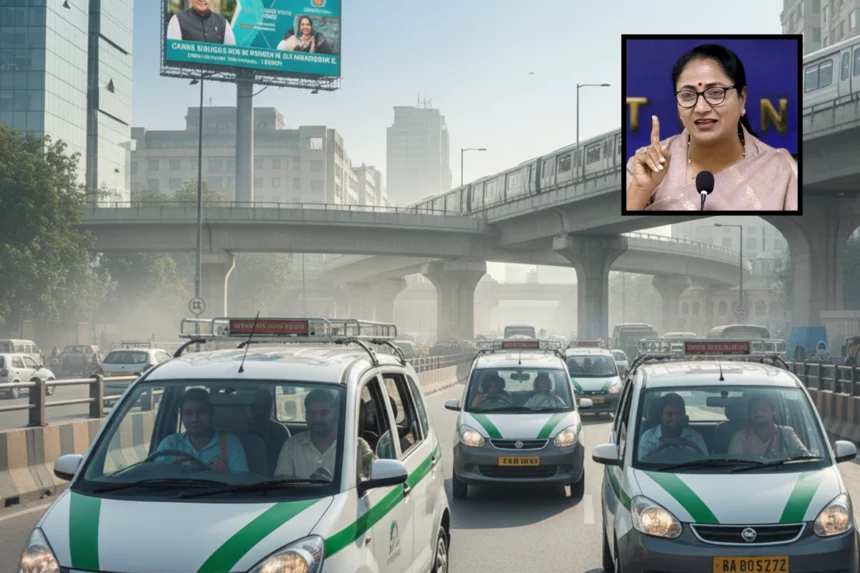
Rekha Gupta said that to improve passenger services and strengthen coordination, the Delhi government will soon hold a dedicated meeting with Transportation Network Companies (TNCs), including ride-hailing platforms such as Ola and Uber. The meeting will focus on reviving shared taxi services, increasing the participation of women drivers, and exploring ways to integrate private electric vehicles into taxi operations. She noted that shared taxi services had been operational in Delhi during the COVID-19 period but were discontinued due to certain challenges, and the government is now working towards reintroducing them in a more structured and sustainable manner.
The Chief Minister emphasised that the transport policy of the Delhi government is designed to ensure that fewer vehicles carry more passengers. “Our aim is that mobility remains smooth and affordable for commuters, while traffic congestion and pollution are significantly reduced,” she said. According to her, encouraging shared rides will help optimise vehicle usage, reduce fuel consumption, and lower emissions, creating a win-win situation for both commuters and the environment.
Highlighting the government’s focus on women’s safety and employment, Rekha Gupta said increasing the number of women drivers in taxi services is a key priority. The initiative is aimed at providing safe and reliable travel options for women passengers while also expanding livelihood opportunities for women in the transport sector. She added that eco-friendly services, particularly electric taxis, are being actively encouraged as part of the government’s long-term vision for sustainable urban mobility.
On vehicle pollution control, the Chief Minister said the government is rapidly expanding automated commercial vehicle fitness testing infrastructure across the capital. She informed that a fitness testing centre at Jhuljhuli is currently operational and is capable of testing around 70,000 vehicles annually. The existing facility at Burari is being upgraded, while two new automated fitness testing stations are under construction at Nand Nagri and Tehkhand and are expected to become operational by March next year. Once functional, these four centres will collectively be able to conduct fitness tests for approximately 2.5 to 3 lakh commercial vehicles every year.
In addition, the government has approved the installation of five more automated vehicle fitness testing stations at Delhi Transport Corporation (DTC) depots. These stations will be set up at Bawana, Ghazipur, Sawda Ghevra, GTK Depot and Dichau Kalan. According to the Chief Minister, all necessary approvals for these facilities have already been secured, marking a major step towards eliminating unfit and polluting vehicles from the city’s roads.
Rekha Gupta said multiple research studies have clearly established that vehicular emissions are among the leading contributors to air pollution in Delhi. Keeping this in mind, the government is making sustained investments in strengthening public transport systems. Metro rail, buses, and electric mobility form the backbone of Delhi’s long-term transport policy, she said. She also noted that the Central Government has granted in-principle approval for certain corridors under Phase 5A of the Delhi Metro, which will further expand the metro network and help reduce dependence on private vehicles.
The Chief Minister stressed that metro expansion will play a crucial role in easing road traffic congestion and providing a long-term solution to pollution control. “A robust public transport network is the most effective way to reduce vehicle density on roads,” she said.
Reiterating the government’s broader environmental strategy, Rekha Gupta said that tackling air pollution requires sustained, coordinated and long-term policy interventions rather than short-term measures. Alongside transport reforms, the Delhi government is implementing a range of pollution-control initiatives, including dust suppression, strict monitoring of construction sites, regular mechanical road sweeping, a complete ban on open burning, and the deployment of mist spray systems and anti-smog guns in pollution hotspot areas.
She added that all concerned departments have been placed in an active mode and are working in close coordination to ensure effective implementation of pollution-control measures. The Chief Minister said the government remains committed to delivering cleaner air, smoother mobility and a more sustainable urban environment for the people of Delhi.