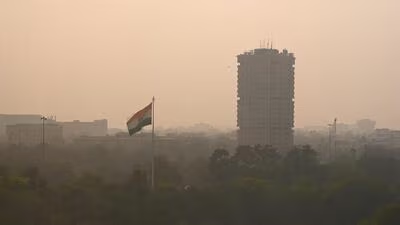
The Delhi government signed an MoU with IIT Madras to study photocatalytic “smog-eating” surfaces using Titanium Dioxide technology to reduce urban air pollution.
New Delhi | March 13, 2026 — The Government of NCT of Delhi has signed a Memorandum of Understanding (MoU) with the Indian Institute of Technology Madras to conduct a pilot study on photocatalytic “smog-eating” surfaces aimed at reducing air pollution in the capital.
The initiative focuses on evaluating the effectiveness of Titanium Dioxide (TiO₂)-based photocatalytic materials that can break down harmful pollutants such as Nitrogen Dioxide (NO₂) and Volatile Organic Compounds (VOCs), which are key contributors to urban smog.
The project titled “Comprehensive Study on the Effectiveness of Photocatalytic Smog-Eating Surfaces for Abatement of Air Pollution in Delhi” will assess the scientific feasibility and practical deployment of such materials across city infrastructure.
The MoU signing ceremony was attended by Delhi Environment Minister Manjinder Singh Sirsa and Professor Somnath C. Roy from the Department of Physics at IIT Madras, who will serve as the Principal Investigator for the study. Officials from the Department of Environment and the Delhi Pollution Control Committee were also present.
Study to Evaluate Smog-Reducing Surfaces
According to officials, the six-month study will begin with laboratory testing at IIT Madras using a dedicated smog chamber to measure pollutant reduction levels. Researchers will examine how photocatalytic materials react under sunlight and assess their capability to neutralize air pollutants.
Following laboratory testing, the research team will conduct field trials in Delhi to evaluate the performance of these materials under real urban conditions. The trials will test the coatings on multiple surfaces including concrete, asphalt roads, metal panels, glass structures, and building exteriors.
These materials work through photocatalysis, a process in which Titanium Dioxide reacts under sunlight and triggers chemical reactions that convert harmful pollutants into less harmful compounds.
Potential Use on Roads, Buildings, and Urban Infrastructure
Officials said the study will explore multiple ways to integrate photocatalytic technology into the city’s infrastructure. This may include mixing the materials into construction components such as concrete or asphalt, applying coatings on building surfaces, or installing specialized panels across urban spaces.
Researchers will also examine the feasibility of installing photocatalytic pollutant-removal panels on rooftops and streetlight poles. These panels could function similarly to solar panels, actively helping remove pollutants from the surrounding air.
Environment Minister Manjinder Singh Sirsa stated that the government is committed to encouraging scientific innovation to address Delhi’s air pollution challenges.
He said the initiative aims to identify long-lasting and affordable solutions that can be applied across urban infrastructure to reduce pollutants such as nitrogen dioxide.
Scientific Approach to Address Air Pollution
The Delhi government said the collaboration reflects its focus on evidence-based solutions to improve air quality. Officials emphasized that the study will provide data on efficiency, durability, and cost-effectiveness before any large-scale deployment.
Professor Somnath C. Roy said the project will follow a structured research approach beginning with controlled laboratory analysis before expanding into field studies across different urban surfaces in Delhi.
The research team will monitor pollutant reduction levels and examine how environmental factors such as sunlight exposure, weather conditions, and surface durability affect the performance of photocatalytic materials.
The government noted that the findings of the study will help determine whether the technology can be scaled across the city during peak smog months later this year.
Officials said the project aligns with the Delhi government’s broader strategy to address air pollution through multiple measures including dust control, technological innovation, and scientific research.
If successful, the initiative could open pathways for scalable urban solutions that integrate pollution-reducing materials into everyday infrastructure across Delhi.