New Delhi, December 19, 2025:
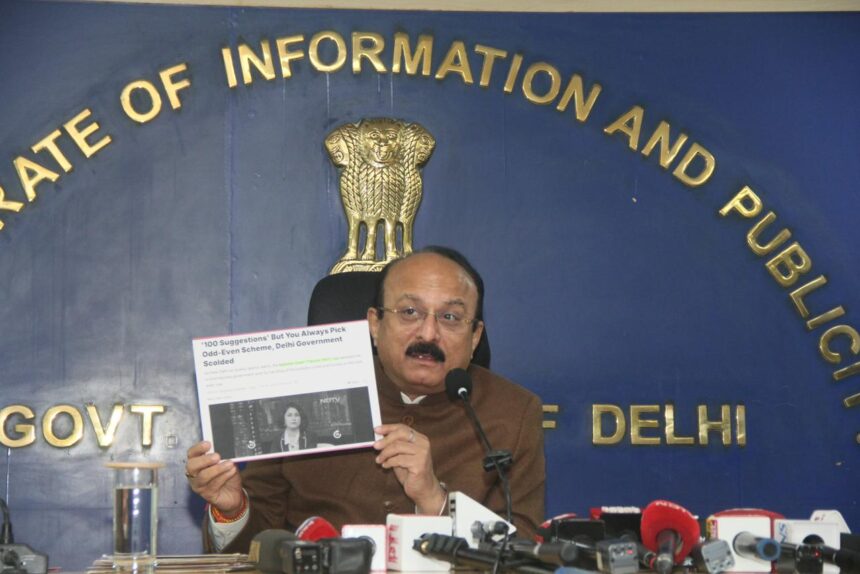
Holding the previous Delhi government responsible for the city’s worsening air quality, Minister for Education, Urban Development, Home and Power Ashish Sood on Thursday said that pollution in the national capital is not a seasonal problem but the outcome of years of flawed policies and administrative neglect. Addressing a press conference at the Delhi Secretariat, the minister outlined the steps taken by the present government over the past 10 months and presented a roadmap aimed at long-term pollution control and environmental reform.
Ashish Sood accused the previous government of prioritising publicity over genuine solutions and misleading the public through advertisements and distorted data instead of implementing scientific and sustainable measures. Citing findings from a Comptroller and Auditor General report, he said that during 2017–18, around 30 per cent of air quality monitoring stations were deliberately installed in green areas, resulting in under-reporting of actual pollution levels in the city.

He further alleged that initiatives such as the Odd-Even traffic scheme and the “Red Light On, Vehicle Off” campaign were largely public relations exercises with limited scientific backing. According to him, even agencies such as the Delhi Pollution Control Committee and the courts had raised questions about the effectiveness of these measures. The minister recalled that the Supreme Court had also reprimanded the previous administration, observing that funds were readily available for advertisements but not for critical public transport projects like the Regional Rapid Transit System.

Highlighting the work done by the present government under the leadership of Chief Minister Rekha Gupta, Ashish Sood said the focus has shifted towards long-term administrative reforms instead of short-term cosmetic solutions. He said that decisive steps have been taken across sectors such as waste management, urban infrastructure, transport and education to address the root causes of pollution.
In the area of waste management, the minister said that a major reform was introduced through the Construction and Demolition Waste Policy. From October 11, 2025, the use of recycled construction material has been made mandatory in all construction works, and payments for civil projects will not be released unless compliance is ensured. He said this step is expected to significantly reduce construction-related dust and waste dumping.
On landfill remediation, Ashish Sood said the government has set a target to completely remediate the Bhalswa landfill by September 2026. A tender has already been issued for the scientific disposal of 18 lakh metric tonnes of legacy waste. In addition, biogas plants have been commissioned at the Nangli Sakrawati and Ghoga dairies to ensure scientific disposal of dairy waste, which has long been a contributor to local pollution.

To tackle dust pollution on roads, the minister announced that one mechanical sweeping machine will be provided in each Assembly constituency. He added that municipal bodies are also being strengthened financially, with ₹175 crore already released and an additional ₹500 crore currently under process to support sanitation, cleaning and pollution-control measures.
Ashish Sood also addressed issues related to public transport and electric mobility. He said the ₹45 crore electric vehicle subsidy that had been withheld by the previous government has now been cleared. Efforts are also underway to remove bottlenecks in major infrastructure projects such as Metro Phase-IV and the Regional Rapid Transit System, which are expected to reduce dependence on private vehicles and lower vehicular emissions.
Emphasising that children’s health is a top priority for the government, the minister announced a major initiative aimed at protecting students from the adverse effects of air pollution. He said that tenders have been issued on Thursday for the installation of air purifiers in 10,000 classrooms of government schools in the first phase. The government plans to extend this facility to all government schools in Delhi, ensuring that polluted air does not negatively impact children’s health or learning outcomes.
In his concluding remarks, Ashish Sood acknowledged that Delhi’s geographical location means that pollution from neighbouring states also affects the city’s air quality. However, he stressed that strong and consistent local-level interventions can substantially reduce the impact. He reiterated the government’s commitment to delivering a cleaner, healthier and more sustainable future for Delhi through structural reforms, scientific planning and accountable governance, rather than short-term measures driven by political optics.